Cutaneous larva migrans
Overview
- Causative agent: Hookworm larvae (Ancylostoma) (Ancylostoma braziliense/caninum) — dog/cat as reservoir, human as accidental host.
- Transmission: Barefoot contact with contaminated sand / soil in tropical / subtropical regions — Caribbean, Africa, Asia, South America; humans are an accidental host, the larva cannot penetrate the basement membrane, so the disease is self-limiting after weeks to months.
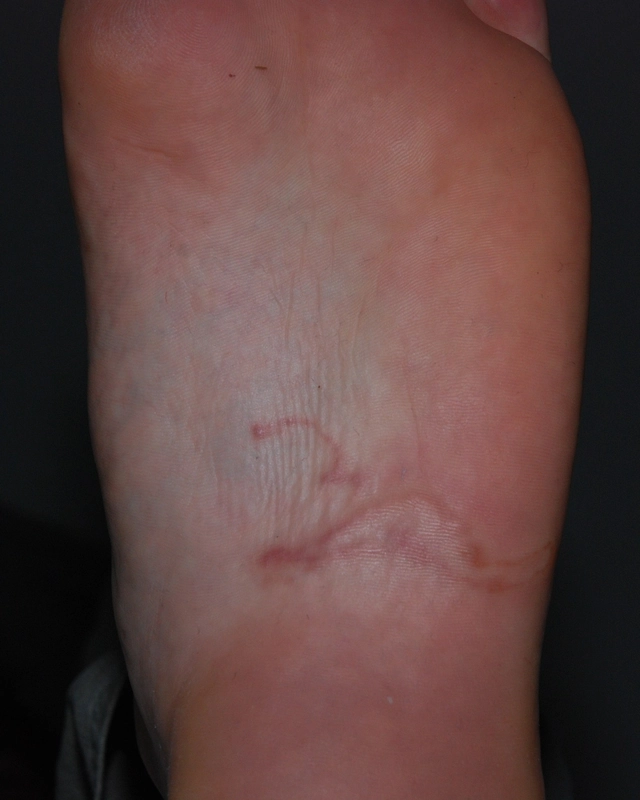
- Clinical presentation: Characteristic is a serpiginous migratory lesion (advancing 1–2 cm/day) — usually on the sole of the foot/buttocks.
- Diagnosis: clinical (pathognomonic).
Differential diagnoses
- Scabies
- Urticaria
- Allergic contact dermatitis
- Tinea pedis
- Erysipelas
- Ecthyma
- Granuloma annulare
- Impetigo
Practise Cutaneous larva migrans in the app
Flashcards with spaced repetition, exam questions and spot-the-diagnosis on this topic – in DermaFuchs, free of charge.
In the DermaFuchs app: 1 flashcards · 5 clinical images
Open in browser Download on the App StoreMore parasitic skin diseases
- Demodicosis
- Filariasis
- Cutaneous leishmaniasis
- Pediculosis capitis
- Caterpillar dermatitis caused by oak processionary moth (Thaumetopoea processionea)
- Crusted (Norwegian) scabies
- Scabies
- Tungiasis
Note: This page is intended for medical education and does not replace diagnosis or treatment decisions in individual cases. Treatment and follow-up content is available in the app.