Caterpillar dermatitis caused by oak processionary moth (Thaumetopoea processionea)
Definition & cause
- Cause: The triggering agent is setae (urticating hairs) from caterpillars of the oak processionary moth (Thaumetopoea processionea).
- Toxin: the seta-bound protein thaumetopoein plus high-molecular-weight allergens — a combined toxic-irritant + IgE-mediated reaction.
- Distribution: widespread in Central and Southern Europe; in Germany expanding since the 1990s, especially Brandenburg, Saxony-Anhalt, North Rhine-Westphalia, Bavaria.
- Season: Main season is May to August (larval stages L3 – L6) — caterpillars from L3 onward AND moulting / nest remnants on the ground stay hazardous into winter.
Clinical picture (triad)
a) **Cutaneous — caterpillar dermatitis
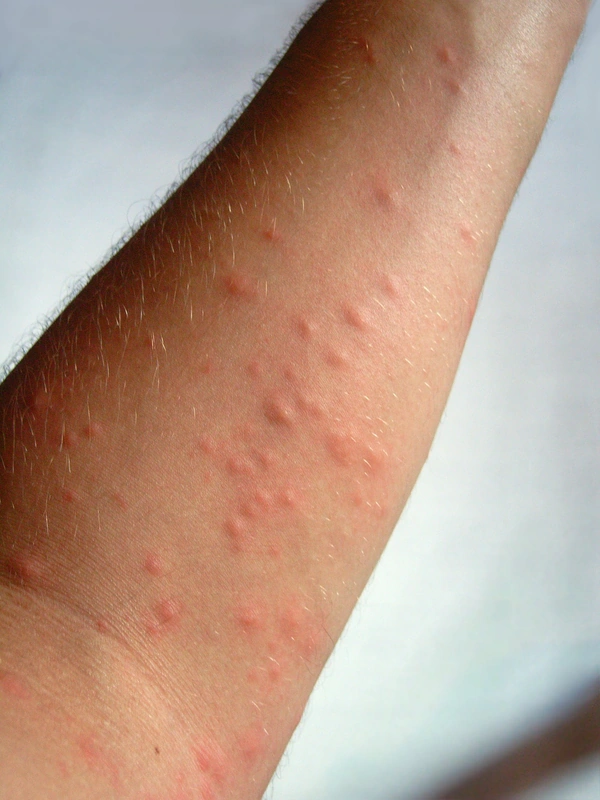
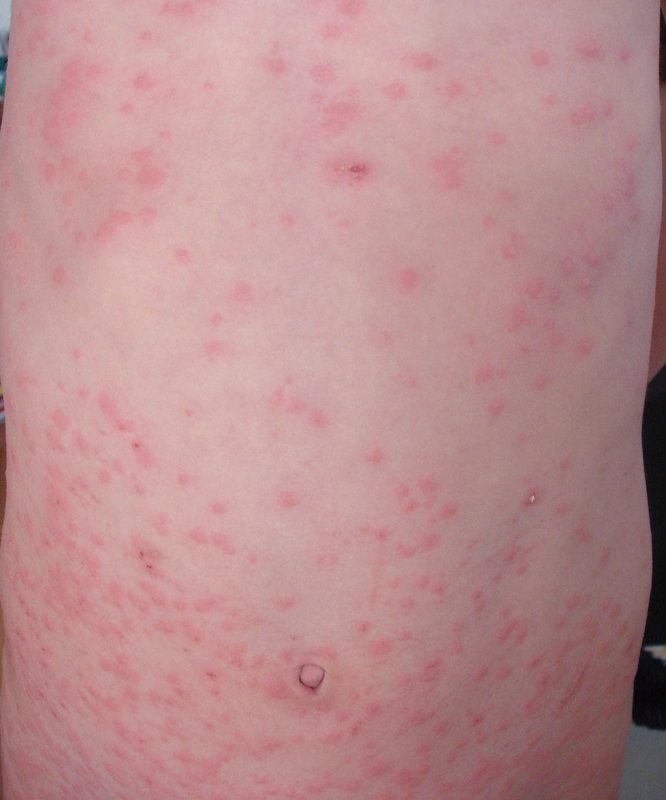
- Hallmark: intensely pruritic erythematous papules / wheals in streaks, typically within the first 8 – 12 h after exposure.
- Predilection: uncovered skin (neck, nape, décolleté, forearms, ankles) — "contact streaks".
- Course: 1 – 2 weeks; persistence due to retained setae (mechanical re-irritation) is possible.
b) **Mucosal & respiratory
- Conjunctivitis with lid swelling and tearing; severe cases keratitis.
- Rhinitis, pharyngitis, bronchial obstruction with cough, dyspnoea — life-threatening in asthmatics.
c) **Systemic (rare)
- Fever, generalised urticaria, dizziness.
- Anaphylaxis with shock is possible, especially with heavy setae load or pre-existing atopy / insect sensitisation.
- Severity grades: As for every immediate-type reaction, grading follows the anaphylaxis grades of Ring and Messmer: I skin/mucosa (urticaria, flush, angioedema), II additionally circulation/airway/abdomen (tachycardia, fall in blood pressure, dyspnoea, nausea), III shock or bronchospasm, IV respiratory/cardiac arrest.
Diagnosis
- Clinical + history: woodland / oak exposure within the last 12 h, streaky pattern on uncovered skin, seasonal context.
- Useful: adhesive-tape sampling → light microscopy of setae.
- Lab: For systemic reactions the rational work-up is tryptase + specific IgE for Thaumetopoea; for respiratory involvement blood gas + spirometry.
- Testing pitfall: Skin tests (prick/intradermal) are not interpretable under antihistamines — observe an adequate washout before testing; tryptase and specific IgE, by contrast, can be taken from blood at any time.
- DDx: insect bites, photoallergic / phototoxic dermatitis, urticaria, allergic contact dermatitis.
- DDx erythema migrans: After time in woodland always also consider a tick bite: erythema migrans is a slowly expanding, annular, usually non-pruritic and non-scaling erythema (scaling points to tinea) — treatment is doxycycline 200 mg for 14 days, but only from the 9th year of life, before that amoxicillin; serology is of little help in stage I (IgM only after 3–6 weeks).
Differential diagnoses
- Airborne contact dermatitis
- Phytophotodermatitis
- Insect bite reaction
- Urticaria
- Urticaria papulosa
- Nummular eczema
- Atopic dermatitis (atopic eczema)
Practise Caterpillar dermatitis caused by oak processionary moth (Thaumetopoea processionea) in the app
Flashcards with spaced repetition, exam questions and spot-the-diagnosis on this topic – in DermaFuchs, free of charge.
Open in browser Download on the App StoreMore parasitic skin diseases
- Demodicosis
- Filariasis
- Cutaneous leishmaniasis
- Cutaneous larva migrans
- Pediculosis capitis
- Crusted (Norwegian) scabies
- Scabies
- Tungiasis
Note: This page is intended for medical education and does not replace diagnosis or treatment decisions in individual cases. Treatment and follow-up content is available in the app.