Demodicosis
- Synonyms
- demodex mites, demodex folliculitis
- Specialty
- Dermatology · Parasitic skin diseases
- Images
- Clinical 1 · Histology 1
- In the app
- 3 flashcards
- Last updated
- 10/2026 · Dr. Pascal Bafteh
Contents
Images (2)
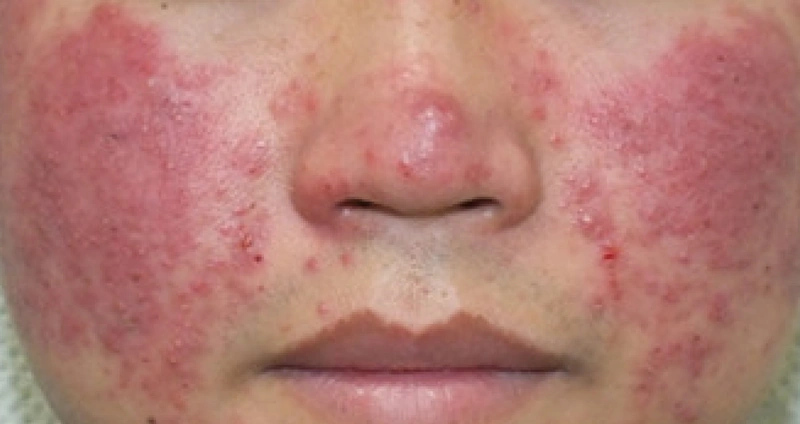
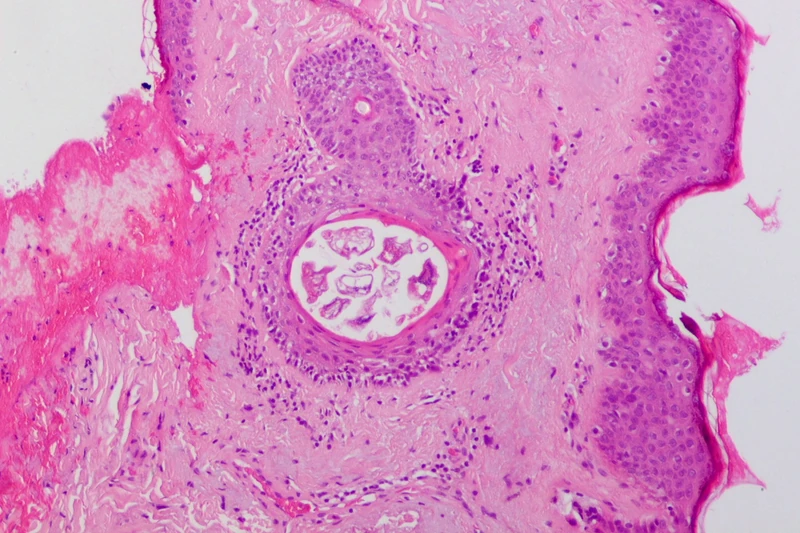 Histology
Definition
Demodicosis is a skin disease caused by proliferation of follicle mites (Demodex folliculorum and Demodex brevis), which are normal inhabitants of sebaceous follicles in almost all adults.
- Causative agent: Demodex folliculorum/brevis — belong to the normal skin flora, pathological with overpopulation > 5/cm².
- Diagnosis: microscopic detection from skin scraping or adhesive tape method (> 5 mites/cm² pathological).
Clinical features
- Rosacea-like, fine follicular papules and pustules with pityriasiform, grater-like scaling on the face, often asymmetrical.
- Itching or burning; usually in older adults or in immunodeficiency (e.g. HIV infection).
Differential diagnoses
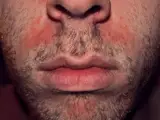
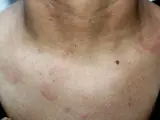
Image credits for the thumbnails
- Rosacea: Michael Sand, Daniel Sand, Christina Thrandorf, Volker Paech, Peter Altmeyer, Falk G Bechara, “Rosacea”, CC BY 2.5, via Wikimedia Commons, cropped · CC BY 2.5 · Source
- Acne vulgaris: Sedef94, “Kürəkdə düyünlü və kistik sızanaqlar (Acne Vulgaris) 08”, CC BY-SA 4.0, via Wikimedia Commons · CC BY-SA 4.0 · Source
- Seborrhoeic dermatitis: Roymishali, “Seborrhoeic dermatitis highres”, CC BY-SA 3.0, via Wikimedia Commons · CC BY-SA 3.0 · Source
- Erythrasma: unknown (Commons user), “Erythrasma”, CC BY-SA 4.0, via Wikimedia Commons · CC BY-SA 4.0 · Source
- Lupus erythematosus: Meriam Hajji, CC BY 4.0, via Wikimedia Commons · CC BY 4.0 · Source
Treatment principles
- Treatment is with topical antiparasitic agents; in extensive or refractory disease, systemic antiparasitic therapy may be used.
- Topical glucocorticoids worsen the condition and are discontinued.
- In pronounced or unusual presentations, underlying immunosuppression should be considered.
Specific treatment regimens with drugs and doses are covered in the DermaFuchs app.
Keep learning in the app
References (selection)
Cross-references
Keep learning
Keep learning with flashcards, exam questions and spot diagnoses in the DermaFuchs app – free, in your browser or as an app.
Related pages: Rosacea · Acne vulgaris · Seborrhoeic dermatitis
Note: This page is intended for medical education and does not replace diagnosis or treatment decisions in individual cases.