Roseola infantum (exanthem subitum)
- Synonyms
- Dreitagefieber, Drei-Tage-Fieber, Roseola infantum, Sechste Krankheit, HHV-6-Infektion, roseola, exanthem subitum, sixth disease, pseudorubella
- Specialty
- Dermatology · Viral infections
- Images
- Clinical 1
- In the app
- 1 flashcards
- Last updated
- 10/2026 · Dr. Pascal Bafteh
Contents
Images (1)
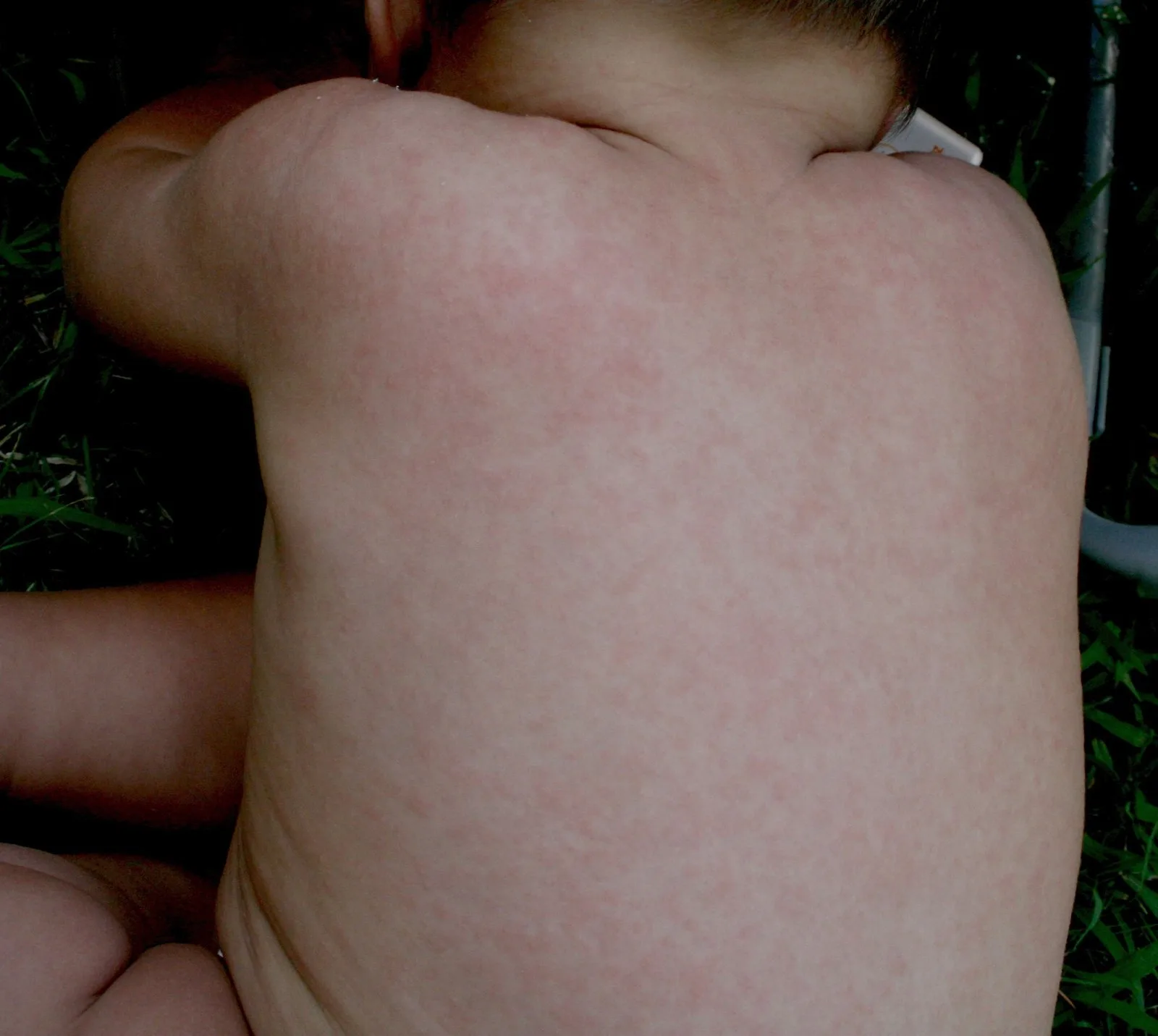
Definition
Roseola infantum (exanthem subitum) is a viral infection of infants and young children caused by human herpesvirus 6B (HHV-6B), less commonly by HHV-7. It is characterised by high fever without localising signs, followed by a rash as the fever settles.
Occurrence & epidemiology
Children between 6 months and 3 years of age are most commonly affected; the disease is rare in adults. It is spread via saliva, typically from asymptomatic family members; the incubation period is about 5–15 days. It occurs most often in spring and autumn.
Clinical features
- Abrupt high fever (39.5–40.5 °C) for 3–5 days; despite the fever the child is usually alert. Cervical and posterior auricular lymphadenopathy often develops.
- As the fever falls rapidly, usually on the 4th day, a macular to maculopapular rose-pink rash appears, most prominent on the chest and abdomen and less so on the face and limbs; small blanching spots (2–5 mm), some with a pale halo, non-itchy and without blisters. It lasts from a few hours to 2 days.
- Similar spots on the soft palate and uvula (Nagayama spots).
- Febrile seizures in about 5–15% of young children; encephalitis or hepatitis are rare.
- In about 70% of HHV-6 infections the classic rash does not occur.
Diagnosis
- Clinical, based on the typical course in a child aged 6 months to 3 years: fever first, then the rash as the fever subsides.
- Laboratory tests are rarely needed; HHV-6 infection can be confirmed by serology or PCR, and quantitative PCR is mainly used to detect viral reactivation.
Differential diagnoses
- Measles
- Rubella (German measles)
- Kawasaki syndrome
- Scarlet fever
- Erythema infectiosum (fifth disease)
- Amoxicillin rash in infectious mononucleosis
Keep learning in the app
References (selection)
Cross-references
Note: This page is intended for medical education and does not replace diagnosis or treatment decisions in individual cases.