Pemphigoid gestationis
- Synonyms
- herpes gestationis
- Specialty
- Dermatology · Blistering diseases
- Images
- Histology 2 · Clinical 2
- In the app
- 2 flashcards
- Last updated
- 10/2026 · Dr. Pascal Bafteh
Contents
Images (4)
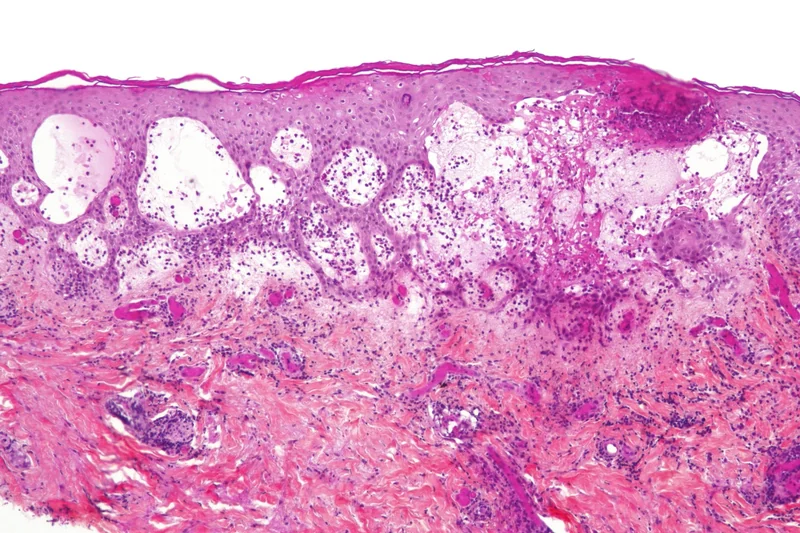 Histology
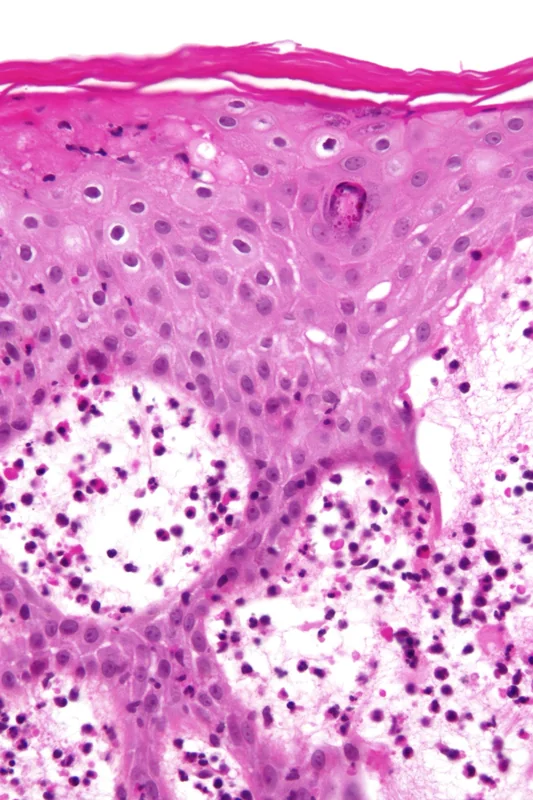 Histology
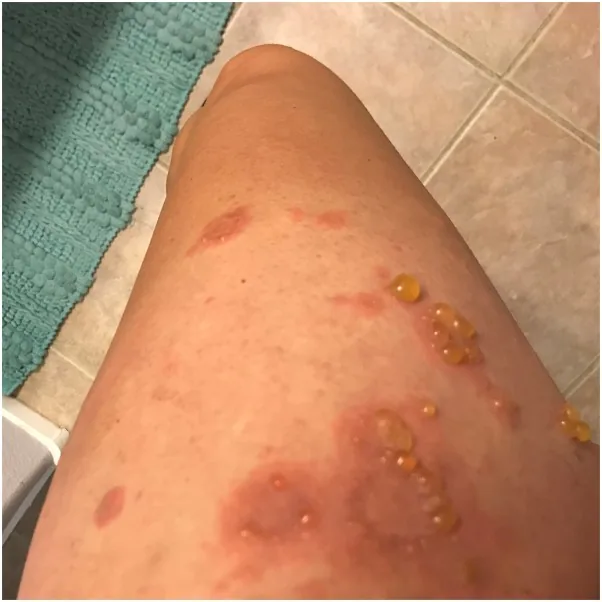
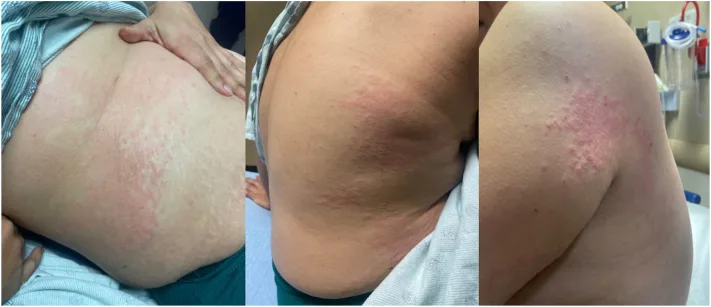
Definition
- Clinical features: Severely pruritic exanthem, usually begins in the 2nd/3rd trimester. Typical is periumbilical involvement.
- Differential diagnosis: Differentiation from PUPP dermatosis (umbilicus spared).
- Risks: There is an increased risk for premature birth. It usually recurs in subsequent pregnancies (often earlier), although unaffected pregnancies may occur in between; flares also with menstruation or hormonal contraception.
- Autoimmune subepidermal blistering. Antibodies against BP180 (collagen XVII). Onset: 2nd–3rd trimester.
- Clinical features: Onset periumbilical, then generalization. DIF: Linear C3 at BMZ.
Diagnosis
- Direct immunofluorescence: linear C3 deposition along the dermo-epidermal junction, present in all cases – important for distinction from polymorphic eruption of pregnancy (PEP/PUPPP), which may be clinically indistinguishable in the early stages.
- Indirect immunofluorescence of serum; on salt-split skin the antibodies bind to the roof of the blister (epidermal side).
- In about 10% of affected pregnancies the newborn shows transient blisters due to transplacentally transferred antibodies, which resolve as maternal antibodies are cleared (3–4 months).
Differential diagnoses
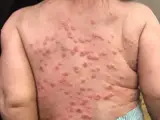 Eczema herpeticum
 Urticaria
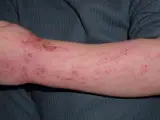 Atopic dermatitis (atopic eczema)
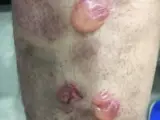 Bullous pemphigoid
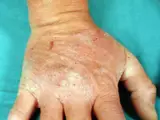 Dermatitis herpetiformis (Duhring disease)
Image credits for the thumbnails
- Eczema herpeticum: Mohammad2018, CC BY-SA 4.0, via Wikimedia Commons, cropped · CC BY-SA 4.0 · Source
- Urticaria: Gzzz, “Urticaria child”, CC BY-SA 4.0, via Wikimedia Commons · CC BY-SA 4.0 · Source
- Atopic dermatitis (atopic eczema): Eisfelder, “Atopic dermatitis child”, CC BY-SA 3.0, via Wikimedia Commons · CC BY-SA 3.0 · Source
- Bullous pemphigoid: Mohammad2018, “Bullous pemphigoid new image”, CC BY-SA 4.0, via Wikimedia Commons · CC BY-SA 4.0 · Source
- Dermatitis herpetiformis (Duhring disease): BallenaBlanca, “Dermatitis Herpetiforme 2”, CC BY-SA 3.0, via Wikimedia Commons · CC BY-SA 3.0 · Source
Treatment principles
- Management is in close collaboration with obstetrics.
- Mild disease is treated with potent topical glucocorticoids and antihistamines, while extensive disease requires systemic glucocorticoids.
- A flare around delivery is typical; the disease then usually regresses but may recur earlier and more severely in subsequent pregnancies or with hormonal contraception.
- Neonates may show transient skin lesions.
Specific treatment regimens with drugs and doses are covered in the DermaFuchs app.
Keep learning in the app
References (selection)
Cross-references
Keep learning
Keep learning with flashcards, exam questions and spot diagnoses in the DermaFuchs app – free, in your browser or as an app.
Related pages: Eczema herpeticum · Urticaria · Atopic dermatitis (atopic eczema)
Note: This page is intended for medical education and does not replace diagnosis or treatment decisions in individual cases.