Lipedema
- Synonyms
- painful fat syndrome, column legs, lipoedema of the legs
- Specialty
- Internal medicine · Angiology
- Images
- Clinical 1
- Last updated
- 10/2026 · Dr. Pascal Bafteh
Contents
Images (1)
Definition
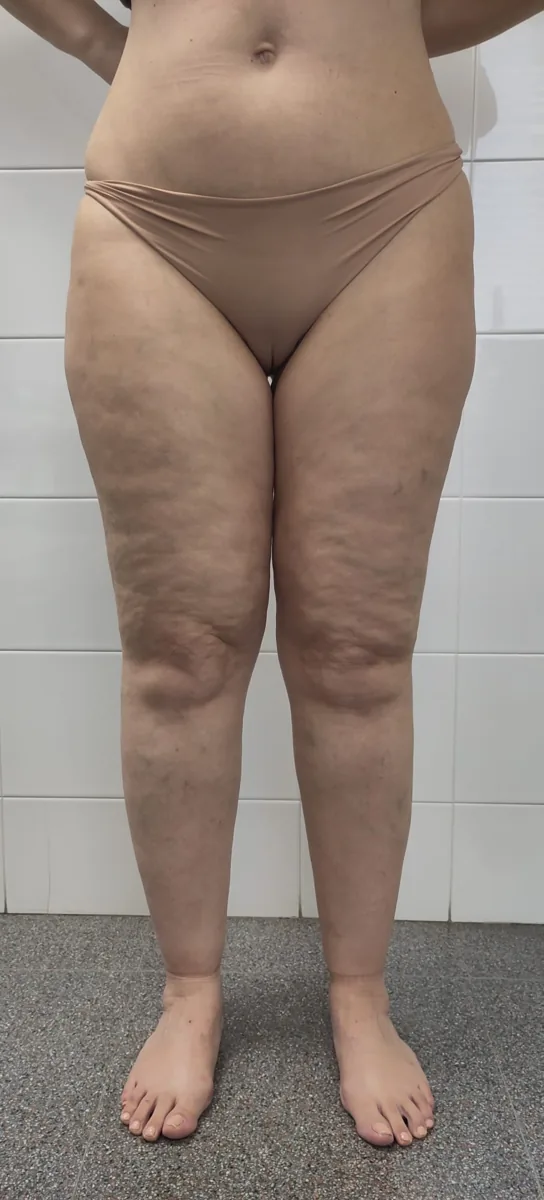
Lipedema is a painful, disproportionate, symmetrical disorder of fat distribution in the limbs that occurs almost exclusively in women. It is always painful: pain on pressure and touch, spontaneous pain and a feeling of heaviness in the increased fatty tissue are typical.
- Only the limbs are affected, symmetrically the hips, thighs and/or lower legs, and in the arms the deltoid region, upper and/or lower arms; head, neck and trunk are spared
- Feet and hands are not affected
- Painless disproportionate fat accumulation is called lipohypertrophy and is not lipedema
- Lipedema is not caused by obesity and does not itself cause obesity
Classification
By location, thigh, lower-leg and ankle types as well as upper- and lower-arm types are among those described; the typing systems of different authors are not uniform.
The morphological staging used to date only describes appearance and is not a measure of disease severity; there is no staging of symptoms. The previously common criterion of “nodular” fatty tissue is not valid for diagnosis.
Occurrence & epidemiology
There are no reliable epidemiological data based on current diagnostic criteria; estimates in the literature vary widely. Men are extremely rarely affected. The first manifestation or an increase in symptoms almost always falls in phases of hormonal change such as puberty, pregnancy and the climacteric.
Aetiopathogenesis
The cause is unknown. Factors under discussion include:
- genetic factors: familial clustering, probably autosomal dominant inheritance; individual gene variants have been described
- hormonal influences: evidence of an association with estrogens, their ratio to progestogens and their receptors
- changes in adipose tissue: altered gene expression and increased proliferation of adipose precursor cells
Many patients also have obesity, which proportionally affects the trunk as well. Obesity-associated lymphedema can develop on this basis. Lipedema is not inherently progressive; an increase is mainly related to weight gain and hormonal influences.
Clinical features
- disproportionate, symmetrical increase in subcutaneous fat on the legs and/or arms compared with the trunk
- even distribution over the thighs and lower legs (“column leg”) or restriction to individual segments
- typical abrupt change in calibre at the border to the healthy neighbouring region (“cuff” sign) and painful fat folds above and below the knees and on the upper arms
- pain on touch and pressure, spontaneous pain, a feeling of tension and heaviness; intensity is perceived very differently and does not depend on the amount of fat
- subjective swelling during the day that could not be objectified by measurement
- a frequently reported tendency to bruise, which is not a diagnostic criterion
- in marked cases knock knees (genua valga) and skin irritation from skin-on-skin friction
- often psychological distress and lack of acceptance of one's own body
Diagnosis
The diagnosis is made clinically; there is no imaging or laboratory test that proves lipedema.
- History: symptoms, onset during phases of hormonal change, weight history, family history
- Examination: disproportion, symmetry, sparing of feet and hands, tenderness; the Kaposi-Stemmer sign at the toes is negative but may become positive with additional lymphedema
- Measurements: body weight, height, waist and hip circumference, plus limb circumference measurements; body mass index is of limited value because of the increased fat on the limbs, and the waist-to-height ratio describes fat distribution more accurately
- Distinction: unlike lymphedema, lipedema has no edema and is symmetrical and tender; lipohypertrophy and obesity are not painful
- Ultrasound: helps to exclude other causes of edema; duplex ultrasound detects coexisting conditions such as varicose veins or post-thrombotic syndrome
Keep learning in the app
Further reading (open access)
Cross-references
Note: Learning content for medical education – not a treatment recommendation and no substitute for diagnosis or treatment decisions in individual cases. Treatment and management are deliberately not covered on this page.