X-linked recessive ichthyosis
- Synonyms
- X-linked ichthyosis, steroid sulfatase deficiency
- Specialty
- Dermatology · Hereditary skin diseases
- Images
- Clinical 2
- In the app
- 1 flashcard
- Last updated
- 10/2026 · Dr. Pascal Bafteh
Contents
Images (2)
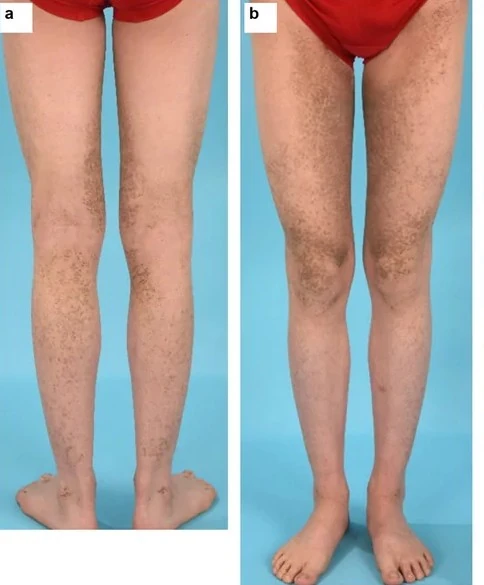
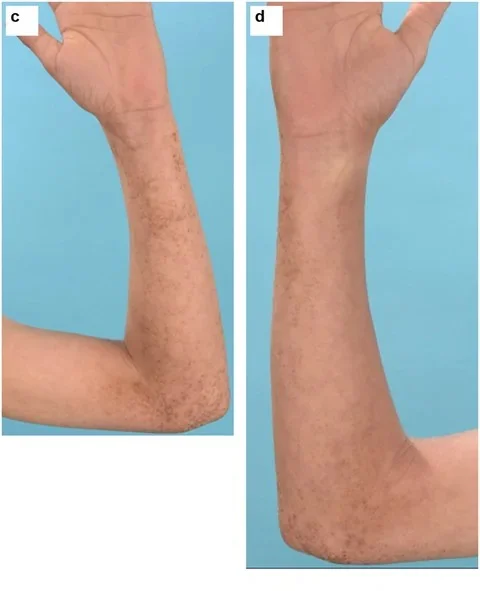
Definition
X-linked recessive ichthyosis is caused by an enzyme deficiency due to changes in the STS gene (usually a deletion). Accumulated cholesterol sulfate delays shedding of corneocytes, resulting in adherent scales.
- Patients: almost exclusively male hemizygotes, incidence 1: 4,000.
- Manifestation: at birth or in the first months of life.
- Clinical features: initially light, later dark, thick, large-plated scaling mainly on extensor surfaces / side of the trunk / neck / abdomen — flexures usually spared (occasionally involved), palms and soles very rarely affected.
- Associated: cryptorchidism, ADHD, corneal opacities.
Diagnosis
- Clinical picture in boys; measurement of STS enzyme activity or molecular genetic detection (e.g. FISH, PCR); about 90% have a complete gene deletion, point mutations may be missed. A skin biopsy is usually not helpful.
- Because of low placental STS activity, labour may be prolonged when delivering affected infants; prenatally, decreased oestrogen levels in maternal urine are found. Also corneal opacities, cryptorchidism and an increased risk of testicular cancer.
Differential diagnoses
 Atopic dermatitis (atopic eczema)
 Seborrhoeic dermatitis
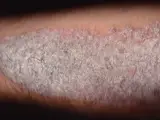 Psoriasis vulgaris (plaque psoriasis)
 Nummular eczema (discoid eczema)
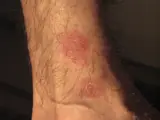 Pityriasis rosea
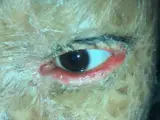 Lamellar ichthyosis
- Congenital ichthyosis
Image credits for the thumbnails
- Atopic dermatitis (atopic eczema): Eisfelder, “Atopic dermatitis child”, CC BY-SA 3.0, via Wikimedia Commons · CC BY-SA 3.0 · Source
- Seborrhoeic dermatitis: Roymishali, “Seborrhoeic dermatitis highres”, CC BY-SA 3.0, via Wikimedia Commons · CC BY-SA 3.0 · Source
- Psoriasis vulgaris (plaque psoriasis): MediaJet, “An Arm Covered With Plaque Type Psoriasis”, CC BY-SA 3.0, via Wikimedia Commons · CC BY-SA 3.0 · Source
- Nummular eczema (discoid eczema): Ifnord, “Nummular dermatitits”, CC BY-SA 4.0, via Wikimedia Commons · CC BY-SA 4.0 · Source
- Pityriasis rosea: Aceofhearts1968, “Pityriasis rosea-1”, Public Domain, via Wikimedia Commons · Public domain · Source
- Lamellar ichthyosis: Macriz-Romero N, Vera-Duarte GR, Guerrero-Becerril J et al. (Int Ophthalmol 2023), CC BY 4.0, via PubMed Central (PMC10504104) · CC BY 4.0 · Source
Treatment principles
- There is no causal treatment; management is symptomatic with keratolytic and emollient preparations and baths.
- In infants and young children, particular caution is needed with keratolytic agents because of the risk of systemic toxicity from percutaneous absorption.
- Systemic retinoids may be used in severe forms; genetic counselling is offered.
Guideline: AWMF guideline register (no. 013-043)
Specific treatment regimens with drugs and doses are covered in the DermaFuchs app.
Keep learning in the app
References (selection)
Cross-references
Keep learning: test yourself
One question from the DermaFuchs app on X-linked recessive ichthyosis – tap an answer.
Question 1 of 1
In X-linked ichthyosis, which group is almost exclusively affected?
Answer
Correct: almost exclusively male hemizygotes. X-linked ichthyosis primarily affects male hemizygotes due to the X-linked recessive inheritance pattern.
More questions like these – with explanations and spaced repetition – in the app.
Note: This page is intended for medical education and does not replace diagnosis or treatment decisions in individual cases.