Lamellar ichthyosis
- Synonyms
- collodion baby
- Specialty
- Dermatology · Hereditary skin diseases
- Images
- Clinical 3
- In the app
- 2 flashcards
- Last updated
- 10/2026 · Dr. Pascal Bafteh
Contents
Images (3)
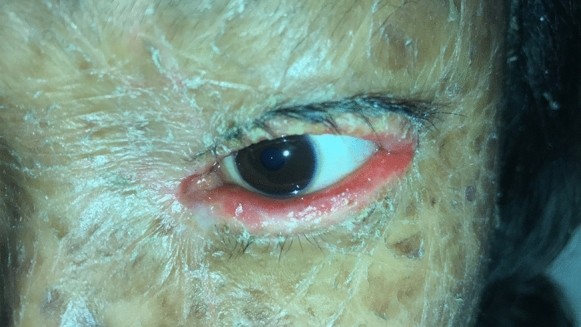
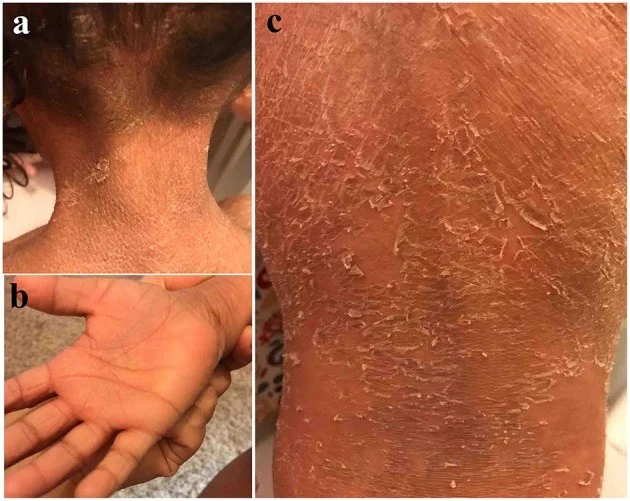
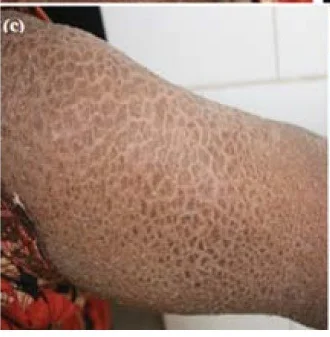
Definition
Lamellar ichthyosis belongs to the autosomal recessive congenital ichthyoses. The most common cause is mutations in the TGM1 gene (transglutaminase 1), which impair formation of the cornified envelope. Many children are born as a "collodion baby" with a shiny, tight membrane.
- Genetics: Transglutaminase-1 (TGM1); very rare (autosomal recessive congenital ichthyoses overall about 1: 60,000–200,000).
- Clinical features: Collodion membrane at birth (collodion baby), later diffuse, generalized, brownish-black scaling (scalp + joint flexures), palmoplantar keratoses, eyebrow loss, ectropion.
- Mnemonic: “Lamellar like roof tiles – TGM1 in a collodion coat.” Harlequin ichthyosis (ABCA12) is not a maximal form of lamellar ichthyosis but a separate type, the most severe within autosomal recessive congenital ichthyosis (Braun-Falco 2018, pp. 1072–1074).
Diagnosis
- Clinical picture with large, plate-like brown scales over the whole body including the flexures, and ectropion.
- Molecular genetic diagnosis (TGM1 and other genes of autosomal recessive congenital ichthyosis).
Differential diagnoses
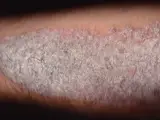
 Pityriasis rubra pilaris
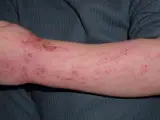
 Psoriasis vulgaris (plaque psoriasis)
 Atopic dermatitis (atopic eczema)
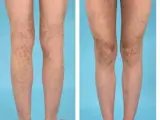 X-linked recessive ichthyosis
- Epidermolytic ichthyosis
- Congenital ichthyosis
Image credits for the thumbnails
- Pityriasis rubra pilaris: Kelly McGauran, “Pityriasis Rubra Pilaris 10”, CC BY-SA 4.0, via Wikimedia Commons · CC BY-SA 4.0 · Source
- Psoriasis vulgaris (plaque psoriasis): MediaJet, “An Arm Covered With Plaque Type Psoriasis”, CC BY-SA 3.0, via Wikimedia Commons · CC BY-SA 3.0 · Source
- Atopic dermatitis (atopic eczema): Eisfelder, “Atopic dermatitis child”, CC BY-SA 3.0, via Wikimedia Commons · CC BY-SA 3.0 · Source
- X-linked recessive ichthyosis: Henostroza Inga K, Greco A, Martínez-Barrios E et al. (Eur J Pediatr 2026), CC BY 4.0, via PubMed Central (PMC13652937) · CC BY 4.0 · Source
Treatment principles
- There is no causal treatment; management is symptomatic and lifelong with emollient and keratolytic topical preparations and baths.
- Systemic retinoids may be considered in severe forms.
- Neonates with a collodion membrane require neonatal intensive care with humidity, temperature control and protection against infection; later on, ectropion, heat intolerance and the absorption toxicity of certain keratolytics in children must be taken into account.
Guideline: AWMF guideline register (no. 013-043)
Specific treatment regimens with drugs and doses are covered in the DermaFuchs app.
Keep learning in the app
References (selection)
Cross-references
Keep learning
Keep learning with flashcards, exam questions and spot diagnoses in the DermaFuchs app – free, in your browser or as an app.
Related pages: Epidermolytic ichthyosis · Pityriasis rubra pilaris · Psoriasis vulgaris (plaque psoriasis)
Note: This page is intended for medical education and does not replace diagnosis or treatment decisions in individual cases.