Aplasia cutis congenita
- Synonyms
- angeborener Hautdefekt, kongenitale Hautaplasie, ACC, membranöse Aplasia cutis, Haarkragenzeichen, congenital absence of skin, membranous aplasia cutis, hair collar sign
- Specialty
- Dermatology · Hereditary skin diseases
- Images
- Clinical 1
- In the app
- 2 flashcards
- Last updated
- 10/2026 · Dr. Pascal Bafteh
Contents
Images (1)
Definition
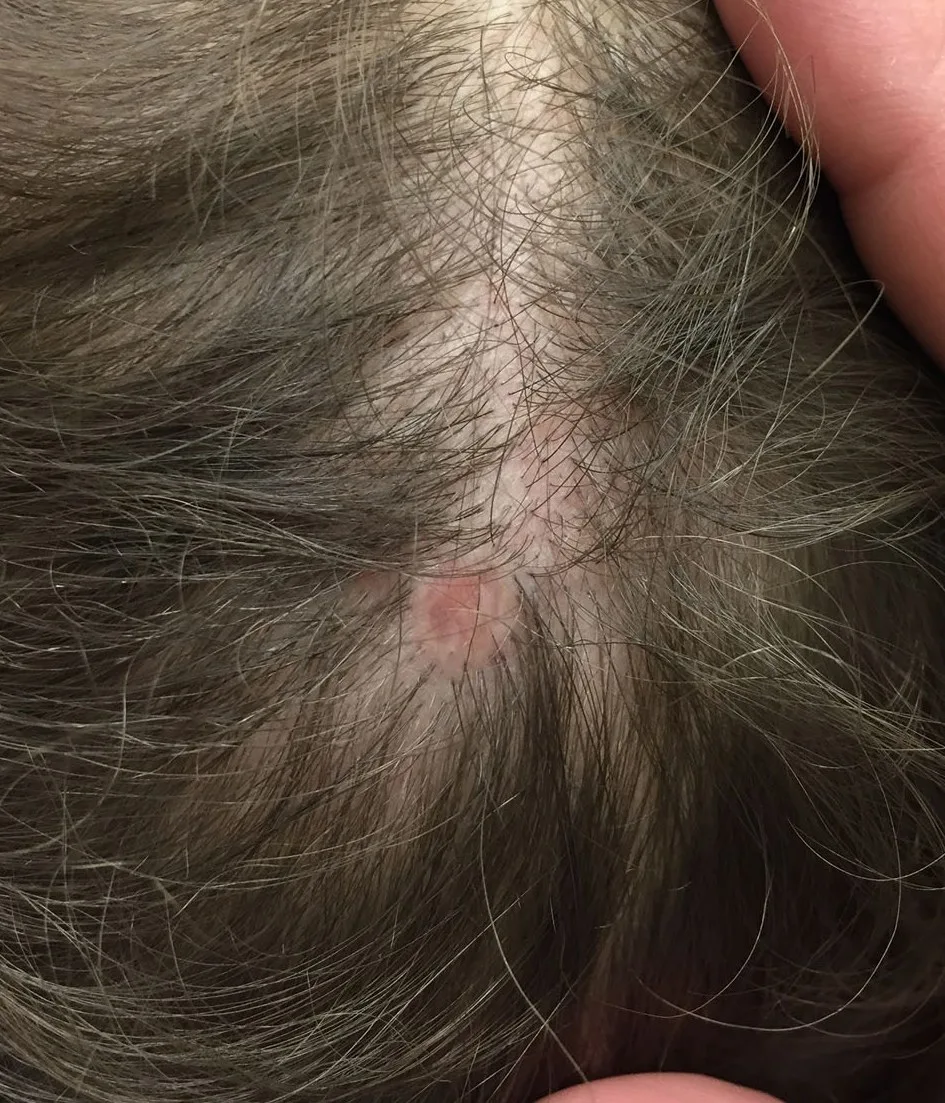
Aplasia cutis congenita (ACC) is a rare congenital malformation in which localised or widespread areas of skin are absent at birth. The scalp is affected most often, often as a single lesion without other anomalies; in principle any body site can be involved.
Classification
The Frieden classification (1986) is widely used and groups ACC by location and pattern of the skin defect, associated malformations and mode of inheritance, e.g. type 1 (scalp ACC without multiple anomalies, the commonest type), type 3 (with epidermal or organoid naevi), type 5 (with fetus papyraceus or placental infarcts), type 6 (with epidermolysis bullosa, Bart syndrome) and type 8 (due to teratogens or intrauterine infection).
Occurrence & epidemiology
The incidence is estimated at about 1–3 per 10,000 live births. In a British 25-year series (56 children) the scalp was involved in 82%; in a Korean series (59 patients) about 10% had multiple lesions.
Aetiopathogenesis
The pathogenesis is heterogeneous; genetic factors, teratogens, vascular disruption and mechanical factors in utero are discussed. Dominant-negative mutations in KCTD1 or KCTD15 have been described as one genetic cause of midline scalp ACC; acting via cranial neural crest cells, they disturb the formation of the cranial sutures and the overlying skin.
Clinical features
- Usually a sharply demarcated defect of the scalp, mainly in the midline or at the vertex, at birth an ulceration or already a hairless atrophic scar (the commonest presentation in the Korean series, 56% of lesions).
- Membranous ACC: membrane-like or bullous, cystic translucent lesion, often surrounded by a ring of dark long hair (hair collar sign).
- Associated among others with underlying (including occult) malformations, limb defects, epidermolysis bullosa and chromosomal abnormalities.
Diagnosis
- Clinical diagnosis at birth, including examination for other congenital malformations.
- The hair collar sign is regarded as a marker of cranial neural tube defects (encephalocele, meningocele, heterotopic brain tissue).
- Imaging clarifies suspected deeper involvement; in the Korean series it was abnormal in 8 of 30 patients examined.
- ACC with terminal transverse limb defects points to Adams-Oliver syndrome (often also with cutis marmorata telangiectatica congenita and nail anomalies).
Differential diagnoses
Keep learning in the app
References (selection)
- PubMed: Aplasia cutis congenita: a clinical review and proposal for classification (PMID 3514708)
- PubMed: Classification of aplasia cutis congenita: a 25-year review of cases presenting to a tertiary paediatric dermatology department (PMID 32501579)
- PubMed: Aplasia cutis congenita in Korea: Single center experience and literature review (PMID 32037608)
- PubMed: Membranous aplasia cutis congenita (PMID 41246959)
- PubMed: 'Membranous aplasia cutis' with hair collars. Congenital absence of skin or neuroectodermal defect? (PMID 7492133)
- PubMed: Aplasia Cutis Congenita Pathomechanisms Reveal Key Regulators of Skin and Skin Appendage Morphogenesis (PMID 39023472)
- PubMed: Cutaneous Features of Adams-Oliver Syndrome: Diagnosis, Differentiation, and Management (PMID 40874655)
Cross-references
Note: This page is intended for medical education and does not replace diagnosis or treatment decisions in individual cases.