Ataxia-telangiectasia (Louis-Bar syndrome)
- Synonyms
- Louis-Bar-Syndrom, Ataxia teleangiectasia, Ataxie-Teleangiektasie, Ataxia-Teleangiektasie-Syndrom, A-T, ataxia telangiectasia, Louis-Bar syndrome
- Specialty
- Dermatology · Hereditary skin diseases
- Images
- Clinical 1
- Last updated
- 10/2026 · Dr. Pascal Bafteh
Contents
Images (1)
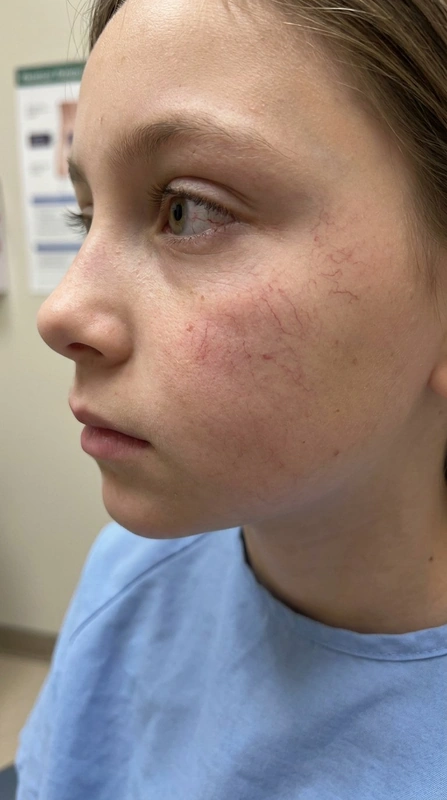 AI illustration
Definition
Ataxia-telangiectasia is a rare autosomal recessive multisystem disorder with progressive cerebellar ataxia, oculocutaneous telangiectasia, combined humoral and cellular immunodeficiency, cancer susceptibility and radiosensitivity. It is one of the genome instability syndromes.
Occurrence & epidemiology
Its frequency is estimated at 1 in 40,000 to 1 in 100,000 live births. It is considerably higher when the parents are consanguineous. All ethnic groups and both sexes are affected.
Aetiopathogenesis
It is caused by inactivating mutations in the ATM gene (11q22–23). The ATM protein, a protein kinase, coordinates the cellular response to DNA double-strand breaks and other genotoxic stress.
Clinical features
- Ataxia is usually the first sign, when children learn to walk (age 1–2 years); it progresses with slurred speech, choreoathetoid movements, impaired control of eye movements and muscle weakness; by about 10–11 years most patients need a wheelchair.
- Telangiectasia usually appears only between 3 and 6 years of age, sometimes not until adolescence: first on the conjunctiva at the corners of the eyes, later on the ears, cheeks, sides of the neck, antecubital and popliteal fossae.
- Recurrent sinus and respiratory infections, up to bronchiectasis.
- Increased risk of cancer, especially leukaemia and lymphoma.
Diagnosis
- Suspected with ataxia (particularly with telangiectasia) and typical laboratory findings: raised alpha-fetoprotein, IgA deficiency (in about 80%), lymphopenia mainly of T cells.
- Chromosome analysis: increased chromosome breaks, 7;14 translocations.
- The diagnosis is confirmed by identifying mutations on both alleles of the ATM gene.
Differential diagnoses
- Rosacea
- Erythema perstans faciei
- Cutis laxa (generalised elastolysis)
- Blaschko's lines
- Bloom syndrome
- Xeroderma pigmentosum (XP)
Keep learning in the app
References (selection)
Cross-references
Note: This page is intended for medical education and does not replace diagnosis or treatment decisions in individual cases.