Bloom syndrome
- Synonyms
- Bloom Syndrom, kongenitales teleangiektatisches Erythem, BLM-Gen, congenital telangiectatic erythema
- Specialty
- Dermatology · Hereditary skin diseases
- Images
- Clinical 1
- In the app
- 2 flashcards
- Last updated
- 10/2026 · Dr. Pascal Bafteh
Contents
Images (1)
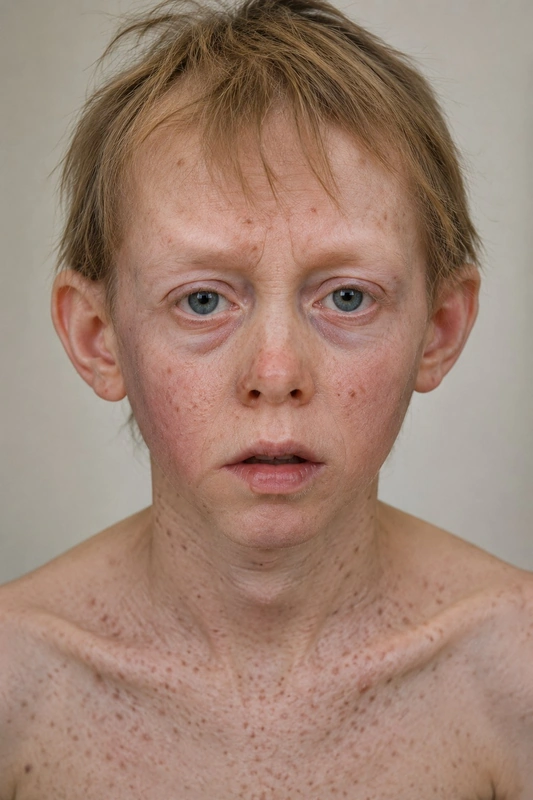 AI illustration
Definition
Bloom syndrome is a rare autosomal recessive chromosomal instability disorder. Its hallmarks are prenatal and postnatal growth deficiency, photosensitive skin changes, immunodeficiency, insulin resistance and a greatly increased risk of early-onset and multiple cancers. It was described in 1954 by the dermatologist David Bloom.
Aetiopathogenesis
It is caused by loss-of-function mutations in the BLM gene (15q26.1), which encodes a RecQ helicase. Absence of the BLM protein leads to chromosomal instability, excessive homologous recombination and a greatly increased number of sister chromatid exchanges. A founder mutation (blmAsh) is carried by about 1 in 100 people of Eastern European Jewish (Ashkenazi) ancestry.
Clinical features
- Short stature from birth; narrow face with a prominent nose owing to little subcutaneous fat, long limbs.
- Telangiectatic erythema of the face, mainly over the bridge of the nose and adjacent cheeks (butterfly distribution), often aggravated by sun; cheilitis with crusting or bleeding; poikiloderma may occur.
- Frequent infections of the ears, airways and gastrointestinal tract; IgA and IgM are reduced.
- Cancers arise unusually early and often multiply, including lymphoma, acute myeloid leukaemia and tumours of the gastrointestinal tract, skin and urogenital tract.
- Reduced fertility in women.
Diagnosis
- Clinical suspicion with short stature and photosensitive facial erythema.
- Cytogenetics: greatly increased sister chromatid exchanges (pathognomonic).
- Molecular genetic detection of mutations in the BLM gene.
- Distinction from Rothmund-Thomson syndrome, erythropoietic protoporphyria and Cockayne syndrome, among others.
Differential diagnoses
Keep learning in the app
References (selection)
Cross-references
Mentioned in
Note: This page is intended for medical education and does not replace diagnosis or treatment decisions in individual cases.