Pityriasis alba
- Synonyms
- Pityriasis simplex faciei, Pityriasis alba faciei, weiße Flecken im Gesicht beim Kind, white patches on the face
- Specialty
- Dermatology · Inflammatory skin diseases
- Images
- Clinical 1
- In the app
- 3 flashcards
- Last updated
- 10/2026 · Dr. Pascal Bafteh
Contents
Images (1)
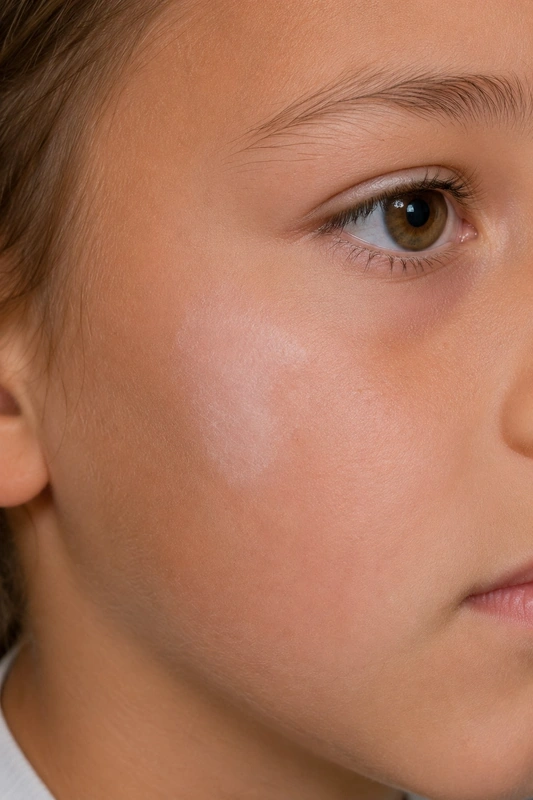 AI illustration
Definition
Pityriasis alba is a mild form of eczema that occurs mainly in children and often accompanies atopic dermatitis. The name describes its appearance: "pityriasis" refers to the fine scale, "alba" to the pale colour (hypopigmentation).
Occurrence & epidemiology
It is common worldwide, with a prevalence in children of around 5%. Children and adolescents aged 3 to 16 years are mainly affected, boys and girls equally. In dark skin the hypopigmentation is more noticeable and the condition is probably more common.
Aetiopathogenesis
The cause is unknown. Dry skin and atopic dermatitis often coexist. Sun exposure makes the patches more visible because the surrounding skin tans. Other proposed factors such as trace element deficiency or Malassezia yeasts are unproven.
Clinical features
- Usually 1–20 round, oval or irregular patches or thin plaques of 0.5–5 cm, mostly poorly defined.
- Mainly on the cheeks and chin, also on the neck, shoulders and upper arms; little or no itch.
- Typical sequence: slightly scaly pink patch → hypopigmented patch with fine scale → scale-free post-inflammatory hypopigmentation → resolution.
- Hypopigmentation is more noticeable in summer, dryness and scaling in winter. Patches clear after about a year on average and skin colour returns completely to normal; recurrences occur.
Diagnosis
- Clinical.
- Wood lamp: no enhancement of the hypopigmentation, no fluorescence.
- Mycology (microscopy, culture) negative.
- Dermoscopy: poorly defined pale area, white structureless areas, faint pigment network, fine white scale, normally pigmented hairs.
- Biopsy rarely needed: mild spongiotic dermatitis, reduced melanin.
Differential diagnoses
Keep learning in the app
References (selection)
Cross-references
Mentioned in
Note: This page is intended for medical education and does not replace diagnosis or treatment decisions in individual cases.