Sturge-Weber syndrome
- Synonyms
- encephalotrigeminal angiomatosis
- Specialty
- Dermatology · Hereditary skin diseases
- Images
- Clinical 2
- In the app
- 5 flashcards
- Last updated
- 10/2026 · Dr. Pascal Bafteh
Contents
Images (2)
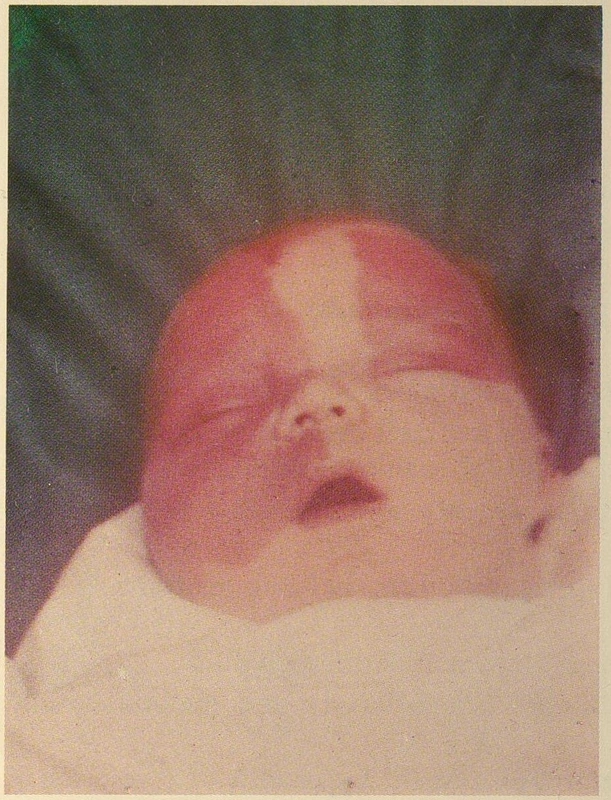
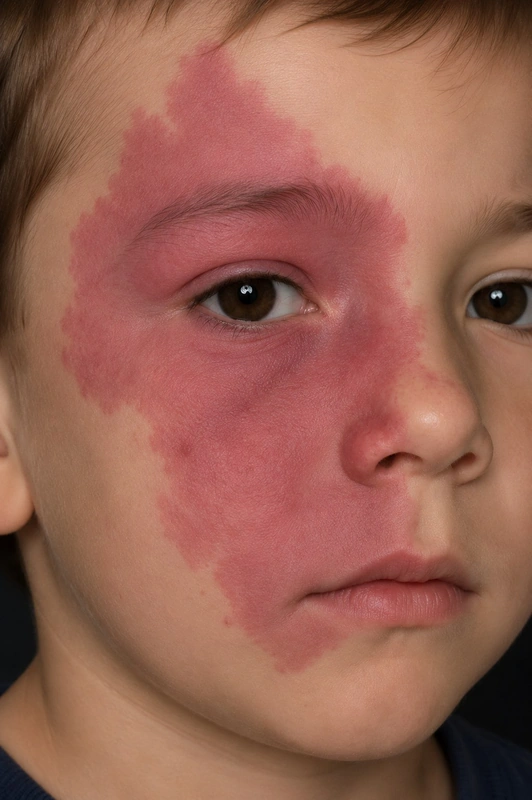 AI illustration
Definition
Sturge-Weber syndrome is a congenital, non-hereditary neurocutaneous vascular malformation with a port-wine stain (naevus flammeus) on the face, an ipsilateral leptomeningeal angiomatosis and often glaucoma. It is caused by a somatic mosaic mutation in the GNAQ gene.
- Genetics: sporadic GNAQ-R183Q somatic (mosaic).
- Triad: asymmetric nevus flammeus V1 + leptomeningeal angiomatosis + glaucoma; typical neurological consequences are epilepsy and hemiparesis.
- Imaging: contrast-enhanced brain MRI (may still be unremarkable in very young infants), ophthalmological IOP measurement obligatory.
Clinical features
- Port-wine stain typically in the territory of the first and second trigeminal divisions (forehead, upper eyelid), possibly bilateral; thickening and nodularity may develop over life.
- Neurological and ophthalmological signs are progressive and usually develop in the first two years of life: seizures and epilepsy, hemiparesis and stroke-like events, behavioural problems, visual field defects and glaucoma.
- Not every facial port-wine stain means Sturge-Weber syndrome (port-wine stains affect about 3 in 1000 infants, most without the syndrome); conversely, leptomeningeal malformations can occur without a port-wine stain. With neurological symptoms, contrast-enhanced MRI of the brain.
Differential diagnoses
Image credits for the thumbnails
- Port-wine stain (naevus flammeus): Dr. Wonko, CC BY-SA 4.0, via Wikimedia Commons · CC BY-SA 4.0 · Source
Treatment principles
- Treatment is symptomatic and multidisciplinary.
- The port-wine stain is treated with pulsed dye laser, ideally early in childhood.
- Neurological care consists mainly of anticonvulsant treatment of epilepsy, and ophthalmological care of regular glaucoma screening and pressure-lowering treatment where needed.
Specific treatment regimens with drugs and doses are covered in the DermaFuchs app.
Keep learning in the app
References (selection)
Cross-references
Keep learning: test yourself
One question from the DermaFuchs app on Sturge-Weber syndrome – tap an answer.
Question 1 of 1
Which genetic mutation is associated with Sturge-Weber syndrome?
Answer
Correct: GNAQ-R183Q somatic (mosaic). The GNAQ-R183Q somatic mutation is linked to Sturge-Weber syndrome, a sporadic neurocutaneous disorder.
More questions like these – with explanations and spaced repetition – in the app.
Note: This page is intended for medical education and does not replace diagnosis or treatment decisions in individual cases.