Marfan Syndrome
- Specialty
- Dermatology · Hereditary skin diseases
- Images
- Clinical 1
- In the app
- 1 flashcard
- Last updated
- 10/2026 · Dr. Pascal Bafteh
Contents
Images (1)
Definition
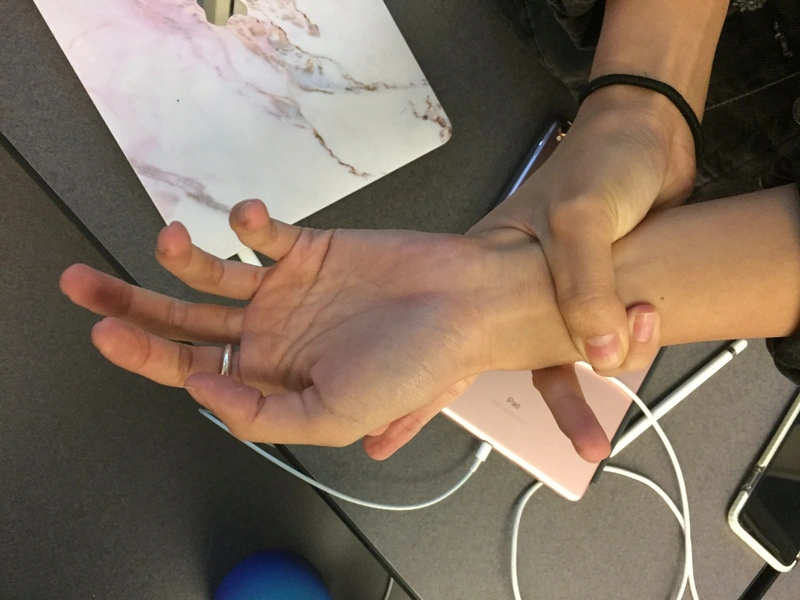
Marfan syndrome is an autosomal dominant connective tissue disorder caused by a defect in the fibrillin gene on chromosome 15. The cardiovascular system, eyes and skeleton are mainly affected; the skin usually shows only subtle changes.
- Genetics: AD, Fibrillin-1 (FBN1), prevalence about 1.5–6.8: 100 000. Ghent Nosology 2010 as diagnostic standard.
Diagnosis
- Clinical diagnosis based on cardiovascular, ocular, skeletal and skin features (e.g. striae distensae) and family history.
- Echocardiography, ophthalmological examination and molecular genetic confirmation.
Differential diagnoses
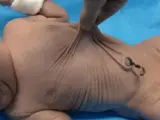 Cutis laxa (generalised elastolysis)
 Ehlers-Danlos syndrome
 Pseudoxanthoma elasticum (PXE, Grönblad-Strandberg)
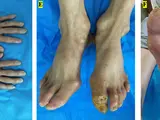 Werner syndrome (adult progeria)
Image credits for the thumbnails
- Cutis laxa (generalised elastolysis): APSP J Case Rep, CC BY 4.0, via Wikimedia Commons · CC BY 4.0 · Source
- Ehlers-Danlos syndrome: Rollcloud, “Skin-hyperelasticity-2”, CC0, via Wikimedia Commons · CC0 · Source
- Pseudoxanthoma elasticum (PXE, Grönblad-Strandberg): kilbad, “Pseudoxanthoma elasticum 3”, CC BY 3.0, via Wikimedia Commons · CC BY 3.0 · Source
- Werner syndrome (adult progeria): Peng H, Wang J, Liu Y et al. (Front Endocrinol 2022), CC BY 4.0, via PubMed Central (PMC9334726) – panels D–F (cropped) · CC BY 4.0 · Source
Treatment principles
- There is no causal treatment; interdisciplinary care by cardiology, ophthalmology, orthopaedics and clinical genetics is central.
- Prognosis depends on regular aortic imaging, drug therapy to slow aortic dilatation (e.g. beta-blockers or angiotensin receptor blockers) and timely prophylactic aortic surgery.
- Genetic counselling and, where desired, prenatal diagnosis are part of management; skin changes such as striae need no specific treatment.
Specific treatment regimens with drugs and doses are covered in the DermaFuchs app.
Keep learning in the app
References (selection)
Cross-references
Mentioned in
Keep learning: test yourself
One question from the DermaFuchs app on Marfan Syndrome – tap an answer.
Question 1 of 1
Which gene mutation is associated with Marfan syndrome, characterized by autosomal dominant inheritance?
Answer
Correct: Fibrillin-1 (FBN1). Fibrillin-1 (FBN1) mutations cause Marfan syndrome, which is inherited in an autosomal dominant manner.
More questions like these – with explanations and spaced repetition – in the app.
Note: This page is intended for medical education and does not replace diagnosis or treatment decisions in individual cases.