Werner syndrome (adult progeria)
- Synonyms
- Progeria adultorum, adulte Progerie, Erwachsenen-Progerie, WRN-Gen, Werner syndrome, adult progeria, Werner's syndrome
- Specialty
- Dermatology · Hereditary skin diseases
- Images
- Clinical 1
- In the app
- 1 flashcards
- Last updated
- 10/2026 · Dr. Pascal Bafteh
Contents
Images (1)
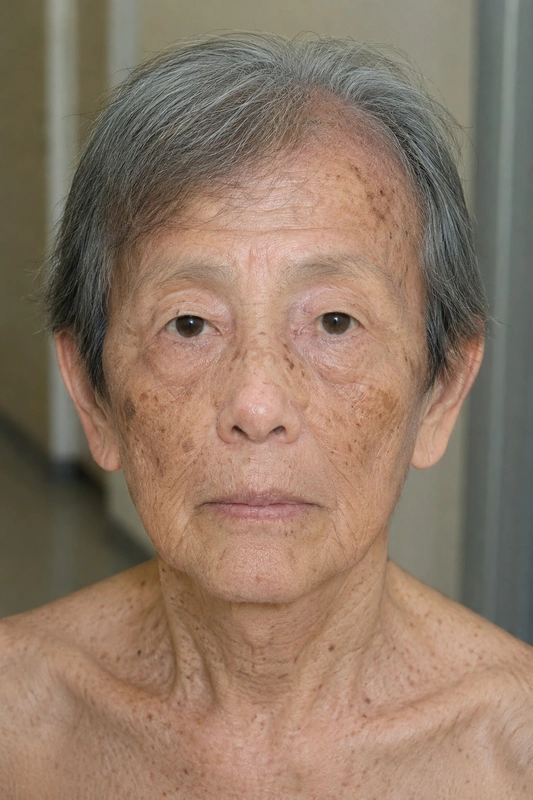 AI illustration
Definition
Werner syndrome is a rare autosomal recessive disorder with premature onset of age-related changes (a segmental progeroid syndrome) and a predisposition to cancer. It is caused by biallelic mutations in the WRN gene, which encodes a DNA helicase of the RecQ family.
Aetiopathogenesis
In addition to its helicase domain, the WRN protein has an exonuclease domain and is involved in DNA repair, recombination, replication and transcription as well as telomere maintenance. The resulting genomic instability is regarded as a key mechanism of premature ageing.
Clinical features
- Normal development until the end of the first decade; the first sign is the lack of a growth spurt in the early teens.
- Usually in the 20s: premature greying and/or thinning of scalp hair, hoarseness, scleroderma-like skin changes.
- In the 30s: bilateral cataracts, type 2 diabetes, hypogonadism, skin ulcers, osteoporosis.
- Skin: scleroderma-like tight skin, ulcers and calluses of the lower limbs, nail dystrophy or loss, alopecia, prematurely aged, wrinkled facial skin, skin cancers; the skin is drier and less distensible than in peers of the same age.
- Myocardial infarction and cancer are the most common causes of death; the mean age at death is 54 years.
Diagnosis
- Clinical criteria: all four cardinal signs (bilateral cataracts, premature greying and/or thinning of scalp hair, characteristic skin pathology, short stature) plus two further characteristic signs.
- Molecular genetics: detection of biallelic pathogenic WRN variants.
- The Japanese criteria were revised in 2013 after a nationwide survey: signs with over 90% frequency as cardinal signs, supplemented by genetic testing and Achilles tendon calcification.
- Radiographs: soft-tissue calcification, muscle atrophy, osteoporosis, foot deformities, osteomyelitis, bone or soft-tissue malignancies.
Differential diagnoses
Keep learning in the app
References (selection)
- PubMed: Werner Syndrome (GeneReviews summary) (PMID 20301687)
- PubMed: Werner syndrome: Clinical features, pathogenesis and potential therapeutic interventions (PMID 26993153)
- PubMed: Werner's syndrome (Dermatol Clin) (PMID 7712642)
- PubMed: Diagnostic criteria for Werner syndrome based on Japanese nationwide epidemiological survey (PMID 22817610)
- PubMed: Radiographic presentation of musculoskeletal involvement in Werner syndrome (adult progeria) (PMID 27931782)
- PubMed: Werner syndrome: quantitative assessment of skin aging (PMID 30122969)
Cross-references
Note: This page is intended for medical education and does not replace diagnosis or treatment decisions in individual cases.