Hypomelanosis of Ito (incontinentia pigmenti achromians)
- Synonyms
- Incontinentia pigmenti achromians, Ito-Syndrom, Pigmentmosaik, Hypomelanose Ito, hypomelanosis of Ito, pigmentary mosaicism
- Specialty
- Dermatology · Pigmentation disorders
- Images
- Clinical 1
- In the app
- 3 flashcards
- Last updated
- 10/2026 · Dr. Pascal Bafteh
Contents
Images (1)
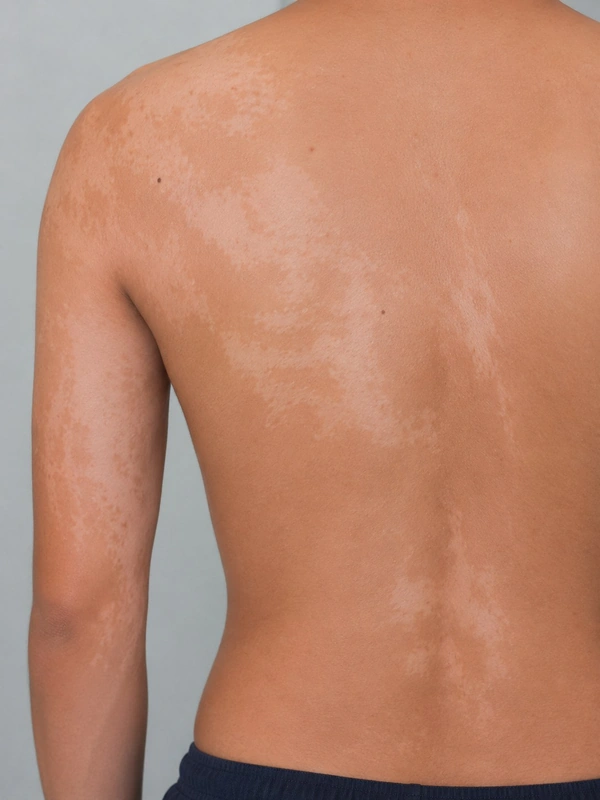 AI illustration
Definition
Hypomelanosis of Ito (formerly incontinentia pigmenti achromians) is a rare pigmentary disorder with streaky and whorled hypopigmented macules along Blaschko lines, often associated with changes in other organ systems, particularly the nervous system. Today it is understood as a non-specific cutaneous sign of genetic mosaicism rather than a single syndrome. It was described in 1952 by the Japanese dermatologist Minoru Ito.
Aetiopathogenesis
The basis is chromosomal or genetic mosaicism arising after conception; as a rule, the disorder is therefore not inherited. Blaschko lines mark the boundaries between the two cell lines in embryonic skin.
Clinical features
- Initially small (0.5–1 cm) pale to white macules that merge into larger areas; whorled on the trunk, linear on the arms and legs.
- Usually more than two dermatomes and both sides of the body are involved, but asymmetrically; the palms, soles and scalp are usually spared.
- Associated abnormalities in about 30–50% (some studies report neurological abnormalities in up to 75–94%): seizures, developmental delay and intellectual disability, abnormal muscle tone, hemimegalencephaly; also the eyes, teeth, skeleton, heart and kidneys. In a paediatric neurology series of 76 children, 57% had intellectual disability.
Diagnosis
- Clinical: the changes are present from birth and are usually recognised in the first two years of life.
- Thorough history and physical, neurological and ophthalmological examination to detect associated abnormalities, together with assessment of growth, development, teeth and renal function.
- In early stages, distinction from incontinentia pigmenti, whose skin lesions can look similar.
Differential diagnoses
Keep learning in the app
References (selection)
- DermNet: Hypomelanosis of Ito
- DermNet: Cutaneous mosaicism
- PubMed: Hypomelanosis of Ito (PMID 26564088)
- PubMed: Neurocutaneous disorders identified in the neonatal period and infancy: Hypomelanosis of Ito (PMID 39389656)
- PubMed: Hypomelanosis of Ito: no entity, but a cutaneous sign of mosaicism (PMID 10398257)
- PubMed: Hypomelanosis of ITO. A study of 76 infantile cases (PMID 9533559)
Cross-references
Mentioned in
Note: This page is intended for medical education and does not replace diagnosis or treatment decisions in individual cases.