Kawasaki syndrome
- Specialty
- Dermatology · Vascular skin disorders
- Images
- Clinical 1
- In the app
- 2 flashcards
- Last updated
- 10/2026 · Dr. Pascal Bafteh
Contents
Images (1)
Definition
Kawasaki disease (mucocutaneous lymph node syndrome) is an acute febrile vasculitis of medium-sized arteries in childhood that can particularly affect the coronary arteries.
Occurrence & epidemiology
80% of patients are younger than 5 years (peak 6 to 24 months); boys are affected about 1.5 times as often as girls. Incidence is particularly high in children of Japanese descent, but the disease occurs worldwide. About 2% have a recurrence. In developed countries, Kawasaki disease is the leading cause of acquired heart disease in children.
Aetiopathogenesis
The cause is unknown. Epidemiology and clinical course suggest an abnormal immune response to an infection in genetically predisposed children.
Clinical features
- Persistent fever for at least 5 days, usually ≥ 38.0 °C; children are often markedly irritable.
- Bilateral bulbar conjunctival hyperaemia without exudate.
- Red, dry, cracked lips, strawberry tongue, reddened oral and pharyngeal mucosa.
- Polymorphous rash, accentuated on the trunk and perineum (maculopapular, morbilliform, scarlatiniform or erythema multiforme-like).
- Erythema and firm oedema of the hands and feet in the acute phase; from about day 10, periungual, palmar, plantar and perineal desquamation.
- Cervical lymphadenopathy (at least one node ≥ 1.5 cm), usually unilateral.
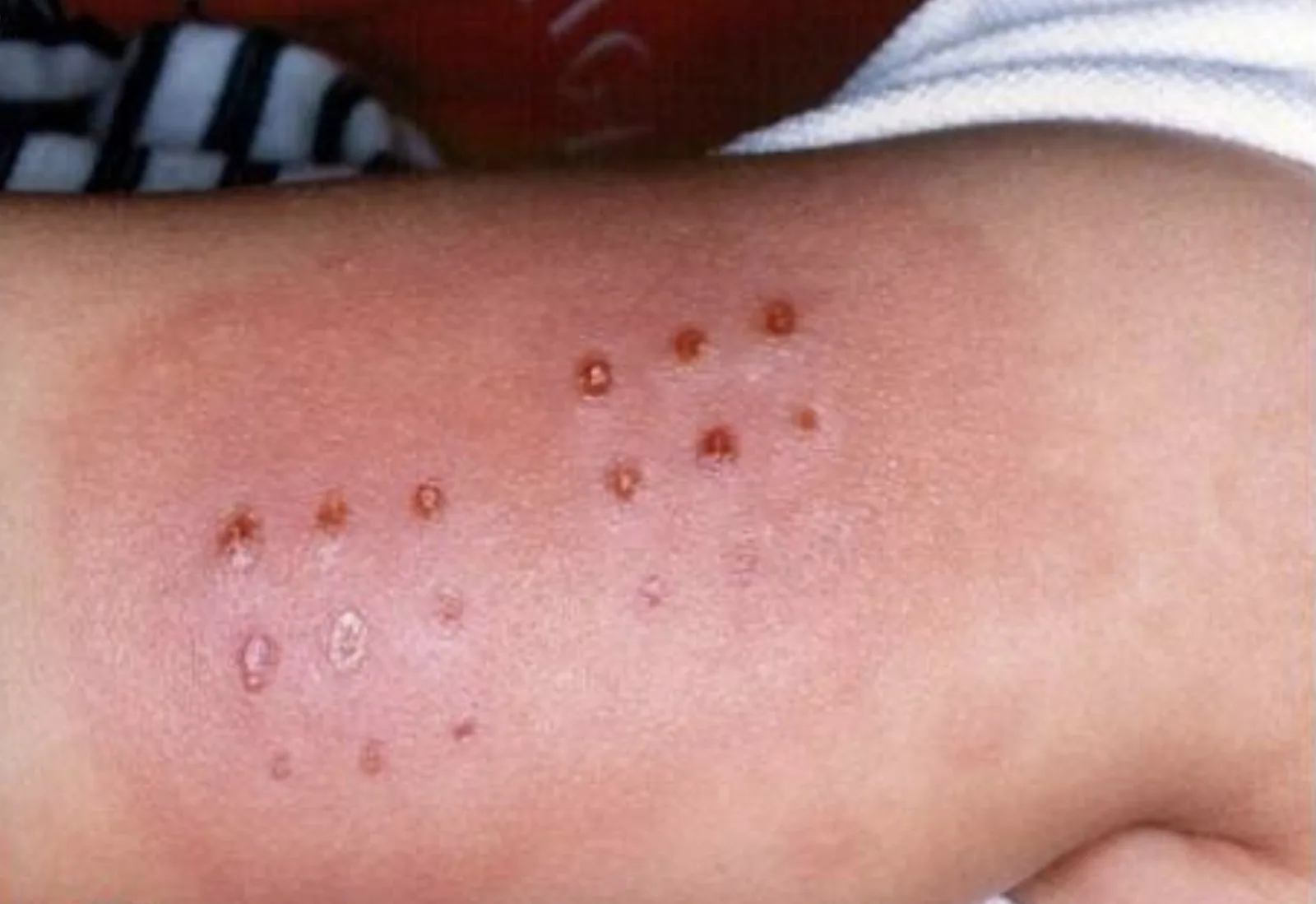
- In children with a BCG scar, inflammation of the scar can be an early clue, particularly in the incomplete form.
- Cardiac involvement usually begins 1 to 4 weeks after onset; the most important complication is coronary artery aneurysm.
Diagnosis
- Classic Kawasaki disease (AHA 2017): fever for at least 5 days (the first day of fever counts as day 1) plus at least 4 of the 5 principal features: changes of the lips/oral mucosa, conjunctival hyperaemia, rash, changes of the hands and feet, cervical lymphadenopathy. With at least 4 principal features, particularly redness and swelling of the hands and feet, the diagnosis can be made after 4 days of fever. This applies provided no other illness explains the findings.
- Incomplete Kawasaki disease: fever with fewer than 4 principal features; coronary artery abnormalities on echocardiography confirm the diagnosis in most cases.
- Laboratory findings are not diagnostic: leucocytosis, raised ESR/CRP, thrombocytosis from the second week, low sodium and albumin, raised liver enzymes, sterile pyuria.
- ECG and echocardiography at diagnosis and repeated during the course.
Differential diagnoses
- Roseola infantum (exanthem subitum)
- Measles
- Scarlet fever
- TEN (toxic epidermal necrolysis)
- Toxic shock syndrome
- DRESS-Syndrom
Keep learning in the app
References (selection)
- MSD Manual Professional: Kawasaki Disease
- DermNet: Kawasaki disease
- PubMed: Diagnosis, Treatment, and Long-Term Management of Kawasaki Disease: A Scientific Statement for Health Professionals From the American Heart Association (PMID 28356445)
- PubMed: Intravenous immunoglobulin for the treatment of Kawasaki disease (PMID 36695415; enthält die AHA-Diagnosekriterien 2017 als Tabelle)
- PubMed: Diagnostic value of the reaction at the bacillus Calmette-Guérin vaccination site in Kawasaki disease (PMID 32876305)
Cross-references
Mentioned in
Note: This page is intended for medical education and does not replace diagnosis or treatment decisions in individual cases.