Trichotillomania
- Synonyms
- hair pulling disorder
- Specialty
- Dermatology · Skin appendages
- Images
- Clinical 2
- In the app
- 2 flashcards
- Last updated
- 10/2026 · Dr. Pascal Bafteh
Contents
Images (2)
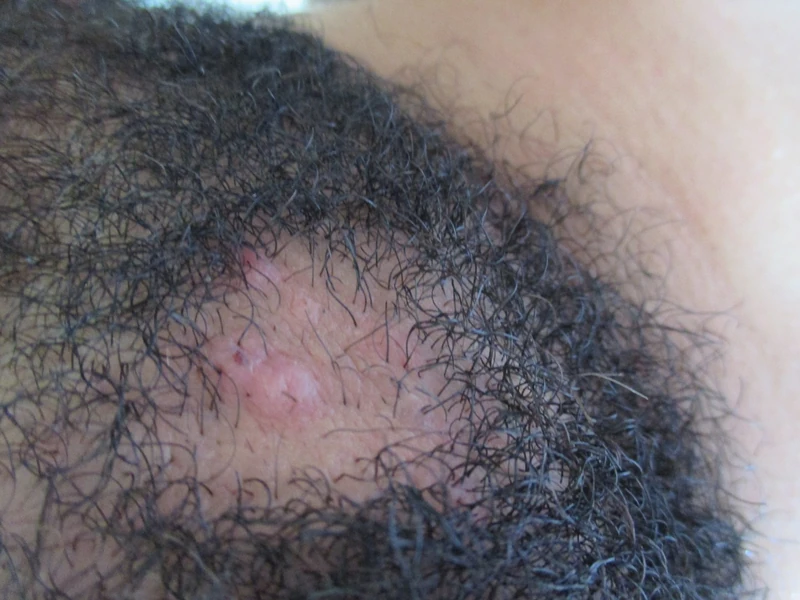
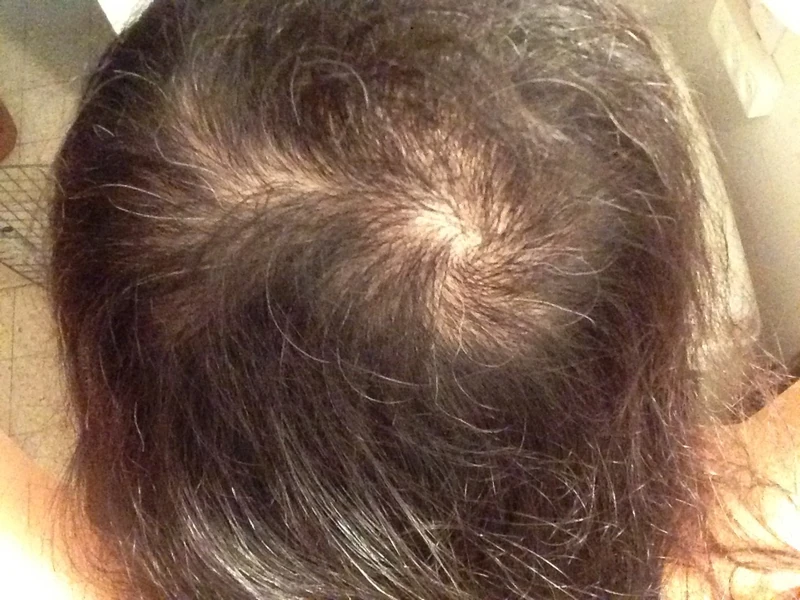
Definition
- Self-inflicted hair loss by pulling — classified in DSM-5 under obsessive-compulsive and related disorders.
- Clinical presentation: irregularly demarcated bald areas with hair stubs of varying lengths, often frontotemporal and at the vertex.
- Trichoscopy: broken hairs of various lengths, trichoptilosis, black dots.
Occurrence & epidemiology
Trichotillomania belongs to the obsessive-compulsive spectrum of body-focused repetitive behaviours. It affects up to 4% of the population and usually begins in the pre-school years or early adolescence; in children both sexes are equally affected, with increasing age females more often. Pulling occurs partly unawares during other activities (e.g. watching TV or reading), partly deliberately with compulsive urges and anxiety; swallowing the hair (trichophagia) can rarely lead to a trichobezoar.
Diagnosis
- Clinical picture: irregularly shaped patches of alopecia with hairs of varying lengths, usually at easily reached sites (in children frontotemporal and vertex on the side of the dominant hand); hair pull test negative. Alopecia areata needs to be excluded; Wood's light to rule out fungal infection.
- Trichoscopy: reduced hair density, broken hairs of uneven length, split ends (trichoptilosis), "hair powder", short vellus hairs.
- Histology: catagen and dystrophic hairs, fractured hair shafts, dilated follicles plugged with keratin and melanin casts, relatively non-inflammatory dermis.
Differential diagnoses
 Alopecia areata
 Anagen effluvium
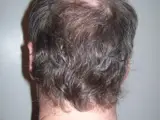 Androgenetic Alopecia
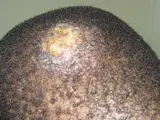 Tinea capitis (scalp ringworm)
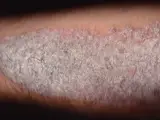 Psoriasis vulgaris (plaque psoriasis)
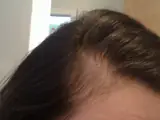 Telogen effluvium
Image credits for the thumbnails
- Alopecia areata: Abbassyma at English Wikipedia, “Allopecia areata”, Public Domain, via Wikimedia Commons · Public domain · Source
- Anagen effluvium: Unnikrishnan, Vudayana, Diddi et al. (2026), “Chemotherapy and the Skin: Understanding Dermatologic Side Effects”, CC BY 4.0, via Wikimedia Commons · CC BY 4.0 · Source
- Androgenetic Alopecia: Before My Ken, “Back of man's head”, CC BY-SA 3.0, via Wikimedia Commons · CC BY-SA 3.0 · Source
- Tinea capitis (scalp ringworm): Grook da oger, “Kérion 01”, CC BY-SA 4.0, via Wikimedia Commons · CC BY-SA 4.0 · Source
- Psoriasis vulgaris (plaque psoriasis): MediaJet, “An Arm Covered With Plaque Type Psoriasis”, CC BY-SA 3.0, via Wikimedia Commons · CC BY-SA 3.0 · Source
- Telogen effluvium: Mvolz, “Postpartum telogen effluvium (hair loss)”, CC0, via Wikimedia Commons · CC0 · Source · cropped
Treatment principles
- Trichotillomania is a mental disorder within the obsessive-compulsive spectrum; psychotherapy is the mainstay, particularly behavioural therapy with habit reversal training.
- There is no established standard drug treatment; coexisting psychiatric conditions are treated as well.
- In young children the disorder is often transient; sensitive explanation of the diagnosis is an important first step.
Specific treatment regimens with drugs and doses are covered in the DermaFuchs app.
Keep learning in the app
References (selection)
Cross-references
Keep learning
Keep learning with flashcards, exam questions and spot diagnoses in the DermaFuchs app – free, in your browser or as an app.
Related pages: Alopecia areata · Anagen effluvium · Androgenetic Alopecia
Note: This page is intended for medical education and does not replace diagnosis or treatment decisions in individual cases.