Great saphenous vein varicosity
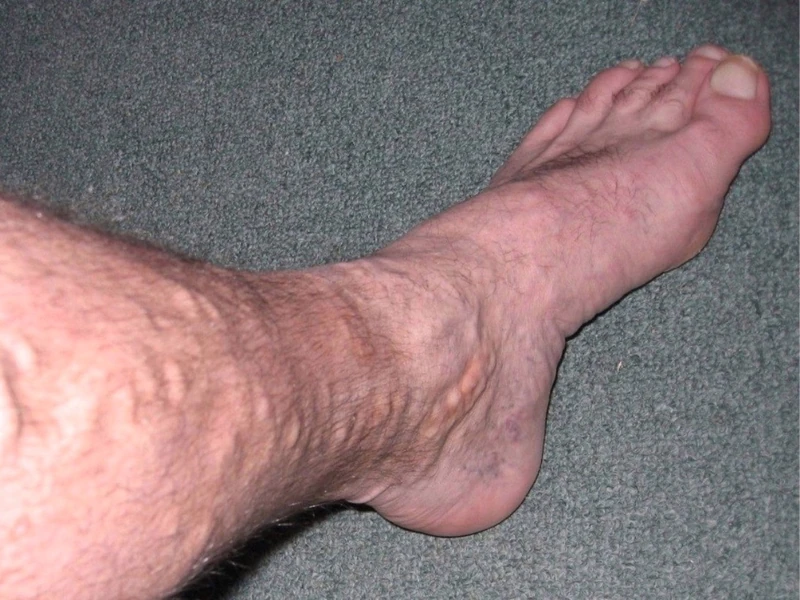
Overview
(For a table overview of compartments, see below at the end of the card)
Risk Factors for Venous Insufficiency
- Classic factors include obesity + standing professions plus pregnancy + DVT + female, familial predisposition (50% with one affected parent), estrogens (pill / HRT), height, lack of physical activity.
CEAP Classification (Eklöf 2004)
C — Clinical Class
| Class | Findings |
|---|---|
| C0 | no visible / palpable signs |
| C1 | telangiectasias / reticular veins |
| C2 | varicose veins (≥ 3 mm) |
| C3 | edema without skin changes |
| C4a | pigmentation and/or eczema |
| C4b | lipodermatosclerosis and/or atrophie blanche |
| C5 | healed venous ulcer |
| C6 | active venous ulcer |
E / A / P
- E (Etiology): primary (Ep), secondary (Es, e.g., post-thrombotic), congenital (Ec)
- A (Anatomy): superficial (As), perforating (Ap), deep (Ad)
- P (Pathophysiology): reflux (Pr), obstruction (Po), both (Pr,o)
Widmer Stages (clinically descriptive, DE)
- Stage I: corona phlebectatica at the medial foot margin
- Stage II: Edema with trophic changes — atrophie blanche, hyperpigmentation, dermatoliposclerosis
- Stage IIIa: healed venous leg ulcer
- Stage IIIb: florid venous leg ulcer
Hach Classification (Truncal Varicose Veins proximal → distal)
Insufficiency of great / small saphenous vein — Valve insufficiency from cranial to caudal:
- Hach I: insufficient junctional valve (crosse) — proximal only
- Hach II: Insufficiency up to proximal to the knee
- Hach III: Insufficiency up to distal to the knee / calf
- Hach IV: Insufficiency up to the ankle (complete length)
Note: an alternative didactic view describes Hach combined with perforating and deep insufficiency as progressive severity grades (superficial → + perforating → + deep → + skin changes / ulcer). The proximal→distal stages are the original Hach definition.
Note (currency): According to Braun-Falco 2018 (p. 1210), the Hach classification has been abandoned in favour of the modern classification into junctional, tributary and perforator types; Hach I–IV remains historically and didactically relevant but is no longer the standard.
Varicose Vein Subtypes
- Spider veins (C1): < 1 mm intradermal — Telangiectasias
- Reticular veins (C1): 1–3 mm subcutaneous
- Truncal varicose veins (C2): Great / small saphenous vein > 3 mm
- Branch varicose veins (C2): Tributary branches
- Perforator varicose veins (C2): insufficient connecting veins (Cockett, Boyd, Dodd)
---
Differential diagnoses
- Telangiectasias (spider veins) and reticular veins
- Corona phlebectatica paraplantaris
- Purpura jaune d’ocre
- Atrophie blanche
- Lipodermatosclerosis
- Chronic venous insufficiency (Widmer II)
Practise Great saphenous vein varicosity in the app
Flashcards with spaced repetition, exam questions and spot-the-diagnosis on this topic – in DermaFuchs, free of charge.
In the DermaFuchs app: 7 flashcards · 2 clinical images
Open in browser Download on the App StoreSources (selection)
More vascular skin disorders
- Erythromelalgia
- Leukocytoclastic vasculitis
- Lichen aureus
- Superficial thrombophlebitis
- Deep vein thrombosis
Note: This page is intended for medical education and does not replace diagnosis or treatment decisions in individual cases. Treatment and follow-up content is available in the app.