Acneiform drug eruption
- Synonyms
- medikamentöse Akne, Akne durch Medikamente, Steroidakne, akneiforme Arzneimittelreaktion, drug-induced acne, acneiform drug reaction, steroid acne
- Specialty
- Dermatology · Drug reactions
- Images
- Clinical 1
- In the app
- 9 flashcards
- Last updated
- 10/2026 · Dr. Pascal Bafteh
Contents
Images (1)
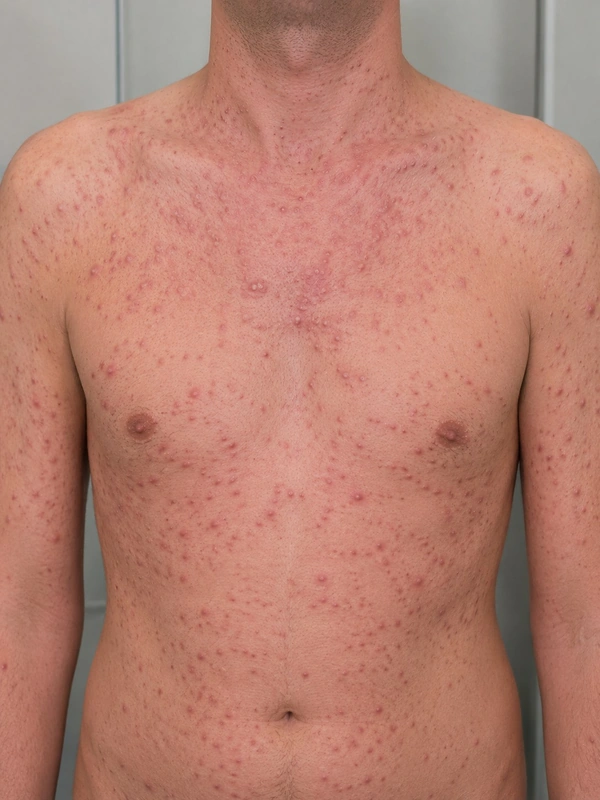 AI illustration
Definition
Acneiform drug eruption is an acne-like follicular skin reaction triggered by drugs. Unlike acne vulgaris, it is typically monomorphic, may occur outside the seborrhoeic areas and at an atypical age, and is temporally linked to a newly started drug.
Occurrence & epidemiology
Follicular drug eruptions are estimated to account for about 1% of all drug reactions; men are affected more often than women.
Aetiopathogenesis
The main triggering drug groups are:
- glucocorticoids, androgens and anabolic agents
- antituberculosis drugs and anticonvulsants
- halogen compounds (iodides, bromides)
- immunosuppressants and immunomodulators
- targeted cancer drugs, with the highest risk for agents directed against the EGF receptor
Pathogenetically, altered sebum composition, a shifted follicular microbiome (Cutibacterium acnes) and neutrophilic follicular inflammation act together.
Clinical features
- Onset usually weeks to months after the triggering drug is started, often as early as 1–3 weeks with targeted cancer drugs.
- Monomorphic inflammatory follicular papules and pustules; comedones are often absent.
- Mainly seborrhoeic areas (face, scalp, upper trunk), sometimes also the upper arms and atypical sites up to the palms and soles.
- Accompanied by burning, itching, seborrhoea; usually no systemic involvement.
- With EGFR blockade, additionally paronychia, disturbed hair growth, itching and dry skin.
Histology
Usually a superficial, neutrophil-predominant suppurative folliculitis with dilated infundibula and focal rupture of the follicular epithelium; comedones are frequently absent.
Diagnosis
- Clinical diagnosis: monomorphic papulopustules with a temporal link to a new drug (drug history).
- Distinction from acne vulgaris (polymorphic, with comedones), rosacea, perioral dermatitis, Malassezia folliculitis and AGEP (abrupt onset of non-follicular pustules, often fever).
Differential diagnoses
Keep learning in the app
References (selection)
Cross-references
Note: This page is intended for medical education and does not replace diagnosis or treatment decisions in individual cases.