Stevens-Johnson syndrome (SJS)
Exam relevance: in 3 of more than 50 board exam reports · rank 45
- Synonyms
- SJS, toxic epidermal necrolysis, TEN
- Specialty
- Dermatology · Drug reactions
- Images
- Clinical 1 · Histology 2
- In the app
- 2 flashcards
- Last updated
- 10/2026 · Dr. Pascal Bafteh
Contents
Images (3)
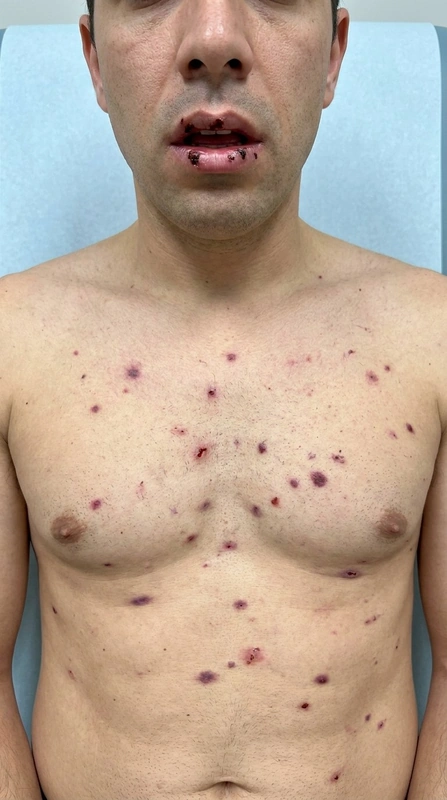
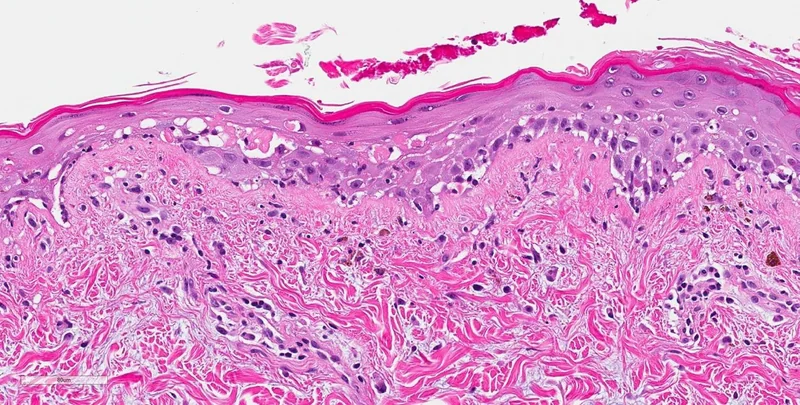 Histology
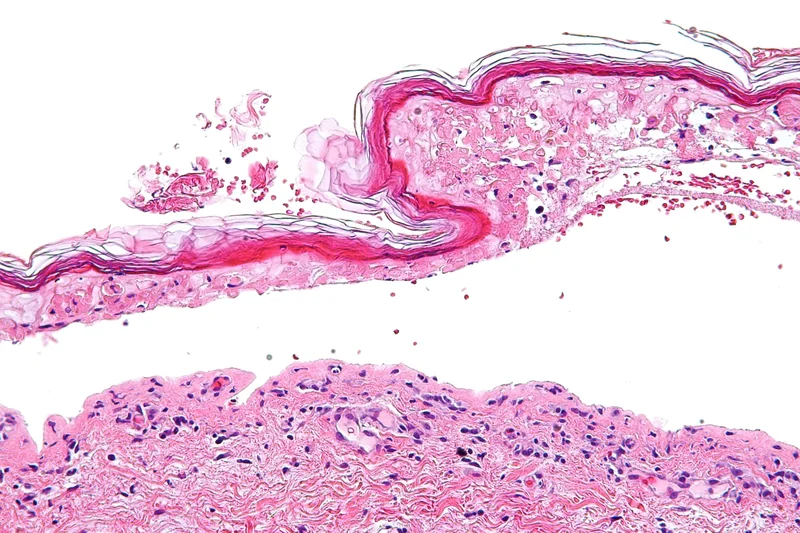 Histology
Definition
- Definition (BSA detachment): SJS < 10 %, SJS/TEN overlap 10–30 %, TEN > 30 % of body surface area.
- Latency: usually 4–28 days after first intake of the culprit drug.
- Pathophysiology: CD8/TNF/IFN-γ/Fas-ligand-mediated keratinocyte necrolysis (granulysin as key mediator).
- Prognostic score SCORTEN > 3 → transfer to burn center: Urea, glucose, bicarbonate, age >40, malignancy, >10 % TBSA.
- Fuchs syndrome: mucosal erythema multiforme without skin involvement – an important differential diagnosis of SJS.
Differential diagnoses
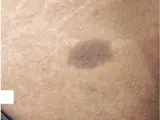
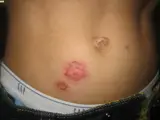
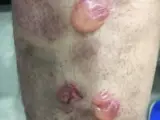
- TEN (toxic epidermal necrolysis)
- Stevens-Johnson syndrome
- Toxic epidermal necrolysis (TEN, Lyell's syndrome)
Image credits for the thumbnails
- Pemphigus vulgaris: Mohammad2018, CC BY-SA 4.0, via Wikimedia Commons, cropped · CC BY-SA 4.0 · Source
- Fixed drug eruption (FDE): Radhi, Almamoori (2026), “Preferential Localization of Fixed Drug Eruption Over a Cosmetic Red Lip Tattoo”, CC BY 4.0, via Wikimedia Commons · CC BY 4.0 · Source
- Impetigo (impetigo contagiosa): Littlekidsdoc, “Bullous impetigo”, CC BY-SA 4.0, via Wikimedia Commons · CC BY-SA 4.0 · Source
- Bullous pemphigoid: Mohammad2018, “Bullous pemphigoid new image”, CC BY-SA 4.0, via Wikimedia Commons · CC BY-SA 4.0 · Source
Treatment principles
- The crucial step is immediate withdrawal of the suspected drug.
- Treatment is supportive in an intensive care or burns unit, with fluid and electrolyte replacement, analgesia, gentle wound care and early ophthalmological, oral and genital mucosal review.
- Immunomodulatory therapies, such as calcineurin inhibitors or TNF-α blockade, are used as options.
- Re-exposure to the culprit must be avoided for life (allergy card).
Guideline: AWMF guideline register (no. 013-103)
Specific treatment regimens with drugs and doses are covered in the DermaFuchs app.
Keep learning in the app
Cross-references
Keep learning: test yourself
Two questions from the DermaFuchs app on Stevens-Johnson syndrome (SJS) – tap an answer.
Question 1 of 2
What are the specific parameters evaluated in the SCORTEN score to determine prognosis in SJS/TEN?
Answer
Correct: Urea, glucose, bicarbonate, age >40, malignancy, >10 % TBSA. The SCORTEN score includes urea, glucose, bicarbonate, age >40, presence of malignancy, heart rate, and >10% total body surface area detachment.
Question 2 of 2
What is the prognostic score used for classifying SJS/TEN based on 7 parameters?
Answer
Correct: SCORTEN. SCORTEN is a prognostic score used to assess severity and outcomes in SJS/TEN patients.
More questions like these – with explanations and spaced repetition – in the app.
Note: This page is intended for medical education and does not replace diagnosis or treatment decisions in individual cases.