Darier disease
Exam relevance: in 2 of more than 50 board exam reports · rank 69
- Synonyms
- keratosis follicularis
- Specialty
- Dermatology · Hereditary skin diseases
- Images
- Clinical 1
- Last updated
- 10/2026 · Dr. Pascal Bafteh
Contents
Images (1)
Definition
Definition & Pathogenesis
- Darier disease (Darier-White disease, Keratosis follicularis) = autosomal-dominant genodermatosis with acantholysis + dyskeratosis.
- Gene / inheritance: Causative gene is ATP2A2 (encodes SERCA2 = sarco-/endoplasmic Ca²⁺-ATPase 2) on chromosome 12q23-q24, autosomal-dominant.
- Pathomechanism: Mechanism is disturbed Ca²⁺ transport into ER → defective desmosome assembly → suprabasal acantholysis + dyskeratosis (corps ronds + grains).
- Penetrance high (not all carriers develop clinical disease), expressivity variable; mosaic form as segmental type 1/2 possible.
- Localization: Seborrheic areas (forehead, preauricular, back, sternum).
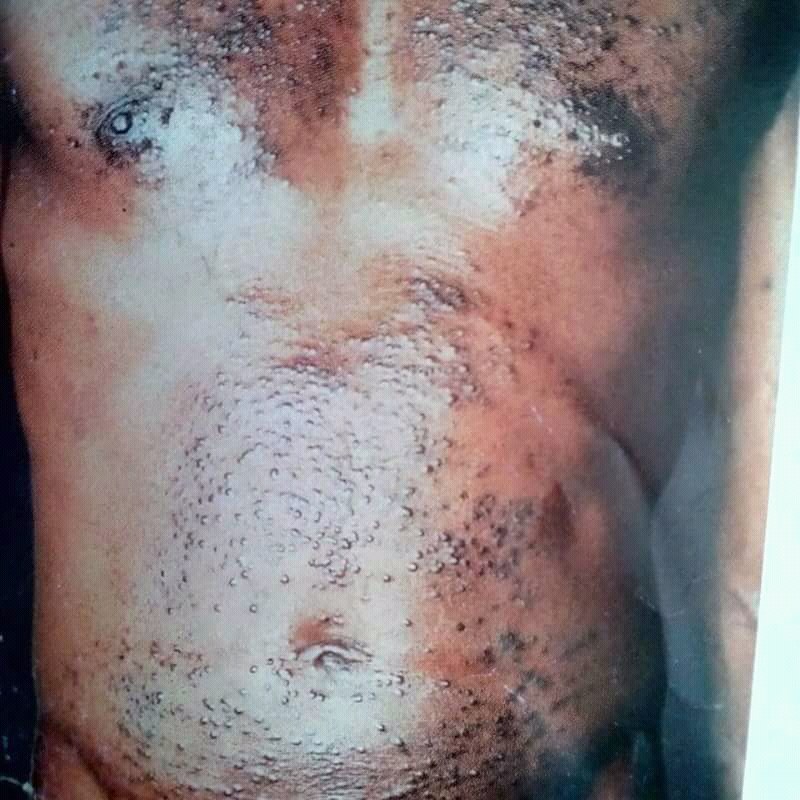
- Clinical features: Reddish-brown keratotic papules, grooved nail dystrophies, onset usually in adolescence.
Clinical features
Clinical Presentation
- Age of onset: Typical first manifestation period is puberty / 2nd decade of life (10–20 yrs).
- Location: Classic distribution is seborrheic (sternum, interscapular, forehead, scalp, nasolabial fold) + intertriginous.
- Skin morphology: Efflorescences are brownish, hyperkeratotic, confluent papules with greasy scaling + malodorous.
- Acral signs: Pathognomonic acral findings are palmoplantar pits + V-shaped nail notches (V-notch / longitudinal striation with a red-white band).
- Mucosa: whitish plaques (cobblestone) on the hard palate.
- Course: chronic, flares with UV / heat / sweating / infections.
- Comorbidity: Frequently associated are neuropsychiatric comorbidities (depression, bipolar disorder, epilepsy, learning disability) + increased suicide risk.
Diagnosis
Diagnostics
- Clinical + family history (autosomal-dominant).
- Histology: Pathognomonic are suprabasal acantholysis + dyskeratosis (corps ronds in stratum spinosum + grains in stratum corneum) + lacunae.
- DIF: negative (DD to pemphigus).
Treatment principles
- There is no causal treatment; the basis is UV protection, cooling, avoidance of heat and sweating, and breathable clothing.
- Topical retinoids, moderate-potency glucocorticoids and antiseptics are used, and systemic retinoids for moderate to severe disease.
- Secondary infections, particularly herpes simplex superinfection, must be recognised promptly and treated with antivirals or antibiotics; circumscribed refractory areas can be treated with ablative procedures.
Specific treatment regimens with drugs and doses are covered in the DermaFuchs app.
Keep learning in the app
References (selection)
Cross-references
Keep learning
Keep learning with flashcards, exam questions and spot diagnoses in the DermaFuchs app – free, in your browser or as an app.
Related pages: Hailey-Hailey disease · Neurofibromatosis type 1 · Neurocutaneous syndromes (phakomatoses)
Note: This page is intended for medical education and does not replace diagnosis or treatment decisions in individual cases.