Rapidly progressive glomerulonephritis (RPGN)
Board exam relevance: in 1 of 105 exam reports · rank 181- Synonyms
- RPGN, crescentic glomerulonephritis, extracapillary glomerulonephritis, pulmonary-renal syndrome
- Specialty
- Internal medicine · Nephrology
- Images
- Histology 2
- Last updated
- 10/2026 · Dr. Pascal Bafteh
Contents
Images (2)
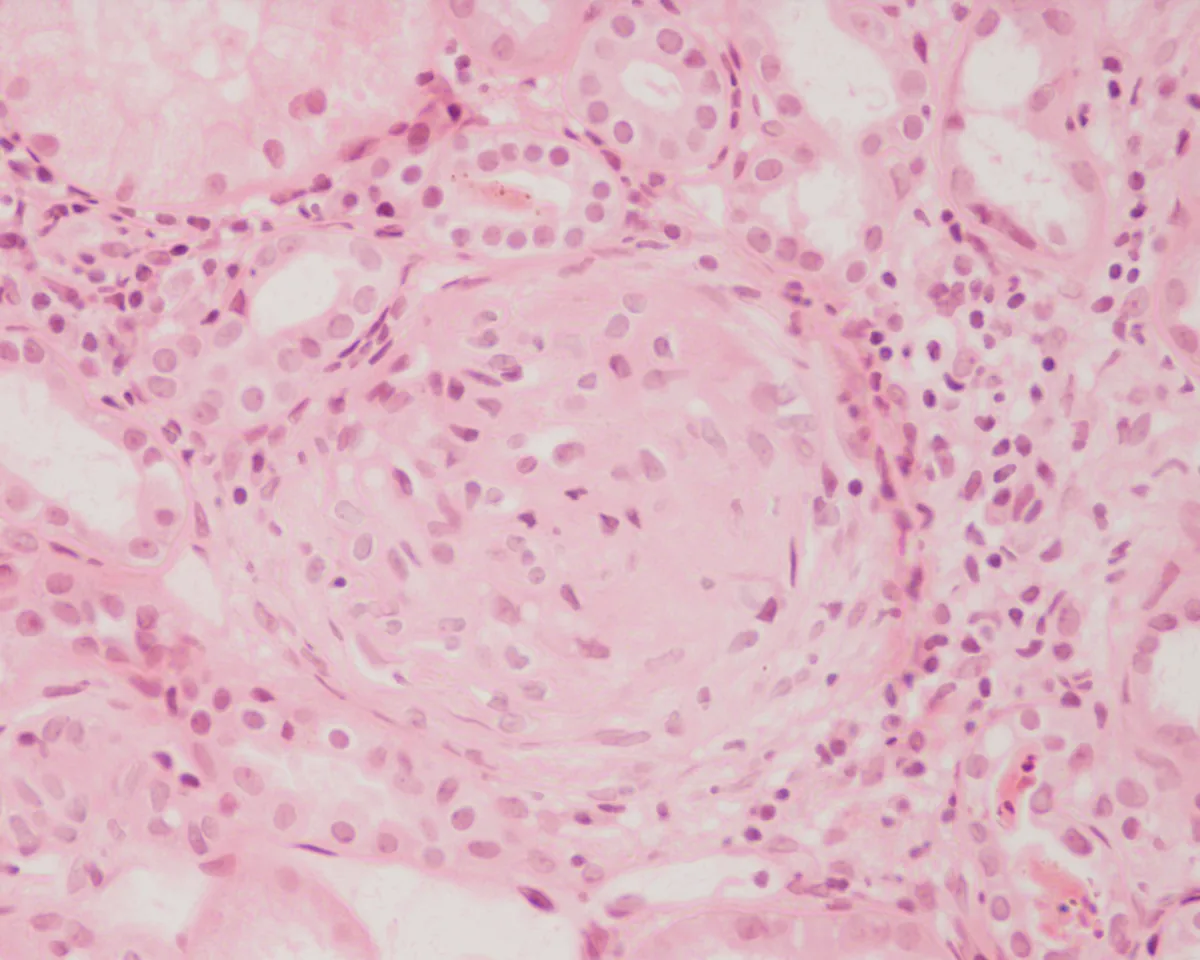 Histology
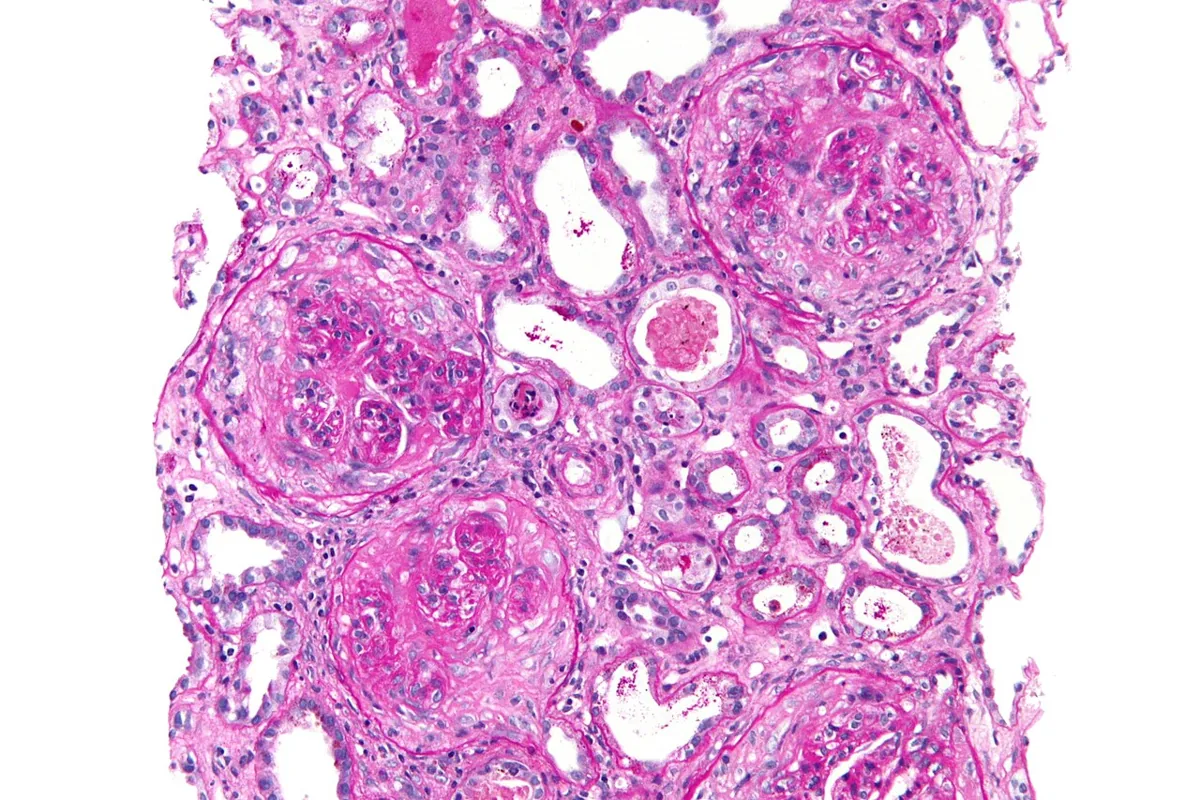 Histology
Definition
Rapidly progressive glomerulonephritis (RPGN) is an acute nephritic syndrome that progresses to kidney failure within weeks to months. Histologically it is defined by crescent formation (extracapillary proliferation) in more than 50% of glomeruli, making it a pathologic diagnosis.
Classification
Immunofluorescence types
Classification is based on the immunofluorescence pattern and serology:
- Type I – anti-GBM antibody-mediated: linear IgG deposition along the basement membrane; called Goodpasture syndrome when pulmonary hemorrhage is present
- Type II – immune complex-mediated: granular deposits; e.g. postinfectious glomerulonephritis, endocarditis, lupus nephritis, IgA vasculitis, IgA nephropathy, cryoglobulinemia, membranoproliferative glomerulonephritis
- Type III – pauci-immune: no or scant immune deposits; almost always ANCA-positive (PR3- or MPO-ANCA) in granulomatosis with polyangiitis, microscopic polyangiitis or renal-limited vasculitis
- Double-antibody positive form: anti-GBM antibodies and ANCA at the same time; rare
Aetiopathogenesis
The common final pathway is severe inflammatory damage to the glomerular capillaries. Epithelial cells then proliferate in Bowman space, often interspersed with neutrophils, and form crescents that fill the capsular space and compress the capillary tuft. Reported frequencies of the individual types vary between cohorts.
Clinical features
Onset is often insidious with weakness, fatigue, fever, nausea, vomiting, anorexia, joint and abdominal pain. About half of patients have edema and report a flu-like illness in the 4 weeks before kidney failure, followed by severe oliguria. Some cases begin like postinfectious glomerulonephritis with sudden hematuria. Hypertension is uncommon and rarely severe. In anti-GBM disease and ANCA vasculitis, pulmonary hemorrhage with hemoptysis or diffuse infiltrates may occur (pulmonary-renal syndrome).
Histology
Cellular crescents of proliferating epithelial cells, often with neutrophils, fill Bowman space in more than 50% of glomeruli; the capillary tuft is usually hypocellular and collapsed. Fibrinoid necrosis in the tuft or crescent points to vasculitis. Immunofluorescence distinguishes linear (anti-GBM), granular (immune complex) and negative (pauci-immune) patterns.
Diagnosis
- Kidney function: creatinine almost always elevated and rising rapidly
- Urine: hematuria always, usually red blood cell casts and dysmorphic red cells; often a "telescopic" sediment with white cells and red cell, white cell, granular and waxy casts
- Blood count: usually anemia, often leukocytosis
- Serology: anti-GBM antibodies (type I); antistreptolysin O, anti-DNA antibodies, cryoglobulins and C3 and C4 (type II, hypocomplementemia common); ANCA (type III)
- Early kidney biopsy: confirms the diagnosis and determines the type
Keep learning in the app
Further reading (open access)
Cross-references
More topics: Nephrology
- Acute kidney injury
- Nephrotic syndrome
- Chronic kidney disease
- Nephritic syndrome and glomerulonephritis
- Acute interstitial nephritis
- Goodpasture syndrome (anti-GBM disease)
- Membranous nephropathy
- Renal artery stenosis
- Diabetic kidney disease
- Urinary tract infection and cystitis
- Acute pyelonephritis
- Autosomal dominant polycystic kidney disease (ADPKD)
Note: Learning content for medical education – not a treatment recommendation and no substitute for diagnosis or treatment decisions in individual cases. Treatment and management are deliberately not covered on this page.