Chronic kidney disease
Board exam relevance: in 6 of 105 exam reports · rank 59- Synonyms
- CKD, chronic renal failure, chronic renal insufficiency, kidney failure, uremia
- Specialty
- Internal medicine · Nephrology
- Images
- Ultrasound 2 · Gross specimen 1 · Clinical 1
- Last updated
- 10/2026 · Dr. Pascal Bafteh
Contents
Images (4)
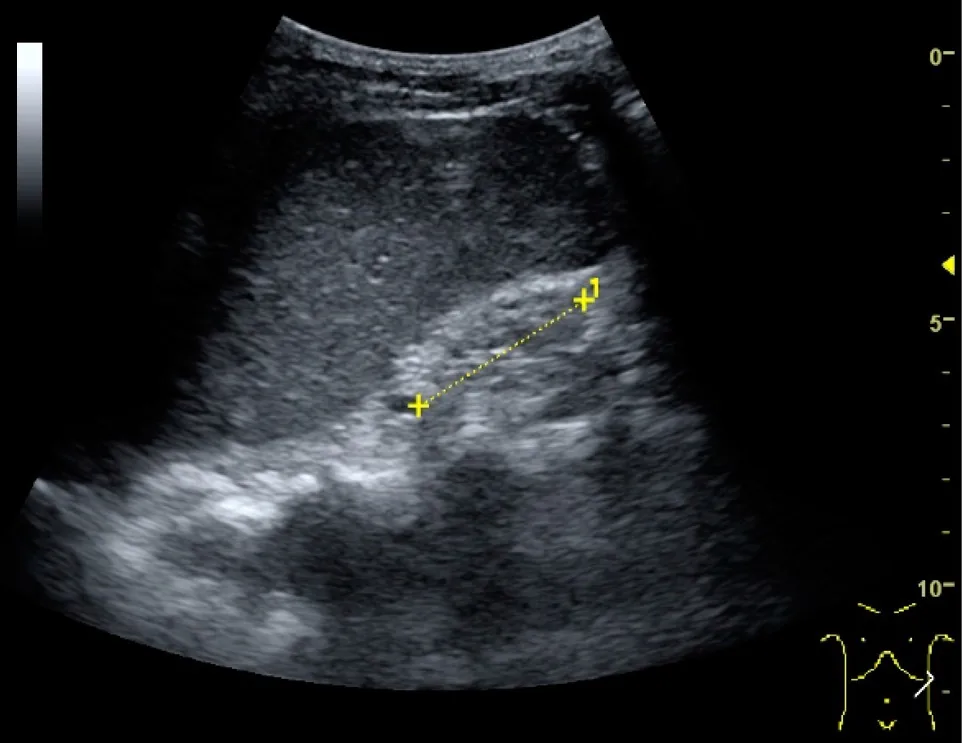 Ultrasound
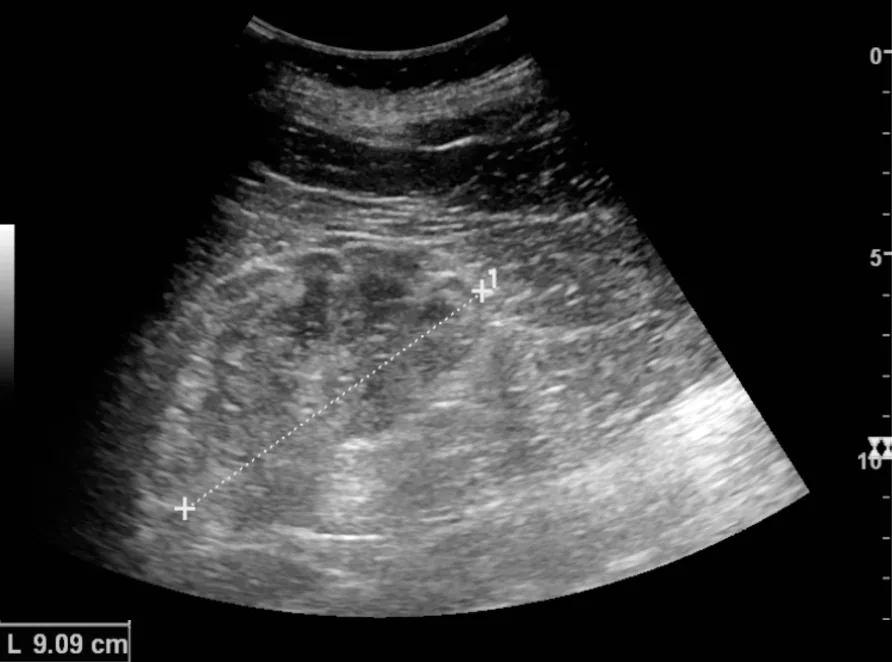 Ultrasound
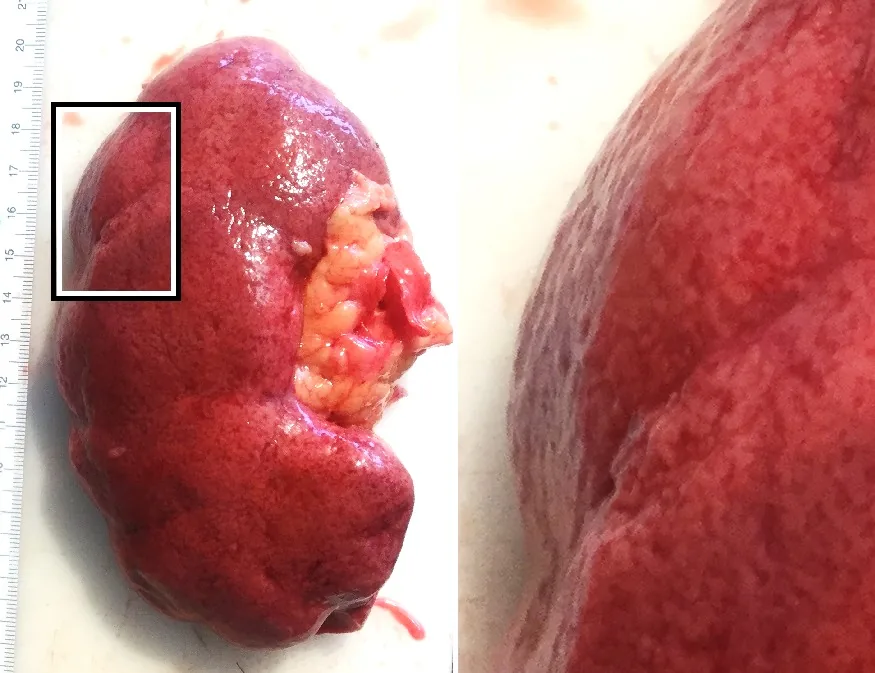 Gross specimen
Definition
Chronic kidney disease (CKD) is a disorder of kidney structure or function present for at least 3 months. The most reliable evidence is an eGFR < 60 mL/min/1.73 m² for ≥ 3 months; with a normal GFR, persistent markers of damage such as albuminuria, an abnormal urinary sediment or structural or hereditary kidney disease on imaging or histology are sufficient. The disease usually progresses slowly and may lead to kidney failure in its end stage.
Classification
GFR and albuminuria categories
Staging combines the GFR category (G) with the albuminuria category (A):
- G1: GFR ≥ 90 mL/min/1.73 m² with markers of damage
- G2: 60–89 mL/min/1.73 m²
- G3a: 45–59 mL/min/1.73 m²
- G3b: 30–44 mL/min/1.73 m²
- G4: 15–29 mL/min/1.73 m²
- G5: < 15 mL/min/1.73 m² (kidney failure)
- A1: albumin excretion < 30 mg/24 h (normal to mildly increased)
- A2: 30–300 mg/24 h (moderately increased, formerly microalbuminuria)
- A3: > 300 mg/24 h (severely increased)
Occurrence & epidemiology
CKD is common: in the United States, its prevalence in adults (eGFR < 60 mL/min/1.73 m² or albumin-to-creatinine ratio ≥ 30 mg/g) was recently estimated at about 14%. The most common causes are diabetic nephropathy and hypertensive nephrosclerosis, followed by primary and secondary glomerulopathies.
Aetiopathogenesis
Causes and pathophysiology
Other causes include chronic tubulointerstitial nephritis, hereditary diseases (polycystic kidney disease, Alport syndrome), chronic urinary tract obstruction and vesicoureteral reflux, and renal artery stenosis. Metabolic syndrome with hypertension and type 2 diabetes is of growing importance.
Pathophysiologically, the remaining nephrons initially compensate for the loss of function, so that few abnormalities are noticeable for a long time. The ability to concentrate urine is lost early, later the excretion of phosphate, acid and potassium. Reduced calcitriol production and phosphate retention lead to secondary hyperparathyroidism and renal osteodystrophy; erythropoietin deficiency causes renal anemia.
Clinical features
Early stages are usually asymptomatic. Nocturia is common, mainly due to the declining ability to concentrate urine. Fatigue, lassitude, anorexia and decreased mental acuity are often the earliest signs of uremia.
- Advanced CKD (eGFR < 15 mL/min/1.73 m²): nausea, vomiting, weight loss, stomatitis, unpleasant taste, pruritus, yellow-brown dry skin, muscle twitches and cramps, restless legs syndrome, peripheral neuropathy, seizures
- Cardiovascular: hypertension in > 80% in advanced stages, heart failure with edema and dyspnea, pericarditis
- Hematologic and metabolic: normochromic, normocytic anemia from stage G3, metabolic acidosis, hyperkalemia, calcium-phosphate disturbances, undernutrition
Diagnosis
- eGFR from creatinine (CKD-EPI 2021 equation, without a race coefficient), ideally combined with cystatin C; cystatin C is particularly helpful in unusual muscle mass
- Urine: albumin-to-creatinine or protein-to-creatinine ratio in a spot urine, urine sediment; broad and waxy casts are common in advanced renal failure
- Blood: electrolytes, urea, creatinine, calcium, phosphate, parathyroid hormone, blood count, blood gases (bicarbonate usually 15–20 mmol/L in moderate acidosis)
- Ultrasound: usually small kidneys (< 10 cm) with thinned, hyperechoic cortex; normal-sized or enlarged kidneys e.g. in diabetic nephropathy, polycystic kidney disease, amyloidosis or myeloma
- Kidney biopsy to determine the cause, not in small, fibrotic kidneys
Distinguishing CKD from acute kidney injury is important: findings favoring CKD are previously known impaired kidney function, small kidneys, subperiosteal erosions on radiographs and chronic symptoms such as pruritus, nocturia and hypertension.
Keep learning in the app
Further reading (open access)
Cross-references
More topics: Nephrology
- Acute kidney injury
- Nephrotic syndrome
- Nephritic syndrome and glomerulonephritis
- Acute interstitial nephritis
- Goodpasture syndrome (anti-GBM disease)
- Membranous nephropathy
- Renal artery stenosis
- Diabetic kidney disease
- Urinary tract infection and cystitis
- Acute pyelonephritis
- Autosomal dominant polycystic kidney disease (ADPKD)
- Hantavirus infection (nephropathia epidemica)
Note: Learning content for medical education – not a treatment recommendation and no substitute for diagnosis or treatment decisions in individual cases. Treatment and management are deliberately not covered on this page.