Osteoporosis
Board exam relevance: in 3 of 105 exam reports · rank 111- Synonyms
- bone loss, brittle bones, osteopenia, fragility fracture, vertebral compression fracture, postmenopausal osteoporosis
- Specialty
- Internal medicine · Endocrinology & diabetes
- Images
- CT 1
- Last updated
- 10/2026 · Dr. Pascal Bafteh
Contents
Images (1)
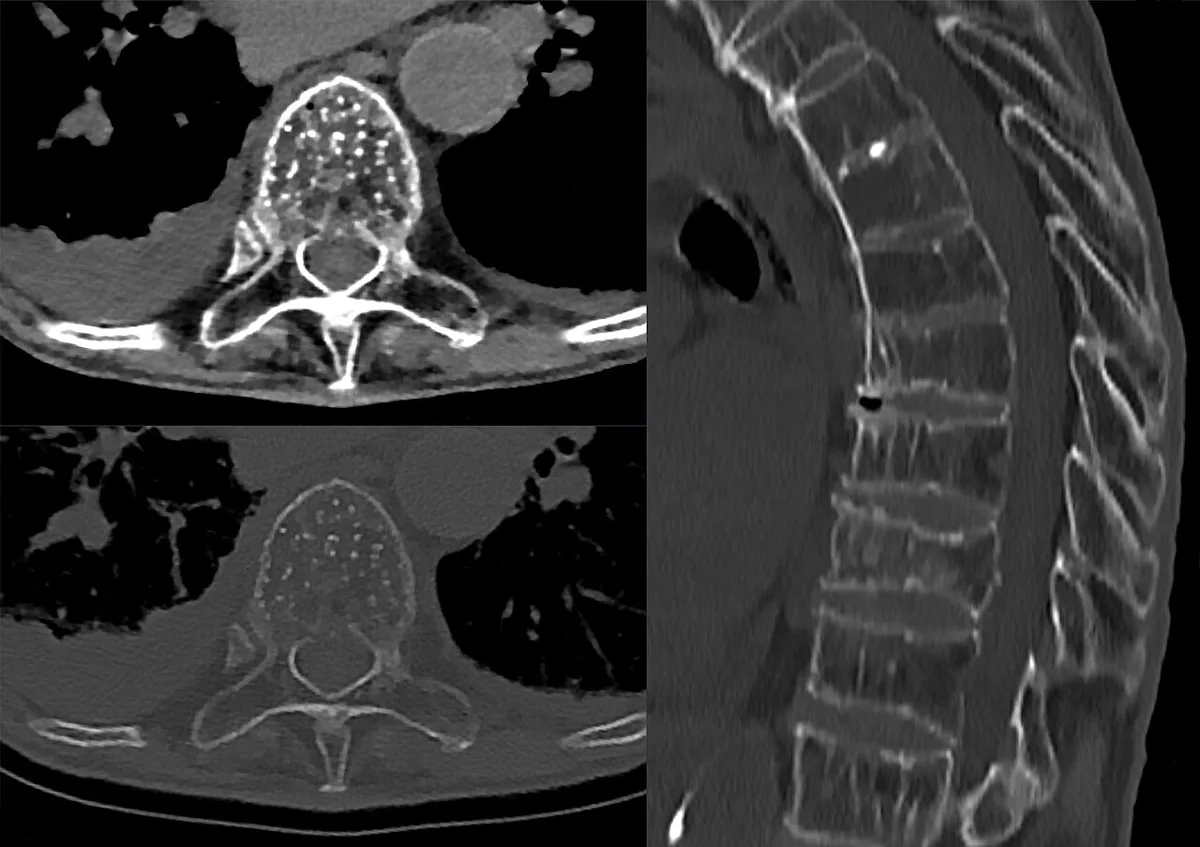 CT
CTDefinition
Osteoporosis is a progressive metabolic bone disease with reduced bone mineral density and deterioration of bone microarchitecture. The increased skeletal fragility leads to fragility fractures – fractures with minor or no recognizable trauma, such as a fall from standing height or out of bed. The diagnosis is based on bone densitometry (DXA) or on the presence of a fragility fracture, regardless of the measured value.
WHO classification (DXA)
- Normal: T-score ≥ -1.0.
- Osteopenia: T-score -1.0 to -2.5.
- Osteoporosis: T-score ≤ -2.5 at lumbar spine, femoral neck, or total hip.
- Established osteoporosis: T-score ≤ -2.5 + low-trauma fracture.
- Z-score: used in men < 50 yr and premenopausal women.
Classification
- Primary osteoporosis: without an identifiable cause; accounts for nearly all cases, mainly in postmenopausal women and older men. It is called idiopathic in children, adolescents, premenopausal women and men under 50 with normal gonadal function and no secondary cause.
- Secondary osteoporosis: up to 30 % of cases in postmenopausal women, more than 50 % in premenopausal women and about 50–80 % in men.
- Causes of secondary osteoporosis: endocrine (Cushing's syndrome, hyperparathyroidism, hyperthyroidism, hypogonadism, hyperprolactinaemia, diabetes mellitus); chronic kidney and liver disease; malabsorption and celiac disease; rheumatoid arthritis; COPD; multiple myeloma and other cancers; immobilisation; hypercalciuria, hypophosphatasia, chronic hypophosphatemia, vitamin D deficiency; glucocorticoid-induced and other drug-induced forms; alcohol and smoking.
Occurrence & epidemiology
Peak bone mass is reached at about 30 years of age in both women and men; men have a higher bone mass. It then remains stable for about ten years. With menopause, bone loss in women accelerates to about 2 % per year for about ten years. Vertebral compression fractures are the most common osteoporotic fractures; about two thirds are asymptomatic.
Aetiopathogenesis
Normally, bone formation by osteoblasts and bone resorption by osteoclasts are balanced; they are regulated by parathyroid hormone, calcitonin, estrogen, vitamin D and cytokines, among others. In osteoporosis resorption usually predominates: cytokines such as RANKL promote maturation of active osteoclasts, while the number and activity of osteoblasts decline with age, partly mediated by increased sclerostin. Cortical and trabecular bone become thinner; trabecular bone loses substance faster because of its higher turnover.
Risk factors: gonadal insufficiency, low body mass index, immobilisation and inactivity, low intake of calcium, phosphate, magnesium and vitamin D, smoking, alcohol, family history (especially a parental hip fracture) and a previous fragility fracture.
Clinical features
Without a fracture, osteoporosis causes no symptoms.
- Typical fracture sites: thoracic and lumbar vertebrae, femoral neck, greater trochanter, distal radius, as well as the proximal humerus and pelvis. Fractures of the nose, ribs, clavicle, patella and metatarsals are not considered typical of osteoporosis.
- Symptomatic vertebral fracture: acute onset of usually non-radiating pain, aggravated by weight bearing, with local spinal tenderness; it typically begins to subside after about a week, and residual pain may last for months.
- Consequences of multiple thoracic fractures: dorsal kyphosis with exaggerated cervical lordosis, height loss, chronic dull back pain; because of reduced thoracic and abdominal volume, shortness of breath and early satiety.
Diagnosis
Bone density and imaging
- DXA: measurement at the lumbar spine and hip; the T-score compares with the peak bone mass of healthy young adults of the same sex. The Z-score compares with people of the same age and is used in children, premenopausal women and men under 50; a Z-score of -2.0 or lower is considered low for age and points to secondary causes. The distal radius is measured when the spine or hip cannot be assessed (e.g. after joint replacement) and in hyperparathyroidism. Marked osteoarthritis can make density appear falsely high.
- Vertebral fracture assessment (VFA): detection of vertebral deformities during DXA; particularly informative with a height loss of 3 cm or more.
- Radiography: reduced radiodensity and loss of trabecular pattern are not sufficient for diagnosis but document fractures: loss of vertebral height, increased biconcavity or anterior wedging. Osteoporotic vertebral fractures are usually mid-thoracic; fractures above this level suggest malignancy or trauma.
- FRAX: estimates from bone density and clinical risk factors the 10-year probability of a hip fracture and a major osteoporotic fracture (hip, spine, forearm, humerus).
Laboratory tests for secondary causes
- serum calcium, magnesium and phosphate
- 25-OH vitamin D
- liver tests including alkaline phosphatase (low in hypophosphatasia)
- intact parathyroid hormone (hyperparathyroidism)
- testosterone in men (hypogonadism)
- 24-hour urinary calcium and creatinine (hypercalciuria)
- depending on the clinical picture TSH and free T4, 24-hour urinary free cortisol, blood count, serum and urine protein electrophoresis and free light chains (myeloma), evaluation for malabsorption and celiac disease
- bone turnover markers (C-terminal or N-terminal telopeptides as resorption markers): measured fasting in the morning; raised levels may indicate a higher fracture risk
- bone biopsy only in exceptional cases, e.g. young people with unexplained fragility fractures or to distinguish osteomalacia
Keep learning in the app
Further reading (open access)
Cross-references
Note: Learning content for medical education – not a treatment recommendation and no substitute for diagnosis or treatment decisions in individual cases. Treatment and management are deliberately not covered on this page.