Cushing's syndrome
Board exam relevance: in 4 of 105 exam reports · rank 90- Synonyms
- hypercortisolism, Cushing's disease, cortisol excess, moon face, ectopic ACTH syndrome, Cushing syndrome
- Specialty
- Internal medicine · Endocrinology & diabetes
- Images
- Clinical 2
- Last updated
- 10/2026 · Dr. Pascal Bafteh
Contents
Images (2)
Definition
Cushing's syndrome is the clinical picture of chronic glucocorticoid excess (cortisol or related substances), regardless of cause. Cushing's disease is the specific form in which a pituitary tumor – almost always a small adenoma – produces excess ACTH and thereby overstimulates both adrenal cortices. Typical features are a moon face, truncal obesity, easy bruising and thin arms and legs.
Classification
ACTH-dependent:
- Cushing's disease (pituitary ACTH hypersecretion)
- ectopic ACTH syndrome due to a tumor outside the pituitary, e.g. small cell lung cancer or a neuroendocrine tumor
- exogenous ACTH
ACTH-independent:
- glucocorticoid-induced (exogenous) Cushing's syndrome
- adrenocortical adenoma or carcinoma
- rarely primary pigmented nodular adrenal dysplasia (usually in adolescents) and bilateral macronodular hyperplasia (in older adults)
Aetiopathogenesis
Cortisol excess has catabolic effects on muscle, skin and bone and promotes fat redistribution, glucose intolerance and hypertension. In ACTH-dependent Cushing's syndrome, ACTH drives cortisol production in both adrenals; in ACTH-independent Cushing's syndrome the adrenal produces cortisol autonomously and ACTH is suppressed. Adrenal tumors may additionally produce excess androgens.
Clinical features
- Face and fat distribution: round moon face with plethora, truncal obesity with supraclavicular and dorsocervical fat pads ("buffalo hump"), usually very slender arms, legs and fingers.
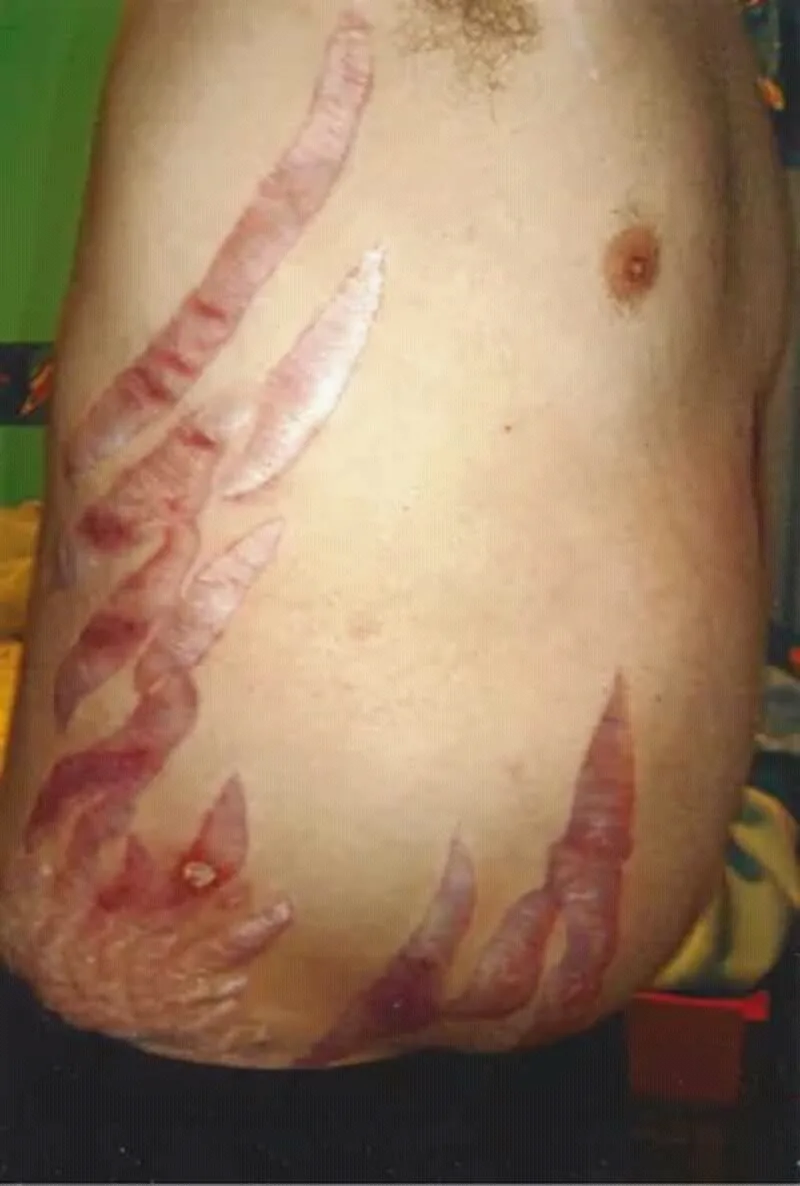
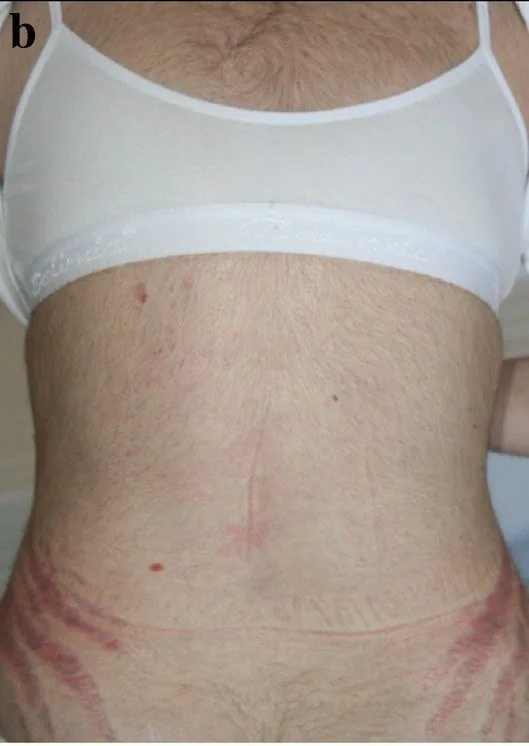
- Skin: thin, atrophic skin, striae (especially on the abdomen), poor wound healing, easy bruising.
- Muscle and bone: muscle wasting and weakness, osteoporosis.
- Metabolism and circulation: arterial hypertension, glucose intolerance, kidney stones.
- Other findings: increased susceptibility to infection, mental disturbances; growth arrest in children.
- Gonads: menstrual irregularities in most women; in adrenal tumors with androgen excess, hirsutism, temporal balding and other signs of virilisation.
Diagnosis
Confirming hypercortisolism
- 24-hour urinary free cortisol: above 331 nmol/24 h in almost all patients. Values between 276 and 414 nmol/24 h also occur with obesity, depression or polycystic ovaries. More than four times the upper limit of normal almost certainly indicates Cushing's syndrome; two to three normal collections usually exclude it.
- Overnight dexamethasone suppression test: in most people without Cushing's syndrome morning serum cortisol falls below 1.8 µg/dl (50 nmol/l), in Cushing's syndrome virtually never. The two-day dexamethasone suppression test is more specific with equal sensitivity.
- Midnight serum or salivary cortisol: normally serum cortisol is 5–25 µg/dl (138–690 nmol/l) in the early morning and falls below 1.8 µg/dl (50 nmol/l) by midnight. In Cushing's syndrome this diurnal rhythm is lost; several saliva samples are collected.
- Pitfall: raised cortisol-binding globulin (congenital or hormone-related) increases serum cortisol, but the diurnal rhythm is preserved.
Determining the cause
- Plasma ACTH: undetectable with an adrenal cause; high with a pituitary or ectopic source.
- Desmopressin test: ACTH and cortisol rise in most patients with Cushing's disease but very rarely in ectopic ACTH syndrome. The CRH test shows a similar pattern but is hardly available.
- Bilateral inferior petrosal sinus sampling: the most accurate but invasive localisation method; a central-to-peripheral ACTH ratio above 3 virtually excludes an ectopic source, a ratio below 3 calls for a search for one. Particularly helpful in children, whose pituitary tumors are often too small to be seen on MRI.
Imaging
- Pituitary: contrast-enhanced MRI (gadolinium) is the most accurate method; some microadenomas are also visible on CT. MRI is preferred in pregnancy.
- Adrenals: high-resolution CT.
- Search for an ectopic ACTH source: high-resolution CT of the chest and pancreas, receptor PET with gallium-68 DOTATATE, occasionally FDG-PET.
Keep learning in the app
Further reading (open access)
Cross-references
More topics: Endocrinology & diabetes
Note: Learning content for medical education – not a treatment recommendation and no substitute for diagnosis or treatment decisions in individual cases. Treatment and management are deliberately not covered on this page.