Hyperthyroidism
Board exam relevance: in 8 of 105 exam reports · rank 39- Synonyms
- overactive thyroid, thyrotoxicosis, subclinical hyperthyroidism, toxic nodular goiter, hot nodule
- Specialty
- Internal medicine · Endocrinology & diabetes
- Images
- Scintigraphy 1 · Histology 1
- Last updated
- 10/2026 · Dr. Pascal Bafteh
Contents
Images (2)
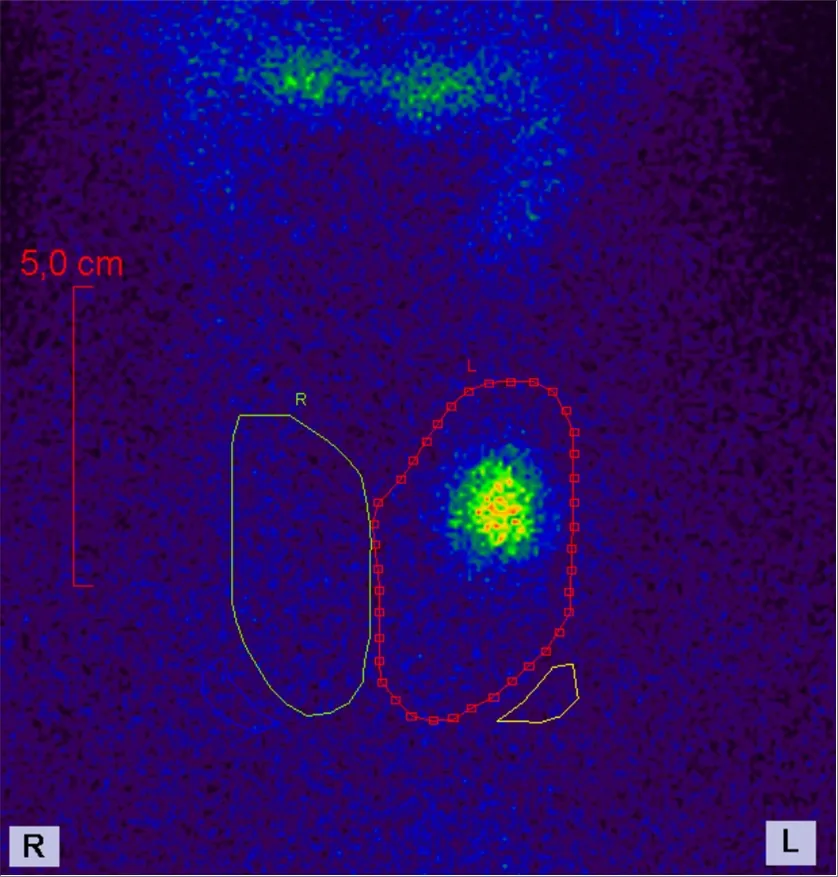 Scintigraphy
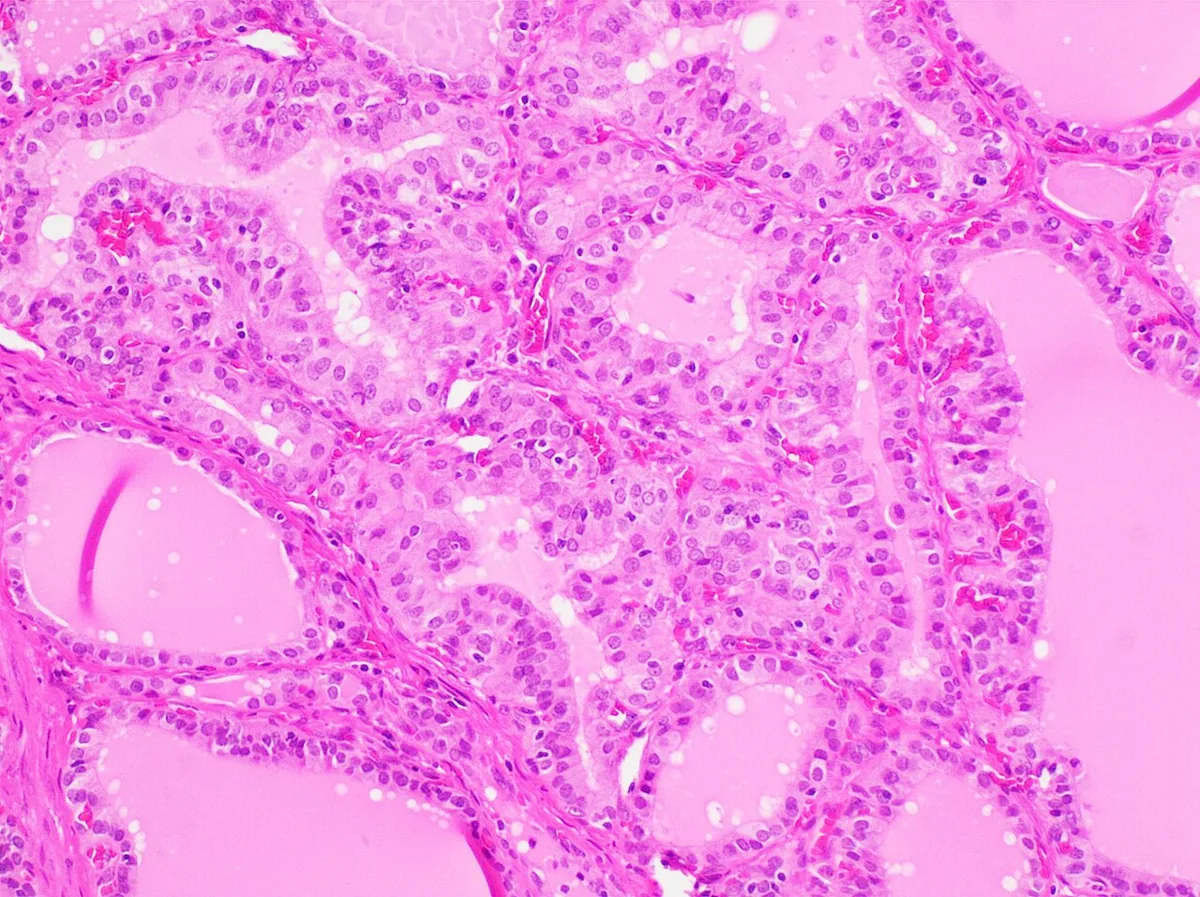 Histology
Definition
Hyperthyroidism is overactivity of the thyroid gland with elevated levels of free thyroid hormones (fT4, fT3) and an increased metabolic rate. In the overt form, TSH is suppressed and fT4 and/or fT3 are raised; in the subclinical form, TSH is low with normal peripheral hormones. The umbrella term thyrotoxicosis covers any hormone excess, including excess without increased hormone synthesis.
Classification
By mechanism and thyroid radioactive iodine uptake, the following can be distinguished:
- Increased hormone synthesis (uptake high): Graves' disease with stimulating TSH receptor antibodies (diffuse uptake), toxic adenoma and toxic multinodular goiter (focal uptake), rarely TSH-secreting pituitary adenoma and hCG-mediated forms.
- Release of stored hormone (uptake low): thyroiditis (subacute granulomatous, Hashimoto's, silent lymphocytic thyroiditis), usually followed by a hypothyroid phase.
- Iodine excess (uptake low): e.g. after iodinated contrast media or iodine-containing medicines, particularly with pre-existing nodular goiter.
- Exogenous intake: thyrotoxicosis factitia due to ingestion of thyroid hormone.
- T3 toxicosis: only T3 is raised; possible with any of the common causes.
Occurrence & epidemiology
In the United States, about 1 % of the population is affected. Hyperthyroidism can occur at any age but is more common in women between 20 and 50 years of age. Risk factors are female sex, older age and smoking.
Aetiopathogenesis
Other causes include hCG-producing conditions (hydatidiform mole, choriocarcinoma, hyperemesis gravidarum; in the first trimester TSH is physiologically low), struma ovarii, rarely hormone-producing metastases of follicular thyroid cancer, and drug-induced forms (e.g. caused by certain immunomodulatory and cancer drugs).
Pathophysiology: T3 usually rises more than T4, because more T3 is secreted and T4 is converted to T3 peripherally. Many symptoms are due to enhanced sensitivity to adrenergic stimuli.
Clinical features
- General: nervousness, restlessness, insomnia, heat intolerance, increased sweating, fatigue, weight loss despite increased appetite, frequent bowel movements up to diarrhea, hypomenorrhea
- Cardiovascular: palpitations, resting tachycardia, widened pulse pressure with systolic hypertension, atrial fibrillation, heart failure
- Skin and appendages: warm, moist skin, fine hair, onycholysis
- Neuromuscular: fine tremor, brisk reflexes, proximal muscle weakness
- Eyes: stare, lid retraction and lid lag caused by adrenergic stimulation; thyroid eye disease and pretibial myxedema occur only in Graves' disease
- Older people: often an "apathetic" form resembling depression or dementia, with atrial fibrillation, syncope and weakness, frequently without tremor
- Thyroid storm as a life-threatening exacerbation
Diagnosis
Laboratory patterns
- Overt hyperthyroidism: TSH ↓ + fT3/fT4 ↑.
- Subclinical hyperthyroidism: TSH suppressed + fT3/fT4 normal.
- TSH in 1st trimester: physiologically suppressed (β-hCG).
- Implication: no premature hyperthyroidism diagnosis.
- TSH is the best screening test; it is suppressed except in TSH-secreting pituitary adenoma or pituitary insensitivity to thyroid hormone.
- fT4 and fT3: if TSH is low and fT4 normal, T3 is measured (T3 toxicosis). In severe systemic illness, fT4 can be falsely normal.
- Antibodies: TSH receptor antibodies (TRAb) point to Graves' disease; TPO antibodies are common but nonspecific.
- Ultrasound with Doppler: size, echotexture, nodules and blood flow of the thyroid.
- Scintigraphy or radioactive iodine uptake: diffusely increased in Graves' disease, focal in autonomy, low in thyroiditis, iodine excess or exogenous intake.
- Thyroglobulin: low to low-normal in thyrotoxicosis factitia, unlike all other causes.
- Examination: pulse and rhythm (ECG), thyroid size, nodules, tenderness (thyroiditis) and bruit (Graves' disease).
Keep learning in the app
Further reading (open access)
Cross-references
More topics: Endocrinology & diabetes
Note: Learning content for medical education – not a treatment recommendation and no substitute for diagnosis or treatment decisions in individual cases. Treatment and management are deliberately not covered on this page.