Lynch syndrome (HNPCC)
- Synonyms
- HNPCC, hereditary nonpolyposis colorectal cancer, hereditary colon cancer, mismatch repair deficiency, microsatellite instability
- Specialty
- Internal medicine · Gastroenterology
- Images
- Histology 1
- Last updated
- 10/2026 · Dr. Pascal Bafteh
Contents
Images (1)
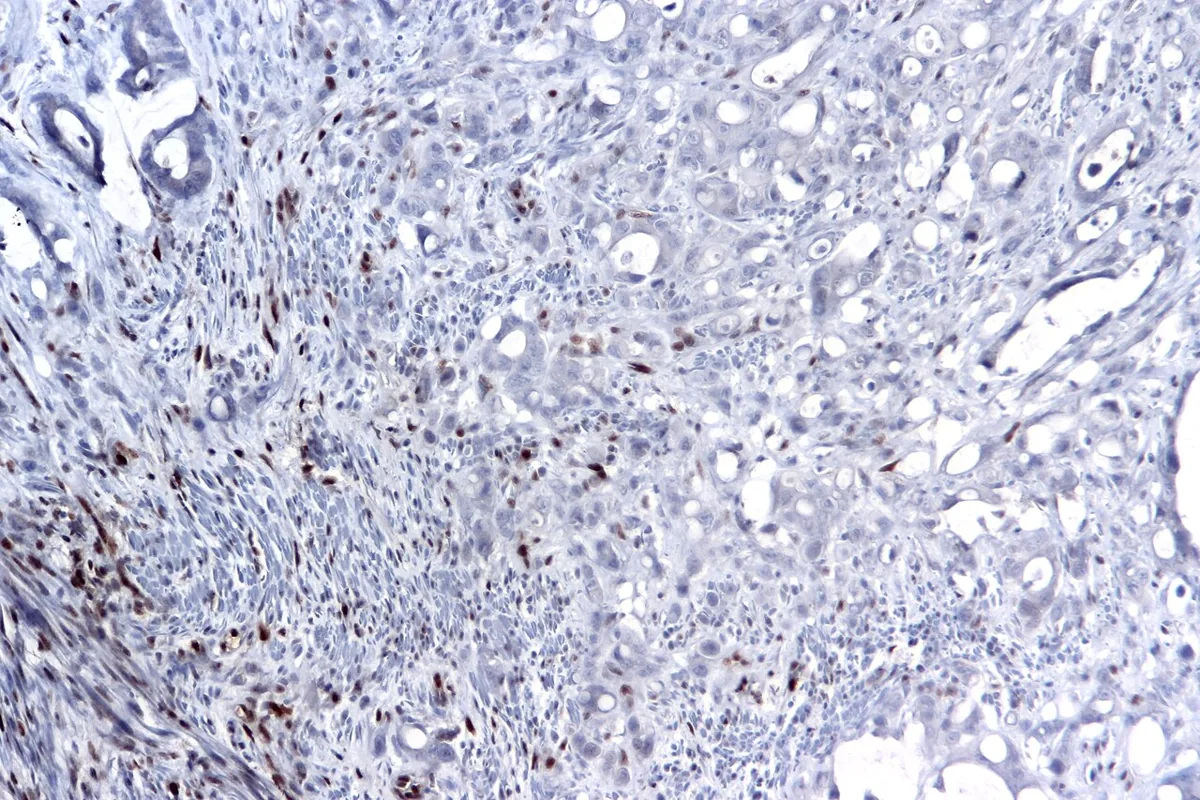 Histology
Definition
Lynch syndrome is an autosomal dominant disorder in which one of several known genetic mutations impairs DNA mismatch repair. Besides familial adenomatous polyposis, it is the main hereditary form of colorectal cancer and also increases the risk of numerous other cancers, especially of the endometrium and ovaries. Its former name is HNPCC (hereditary non-polyposis colorectal cancer).
Occurrence & epidemiology
Lynch syndrome is responsible for 2–3% of colorectal cancers. The lifetime risk of colorectal cancer is 70–80%. Compared with sporadic colon cancer, affected individuals are younger, on average in their mid-40s.
Aetiopathogenesis
Genetics and tumor spectrum
- Genetics: autosomal dominant germline variant in a mismatch repair gene (MLH1, MSH2, MSH6, PMS2); deletions in the EPCAM gene epigenetically silence MSH2
- Tumor spectrum: colon and rectum, endometrium, ovary, stomach, urothelium (ureter, renal pelvis) and others
Because mismatch repair fails, mismatches during DNA replication are no longer corrected; in tumor tissue this appears as microsatellite instability (MSI) or as loss of mismatch repair proteins on immunohistochemistry. The precursor is usually a single colonic adenoma – unlike the numerous adenomas in familial adenomatous polyposis.
Clinical features
- Colorectal cancer: younger age at onset, more often proximal to the splenic flexure; symptoms as in other colorectal cancers
- Endometrial cancer: risk by age 70 about 39%
- Ovarian cancer: risk by age 70 about 9%
- other cancers: stomach, urinary tract, pancreas, biliary tree and gallbladder, small bowel and brain
- Skin: café-au-lait spots, sebaceous gland tumors and keratoacanthomas
Diagnosis
Unlike familial adenomatous polyposis, Lynch syndrome has no typical phenotype. Suspicion arises mainly from a detailed family history, especially in younger patients with colorectal cancer.
Amsterdam II criteria (all present):
- at least three family members with Lynch-associated cancers (colon/rectum, endometrium, small bowel, urothelium of the ureter or renal pelvis), one of them a first-degree relative of the other two
- at least two successive generations affected
- at least one affected person younger than 50 years at diagnosis; familial adenomatous polyposis excluded
Prediction models (e.g. PREMM5) and the Bethesda criteria are also used.
Tumor tissue: colorectal adenocarcinomas are now routinely tested by immunohistochemistry for mismatch repair protein deficiency or for microsatellite instability.
Germline testing: if immunohistochemistry or MSI testing is abnormal, genetic testing for the specific Lynch mutations confirms the diagnosis. First-degree relatives are also tested genetically.
Keep learning in the app
Further reading (open access)
- MSD Manual Professional: Lynch Syndrome
- MSD Manual Professional: Colorectal Cancer
- StatPearls: Hereditary Nonpolyposis Colon Cancer (Lynch Syndrome)
- Leitlinienprogramm Onkologie/DGVS: S3-Leitlinie Kolorektales Karzinom (Anhang Amsterdam- und Bethesda-Kriterien)
- NCI PDQ: Genetics of Colorectal Cancer (Health Professional Version)
Cross-references
More topics: Gastroenterology
Note: Learning content for medical education – not a treatment recommendation and no substitute for diagnosis or treatment decisions in individual cases. Treatment and management are deliberately not covered on this page.