Hypoparathyroidism
- Synonyms
- underactive parathyroid, parathyroid hormone deficiency, postoperative hypoparathyroidism, pseudohypoparathyroidism, Albright hereditary osteodystrophy
- Specialty
- Internal medicine · Endocrinology & diabetes
- Images
- CT 1
- Last updated
- 10/2026 · Dr. Pascal Bafteh
Contents
Images (1)
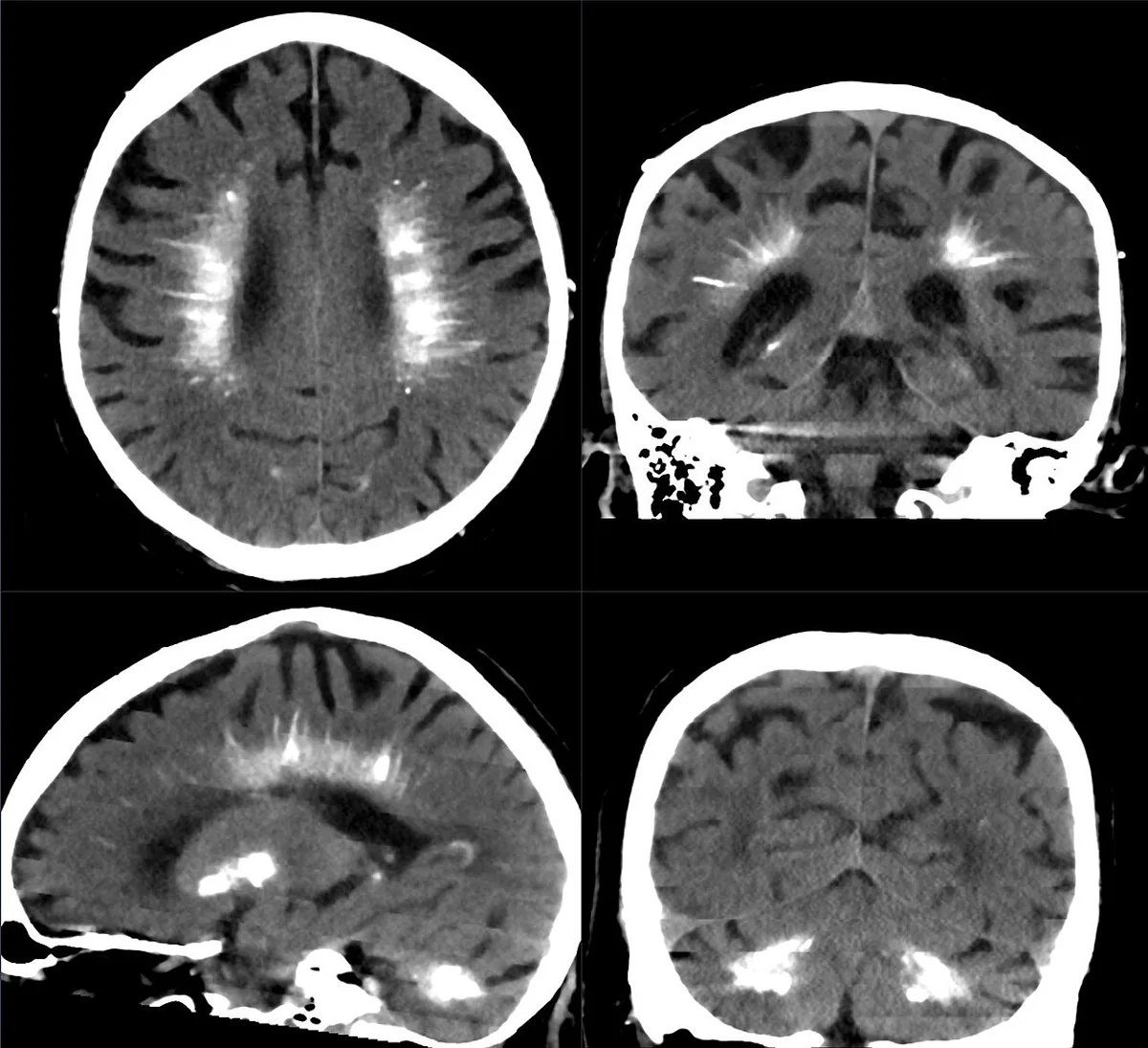 CT
CTDefinition
Hypoparathyroidism is a deficiency of parathyroid hormone (PTH). It causes hypocalcemia and hyperphosphatemia and often leads to chronic tetany.
It is distinguished from pseudohypoparathyroidism, a rare group of inherited disorders with end-organ unresponsiveness to PTH; PTH is not reduced but raised.
Hypocalcemia is defined as a total calcium below 8.8 mg/dl (2.20 mmol/l) with normal plasma proteins or an ionised calcium below 4.7 mg/dl (1.17 mmol/l).
Classification
Causes
- Postoperative: damage to several parathyroid glands after surgery on the thyroid or parathyroids. Transient hypoparathyroidism is common afterwards, permanent hypoparathyroidism is rare. It is more frequent after surgery for thyroid cancer and after surgery on the parathyroids themselves.
- Autoimmune: isolated or as part of a polyglandular autoimmune syndrome, also together with mucocutaneous candidiasis.
- Congenital or idiopathic: absent or atrophic parathyroid glands, manifesting in childhood; e.g. DiGeorge syndrome with thymic aplasia or an X-linked recessive form.
- Functional: severe magnesium depletion (usually below 1.0 mg/dl, equivalent to about 0.4 mmol/l) causes relative PTH deficiency and reduced PTH action.
- Pseudohypoparathyroidism: type Ia (Albright hereditary osteodystrophy, GNAS1 mutation), type Ib (without physical abnormalities) and type II; a paternally inherited GNAS1 mutation without hypocalcemia is called pseudopseudohypoparathyroidism.
Aetiopathogenesis
PTH normally raises serum calcium and renal phosphate excretion. Without PTH, calcium falls and phosphate rises. In pseudohypoparathyroidism type Ia a GNAS1 mutation disrupts the stimulatory G protein of the adenylyl cyclase complex: the kidney responds to PTH neither with increased phosphate excretion nor with a rise in urinary cAMP. Because only the maternal GNAS1 allele is expressed in the kidney, carriers of a paternally inherited mutation do not develop hypocalcemia.
Clinical features
- Neuromuscular hyperexcitability: tingling in the hands and around the mouth, muscle cramps, in severe cases tetany with carpopedal spasm.
- Severe hypocalcemia (calcium below 7 mg/dl or 1.75 mmol/l): hyperreflexia, laryngospasm, generalised seizures; occasionally papilledema.
- Timing after surgery: symptoms usually begin 24–48 hours postoperatively, occasionally only after months or years.
- Chronic hypocalcemia: dry, scaly skin, brittle nails, coarse hair, cataracts; Candida infections mainly in idiopathic hypoparathyroidism.
- Pseudohypoparathyroidism type Ia: short stature, round face, shortened metacarpal and metatarsal bones (especially I, IV and V), intellectual disability, basal ganglia calcification, sometimes vitiligo.
Diagnosis
- Clinical signs of latent tetany: Chvostek sign (twitching of the facial muscles on tapping the facial nerve in front of the external auditory meatus; positive in up to 10 % of healthy people and often absent in chronic hypocalcemia) and Trousseau sign (carpal spasm when a blood pressure cuff is inflated to 20 mmHg above systolic pressure on the arm for 3 minutes; also present in about 6 % without an electrolyte disturbance).
- Calcium: low; in hypoalbuminemia total calcium is only apparently reduced – ionised or albumin-adjusted calcium is decisive.
- Intact PTH: low or inappropriately low-normal despite hypocalcemia; undetectable PTH suggests idiopathic hypoparathyroidism. A high PTH points to pseudohypoparathyroidism or a disorder of vitamin D metabolism.
- Other values: phosphate raised, alkaline phosphatase normal; magnesium, kidney function and vitamin D (25-OH and 1,25-(OH)2) to clarify the cause.
- Pseudohypoparathyroidism type I: despite high PTH no rise in urinary cAMP and phosphate, even after stimulation with PTH.
- ECG in severe hypocalcemia: prolonged QTc and ST intervals, repolarisation changes; occasionally arrhythmias or heart block.
Keep learning in the app
Further reading (open access)
Cross-references
Note: Learning content for medical education – not a treatment recommendation and no substitute for diagnosis or treatment decisions in individual cases. Treatment and management are deliberately not covered on this page.