Adrenal insufficiency (Addison's disease)
Board exam relevance: in 4 of 105 exam reports · rank 90- Synonyms
- Addison's disease, adrenal crisis, Addisonian crisis, cortisol deficiency, hypoadrenalism, adrenocortical insufficiency
- Specialty
- Internal medicine · Endocrinology & diabetes
- Images
- Clinical 2
- Last updated
- 10/2026 · Dr. Pascal Bafteh
Contents
Images (2)

Definition
In adrenal insufficiency the adrenal cortex produces too little hormone.
- Primary form (Addison's disease): the adrenal cortex itself is destroyed; both cortisol and aldosterone are deficient. ACTH is raised as a compensatory response.
- Secondary form: ACTH deficiency due to pituitary disease; mainly cortisol is lacking, while the renin–angiotensin–aldosterone system remains intact.
- Tertiary form: inadequate stimulation of the pituitary by the hypothalamus; clinically like the secondary form.
Adrenal crisis (Addisonian crisis) is the acute, life-threatening decompensation with circulatory collapse.
Occurrence & epidemiology
The prevalence of Addison's disease is highest in Europe (10–22 per 100,000 people) and lower in Asia. It occurs in all age groups and affects both sexes about equally. It often becomes clinically apparent only during physical stress, infection or trauma.
Aetiopathogenesis
Causes
Primary adrenal insufficiency:
- Autoimmune adrenalitis: by far the most common cause in Europe and the USA; often together with diabetes mellitus or hypothyroidism as part of a polyglandular autoimmune syndrome.
- Granulomatous destruction: tuberculosis, histoplasmosis.
- Other causes: metastases and other tumors, amyloidosis, hemorrhage, inflammatory necrosis; certain substances that block cortisol synthesis.
- In children: most commonly congenital adrenal hyperplasia; less often adrenoleukodystrophy.
Secondary adrenal insufficiency:
- hypopituitarism due to pituitary and other tumors (e.g. craniopharyngioma), granulomas, rarely infection or trauma
- isolated ACTH deficiency
- glucocorticoid-induced suppression of the hypothalamic–pituitary–adrenal axis, possible after more than four weeks of use and persisting for up to one year after it ends
Pathophysiology
- Aldosterone deficiency: increased sodium and reduced potassium excretion lead to hyponatremia, hyperkalemia, dehydration, hypovolaemia, acidosis and hypotension up to circulatory collapse.
- Cortisol deficiency: contributes to hypotension and causes reduced gluconeogenesis with hypoglycemia, weakness and poor tolerance of infection, trauma and stress.
- Hyperpigmentation: cortisol deficiency raises ACTH and beta-lipotropin, which have melanocyte-stimulating activity. Hyperpigmentation is absent in secondary insufficiency.
- Secondary form: electrolytes usually normal or only mildly deranged; any hyponatremia is then usually dilutional due to increased vasopressin secretion.
Polyglandular autoimmune syndromes
- Autoimmune polyglandular syndrome type 1 (APECED): mutations in the AIRE gene, autosomal recessive inheritance, usually beginning in childhood; defined by at least two of three components: chronic mucocutaneous candidiasis, hypoparathyroidism and adrenal insufficiency.
- Autoimmune polyglandular syndrome type 2 (Schmidt syndrome): usually in adults, about three times more common in women; typically adrenal insufficiency combined with hypothyroidism or hyperthyroidism and type 1 diabetes.
Clinical features
Chronic insufficiency
- Early symptoms: weakness, fatigue and orthostatic hypotension.
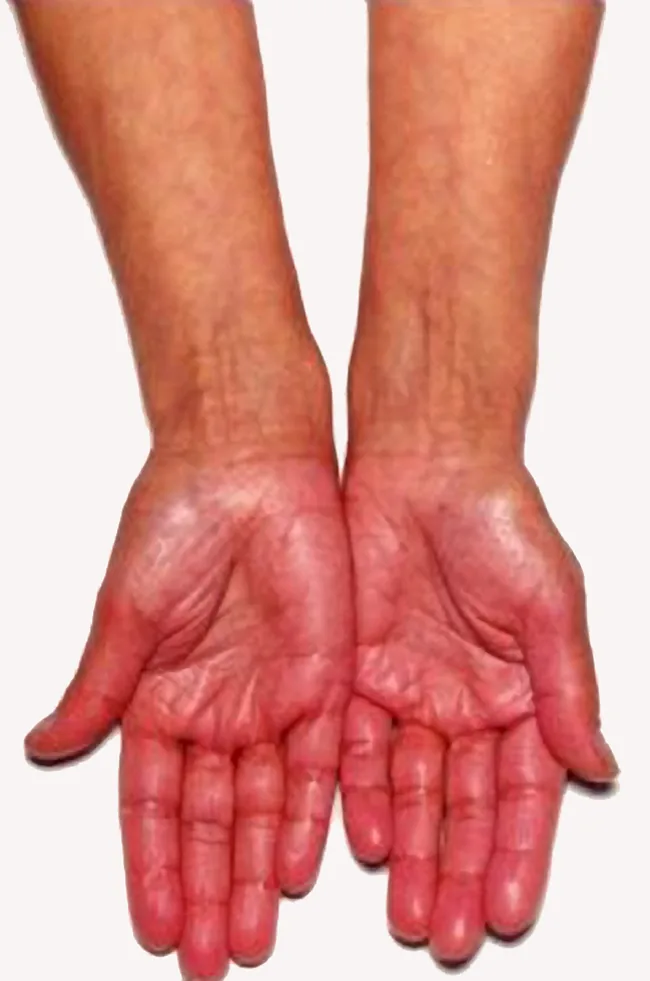
- Hyperpigmentation (primary only): diffuse darkening of sun-exposed and, to a lesser extent, unexposed skin, accentuated at pressure points, skin folds, palmar creases, scars and extensor surfaces; black freckles on the forehead, face, neck and shoulders; bluish-black patches on the areolae and mucous membranes of the lips, mouth, rectum and vagina. Some patients also have vitiligo.
- Gastrointestinal: anorexia, nausea, vomiting, diarrhea.
- Other signs: cold intolerance, dizziness and syncope; in later stages weight loss, dehydration and hypotension.
- Because of the insidious onset and non-specific early symptoms, the disease is often initially misdiagnosed.
- Secondary form: no hyperpigmentation, less hypovolaemia; with hypopituitarism additional signs of hypothyroidism and hypogonadism, sometimes hypoglycemia.
Adrenal crisis
- profound weakness
- severe pain in the abdomen, lower back or legs
- peripheral circulatory collapse (shock)
- acute kidney failure with azotaemia
- low body temperature or – particularly when triggered by infection – high fever
Triggers are mainly acute infections, as well as trauma, the period after major surgery and sodium loss through heavy sweating. With partial loss of adrenal function, shock and fever under stress may be the only signs.
Diagnosis
Clues in routine tests (primary form)
- sodium below 135 mmol/l, potassium above 5 mmol/l, sodium-to-potassium ratio below 30:1
- low fasting glucose (below 2.8 mmol/l), low bicarbonate, raised urea
- raised hematocrit, low white cell count, relative lymphocytosis, eosinophilia
Hormone tests and imaging
- Morning serum cortisol and plasma ACTH: ACTH of 50 pg/ml (11 pmol/l) or more with cortisol below 5 µg/dl (138 nmol/l) is diagnostic of primary insufficiency. Low ACTH (below 5 pg/ml or 1.1 pmol/l) with low cortisol suggests secondary insufficiency. A very low cortisol requires further evaluation even when ACTH is normal.
- ACTH stimulation test: cortisol before and 30 and 60 minutes after synthetic ACTH. A peak below 18 µg/dl (500 nmol/l) makes insufficiency likely; the exact threshold depends on the assay. In recent-onset ACTH deficiency the test may still be normal during the first 2–4 weeks because the adrenals have not yet atrophied.
- Primary or secondary: in the prolonged ACTH test cortisol continues to rise over 24 hours in secondary or tertiary insufficiency, but not in primary insufficiency. The glucagon test and hypoglycemia provocation tests are also used to assess the pituitary–adrenal axis.
- In the primary form: aldosterone low, renin raised; adrenal autoantibodies (21-hydroxylase) often positive initially in autoimmune disease.
- Imaging: chest X-ray if tuberculosis is suspected; CT or MRI of the adrenals – atrophic in autoimmune adrenalitis, initially enlarged and often calcified in tuberculosis and other granulomas, hemorrhage usually clearly visible. Bilateral hyperplasia in children and young adults suggests an enzyme defect. In the secondary form, MRI or CT of the sellar region.
Keep learning in the app
Further reading (open access)
- MSD Manual Professional: Primary Adrenal Insufficiency (Addison Disease)
- MSD Manual Professional: Secondary Adrenal Insufficiency
- MSD Manual Professional: Generalized Hypopituitarism
- Endocrine Society Clinical Practice Guideline 2016: Diagnosis of Primary Adrenal Insufficiency (PMC)
- MSD Manual Professional: Polyglandular Deficiency Syndromes
Cross-references
Note: Learning content for medical education – not a treatment recommendation and no substitute for diagnosis or treatment decisions in individual cases. Treatment and management are deliberately not covered on this page.