Dengue fever
Board exam relevance: in 1 of 105 exam reports · rank 181- Synonyms
- dengue, breakbone fever, dengue virus, dengue hemorrhagic fever, severe dengue
- Specialty
- Internal medicine · Infectious diseases
- Images
- Clinical 2
- Last updated
- 10/2026 · Dr. Pascal Bafteh
Contents
Images (2)
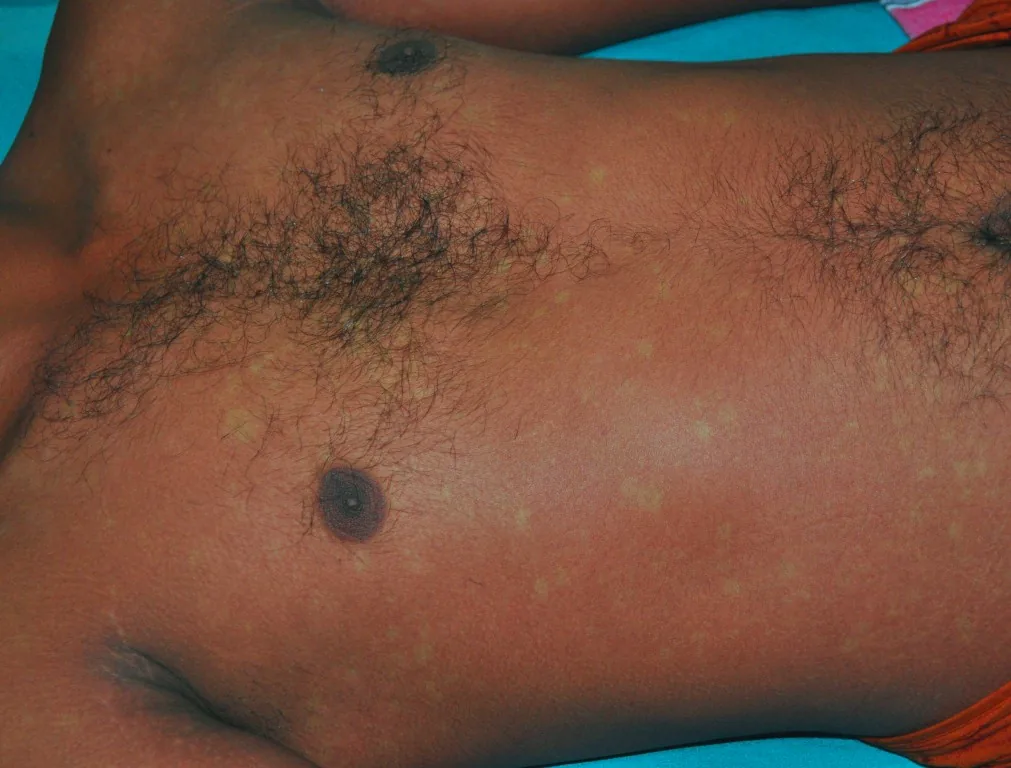
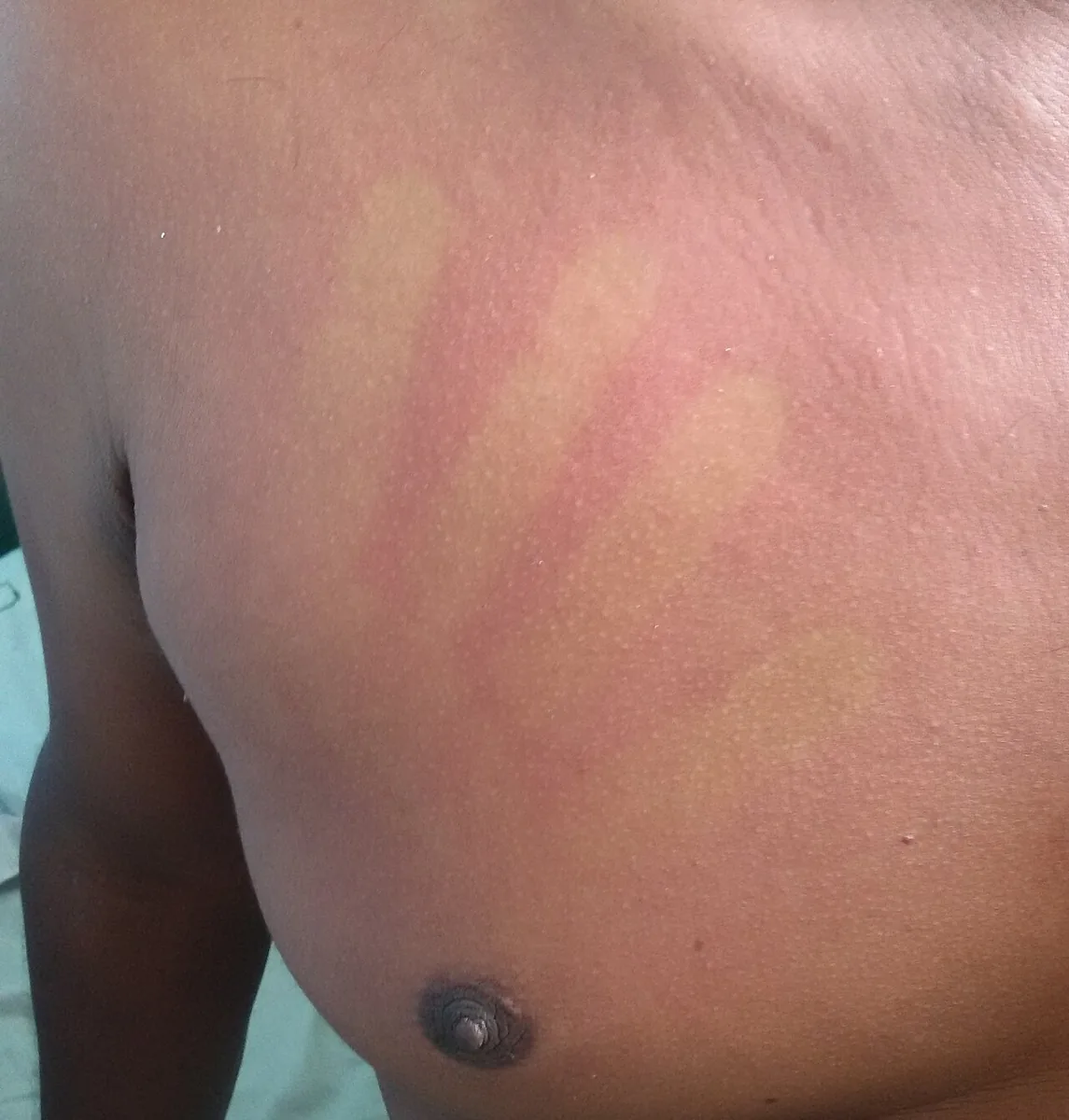
Definition
Dengue fever is a viral infection with dengue virus (flavivirus, four serotypes) transmitted by mosquitoes of the genus Aedes. Most infections are asymptomatic or mild. Typical features are sudden high fever, severe headache, eye, muscle and joint pain ("breakbone fever") and a rash. Rarely, severe dengue develops with plasma leakage, bleeding tendency and shock.
Classification
- Revised WHO classification (2009): dengue without warning signs, dengue with warning signs and severe dengue.
- Warning signs (mostly during the critical phase, about days 4–7): abdominal pain or tenderness, persistent vomiting, fluid accumulation, mucosal bleeding, lethargy or restlessness, liver enlargement, rising hematocrit with a simultaneous fall in platelet count.
- Severe dengue: severe plasma leakage, severe bleeding or organ failure.
- Former WHO classification: classic dengue fever, dengue hemorrhagic fever (fall in platelet count, plasma leakage and bleeding) and dengue shock syndrome (additionally circulatory shock).
Occurrence & epidemiology
- Endemic in more than 100 countries in Africa, the Americas, the Eastern Mediterranean, Southeast Asia and the Western Pacific, mainly in the tropics between about 35° north and 35° south latitude.
- Cases reported to WHO rose from about 505,000 in 2000 to 14.6 million in 2024, the highest figure so far; over 13 million of these came from the Americas. Because most infections are asymptomatic or mild, the true number is far higher; modeling estimates about 390 million infections per year, 96 million of them clinically apparent.
- Spread to new areas, including Europe: in 2024, 308 cases were reported to WHO from France, Italy and Spain. In returning travelers, dengue is an important cause of fever.
Aetiopathogenesis
- Pathogen: enveloped single-stranded RNA virus of the genus Flavivirus with four serotypes.
- Vectors: day-biting female Aedes mosquitoes, mainly Aedes aegypti, also Aedes albopictus. After ingesting the virus, the mosquito takes about 8–12 days (at 25–28 °C) to become infectious; it then remains infectious for life.
- Viremia: usually about 4–5 days (up to 12 days); mosquitoes can be infected from 2 days before symptom onset until 2 days after the fever resolves, including by asymptomatic people.
- Rare routes: vertical transmission during pregnancy or around birth, blood products and organ donation.
- Immunity and severe disease: immunity to the infecting serotype is long-lasting, whereas immunity to other serotypes lasts only about 2–12 months. Secondary infection with a different serotype increases the risk of severe dengue, probably through antibody-dependent enhancement of infection (non-neutralizing antibodies from the first infection).
- Factors promoting spread: changing distribution of vectors, climate change with heat and humidity, rapid urbanization, water storage and travel.
Clinical features
- Incubation period: usually 4–10 days (range about 3–15 days).
- Febrile phase: abrupt onset with fever up to 40 °C, chills, headache, retro-orbital pain on eye movement, back pain and severe prostration; marked leg and joint pain; relative bradycardia, reddened conjunctivae, transient facial flushing or macular rash, lymphadenopathy; sometimes sore throat, nausea and vomiting.
- Biphasic course: after 48–96 hours, rapid defervescence with sweating, about 24 hours of well-being, then often recurrent, usually lower fever (saddleback pattern) with a blanching maculopapular rash spreading from the trunk to the extremities and face.
- Critical phase (about days 4–7): severe dengue often appears only after the fever has subsided: severe abdominal pain, persistent vomiting, rapid breathing, bleeding gums or nosebleeds, blood in vomit or stool, restlessness, intense thirst, pale cold skin and weakness as signs of plasma leakage and impending shock.
- Rare neurologic manifestations: encephalopathy, seizures, Guillain-Barré syndrome.
- Course: mild cases usually resolve within 1–2 weeks; fatigue may then persist for several weeks.
- Pregnancy: preterm birth, low birth weight and fetal distress are possible.
Diagnosis
- Clinical suspicion: sudden fever with severe retro-orbital headache, myalgias and lymphadenopathy after a stay in an endemic area, especially with the typical rash or a second fever peak. Malaria, Zika, chikungunya and leptospirosis are to be excluded.
- Direct pathogen detection in the first week of illness: nucleic acid testing (PCR) of blood, NS1 antigen detection (also as rapid test), rarely virus isolation in specialized laboratories.
- Serology: antibody detection with acute and convalescent sera; cross-reactions with other flaviviruses, especially Zika virus, are possible. The plaque reduction neutralization test is the most specific.
- Complete blood count: leukopenia from the 2nd day of fever, often 2,000–4,000/µL with only 20–40 % granulocytes by day 4–5. In severe dengue, an acute rise in hematocrit with a simultaneous fall in platelets around days 4–6 of illness.
- Urine: moderate albuminuria and a few casts.
Keep learning in the app
Further reading (open access)
Cross-references
More topics: Infectious diseases
Note: Learning content for medical education – not a treatment recommendation and no substitute for diagnosis or treatment decisions in individual cases. Treatment and management are deliberately not covered on this page.