Malaria
Board exam relevance: in 2 of 105 exam reports · rank 142- Synonyms
- falciparum malaria, vivax malaria, plasmodium infection, marsh fever
- Specialty
- Internal medicine · Infectious diseases
- Images
- Blood smear & cytology 2
- Last updated
- 10/2026 · Dr. Pascal Bafteh
Contents
Images (2)
 Blood smear & cytology
 Blood smear & cytology
Definition
Malaria is a febrile infectious disease caused by single-celled parasites of the genus Plasmodium, transmitted by the bite of female Anopheles mosquitoes. It is one of the most important infectious diseases worldwide. Falciparum malaria, caused by P. falciparum, is the most dangerous form and can rapidly become life-threatening.
Classification
- Falciparum malaria (malignant tertian): P. falciparum; irregular fever without a fixed rhythm.
- Tertian malaria: P. vivax and P. ovale; fever attacks every 48 hours.
- Quartan malaria: P. malariae; fever at 72-hour intervals.
- Knowlesi malaria: P. knowlesi (Southeast Asia, reservoir in monkeys); daily fever spikes, often high parasitemia.
- Uncomplicated and severe (complicated) malaria. Criteria for severe malaria (any one suffices) – clinical: acute respiratory distress syndrome or pulmonary edema, bleeding, impaired consciousness or coma, jaundice, recurrent seizures, shock; laboratory: severe anemia (hemoglobin below 7 g/dL), disseminated intravascular coagulation, hemoglobinuria, metabolic acidosis, parasitemia above 5 %, renal failure.
Occurrence & epidemiology
- According to WHO estimates, there were about 282 million malaria cases in 80 countries worldwide in 2024; about 95 % occurred in the WHO African Region.
- P. falciparum is the most common species in Africa, while P. vivax dominates in most countries outside sub-Saharan Africa.
- Germany: imported cases, recently about 500–600 notified cases per year (over 1,000 in 2014); about 80 % due to P. falciparum; mostly acquired in Africa, especially West Africa and Kenya, and outside Africa mainly in India and Pakistan.
- Special forms outside endemic areas: airport and baggage malaria due to imported mosquitoes; occasional autochthonous tertian malaria in southern Europe.
- Nonimmune people are most at risk, especially young children and older adults; repeated infections in endemic areas lead to temporary semi-immunity.
Aetiopathogenesis
- Pathogens: P. falciparum, P. vivax, P. ovale, P. malariae and P. knowlesi are pathogenic for humans. Humans are the only relevant host (for P. knowlesi, monkeys as well).
- Transmission: by the bite of female Anopheles mosquitoes; rarely via blood products, shared needles, needlestick injuries or transplacentally.
- Life cycle: sporozoites invade liver cells and mature there into tissue schizonts (5–7 days for P. falciparum, 6–18 days for the other species). Released merozoites invade red blood cells, multiply through ring and schizont stages and are released again when the red cells rupture; this cycle determines the clinical picture. Some become gametocytes, which are taken up by the mosquito.
- Hypnozoites: dormant liver forms of P. vivax and P. ovale that can cause relapses up to 2 and 5 years after infection, respectively. P. malariae forms no hypnozoites but can persist at very low parasitemia for up to 40 years.
- Pathophysiology of falciparum malaria: infected red blood cells adhere to the vascular endothelium and obstruct the microcirculation, causing tissue hypoxia, particularly in the brain, kidneys, lungs and gut.
- Incubation period: P. falciparum 7–15 days, P. vivax and P. ovale 12–18 days, P. malariae 18–40 days; longer periods are possible with all forms.
Clinical features
- Onset: nonspecific with fever, headache, aching limbs and general malaise; often mistaken for a flu-like illness or gastrointestinal infection.
- Falciparum malaria: fatigue, irregular fever, often diarrhea; the fever pattern is not a diagnostic criterion. Thrombocytopenia in about 60 %, splenomegaly in about 26 %, hepatomegaly in about 14 %.
- Tertian malaria: sudden onset; after a few days often rhythmic fever attacks every 48 hours with chills in the late afternoon, rapid fever rise to about 40 °C and an abrupt fall after 3–4 hours with profuse sweating.
- Quartan malaria: fever every 72 hours; chronic low-level parasitemia can cause immune complex nephritis or nephrotic syndrome.
- Complications of falciparum malaria: cerebral malaria (seizures, impaired consciousness up to coma), acute kidney injury, pulmonary edema or ARDS, circulatory shock, hemolytic anemia, disseminated intravascular coagulation, hypoglycemia and lactic acidosis.
- Timing: 90 % of imported cases occur within the first month after return; fever less than 7 days after arrival in a malaria area is probably not malaria. Late manifestations after long latency are easily missed.
Histology
Blood smear
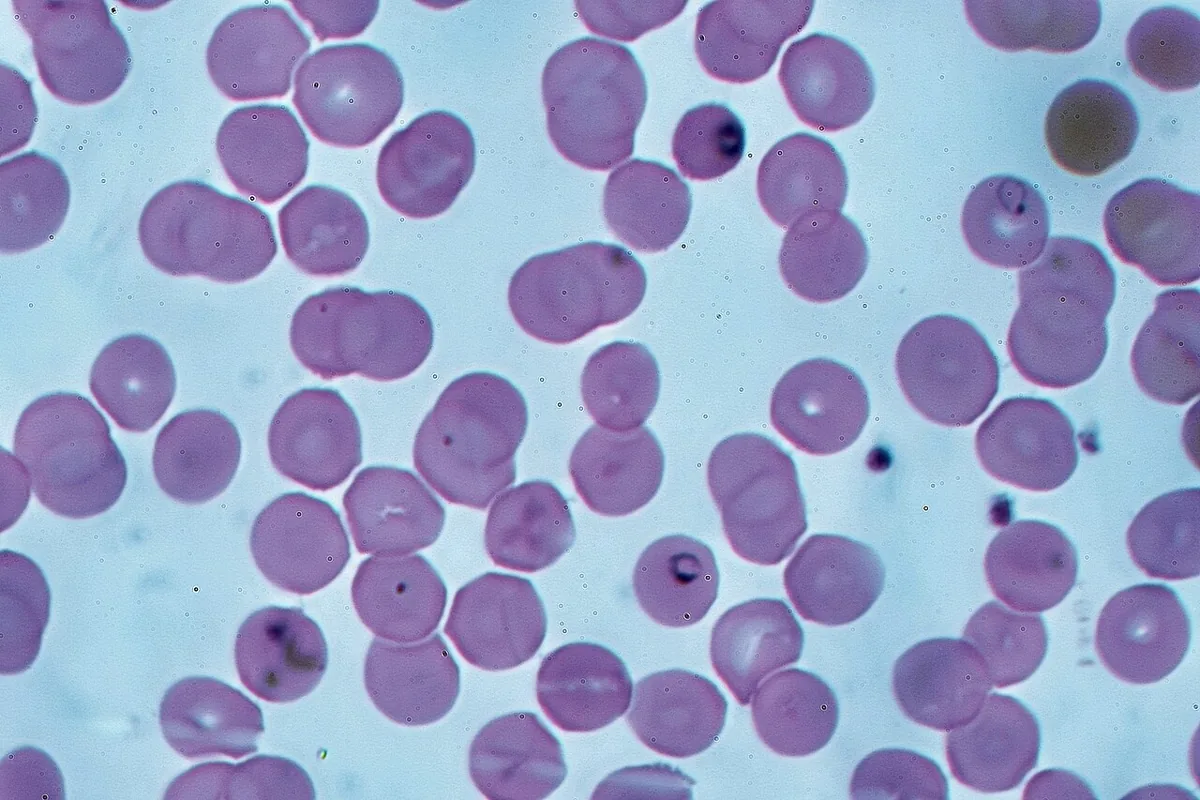
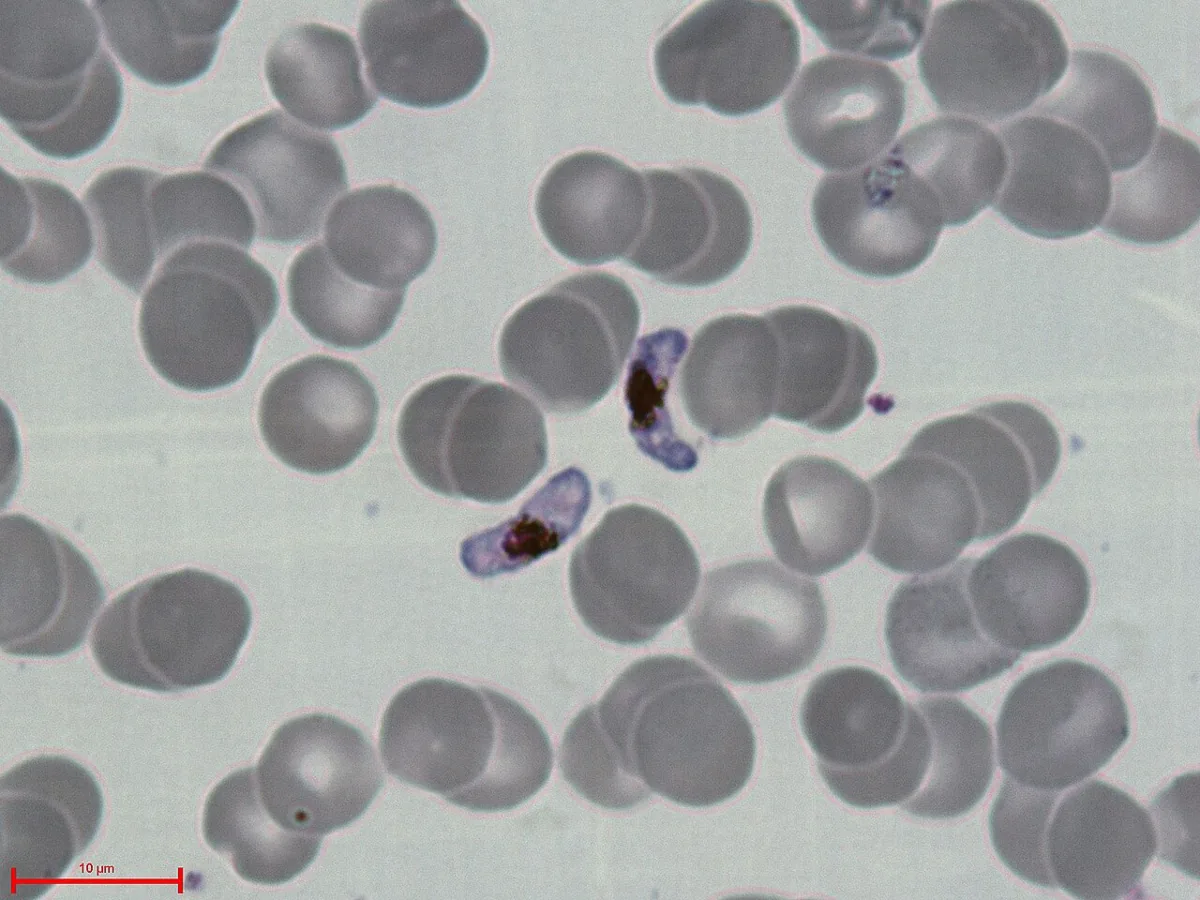
In the Giemsa-stained thin blood smear, plasmodia within red blood cells can be distinguished by species and developmental stage (e.g. ring forms, schizonts, gametocytes), and the proportion of infected red cells (parasitemia) can be determined. In the thick smear, parasites are concentrated about 6- to 10-fold, but species identification is not possible there.
Diagnosis
- Travel history: malaria is considered in every unexplained fever after a stay in the tropics.
- Microscopy (gold standard): thick and thin blood smears with Giemsa stain; species identification on the thin smear; parasitemia reported as parasites/µL or as percentage of infected red cells to assess severity. A negative result does not reliably exclude malaria; if suspicion persists, testing is repeated daily.
- Rapid antigen tests: detection of parasite-specific antigens (e.g. HRP-2 of P. falciparum); insufficient species differentiation, false-negative results with low parasite density (below about 200/µL) and with very high parasitemia (above 10 %, prozone effect).
- PCR: for special questions; less suitable for acute diagnosis because of time and cost.
- Serology: unsuitable for acute diagnosis, as it is negative early on; positive results indicate prior exposure.
- Laboratory tests: thrombocytopenia, anemia and signs of hemolysis (LDH, bilirubin, haptoglobin), creatinine, blood glucose, lactate and coagulation to detect organ complications.
- Detection of plasmodia in semi-immune people from endemic areas does not necessarily prove disease, as clinically healthy carriers occur.
Keep learning in the app
Further reading (open access)
Cross-references
More topics: Infectious diseases
Note: Learning content for medical education – not a treatment recommendation and no substitute for diagnosis or treatment decisions in individual cases. Treatment and management are deliberately not covered on this page.