Lyme disease (Lyme borreliosis)
Board exam relevance: in 1 of 105 exam reports · rank 181- Synonyms
- borreliosis, tick-borne Lyme disease, erythema migrans, neuroborreliosis
- Specialty
- Internal medicine · Infectious diseases
- Images
- Clinical 3
- Last updated
- 10/2026 · Dr. Pascal Bafteh
Contents
Images (3)
Definition
Lyme disease (Lyme borreliosis) is a tick-borne bacterial multisystem disease caused by spirochetes of the Borrelia burgdorferi sensu lato complex. It can affect the skin, nervous system, joints and heart. Most infections cause no signs of disease. In Europe it is by far the most common tick-borne disease.
Classification
- Early localized manifestation: erythema migrans; borrelial lymphocytoma.
- Early disseminated manifestation: multiple erythemata migrantia, early neuroborreliosis (lymphocytic meningitis, meningoradiculitis, cranial nerve palsies), Lyme carditis, early transient Lyme arthritis, very rarely ocular involvement.
- Late manifestation: acrodermatitis chronica atrophicans (ACA), late neuroborreliosis (encephalomyelitis, cerebral vasculitis, peripheral neuropathy with ACA), chronic Lyme arthritis.
Occurrence & epidemiology
- Distributed throughout the northern hemisphere (North America, Europe, Asia); there is a risk of infection throughout Germany, and the proportion of infected ticks varies greatly between localities.
- After a tick bite, seroconversion is found in 2.6–5.6 % of those bitten; clinically manifest disease is expected in 0.3–1.4 %.
- The notification incidence in German states with mandatory reporting ranged from 26 (2015) to 41 (2013) cases per 100,000 population per year.
- Erythema migrans occurs mostly in June and July, neuroborreliosis in July and August, Lyme arthritis year-round.
- Seroprevalence rises with age: about 7 % in 14- to 17-year-olds, 16.4 % of women and 24.5 % of men aged 70–79 years.
- Frequency of manifestations (population-based study): erythema migrans as the only symptom in 89 %, Lyme arthritis 5 %, early neuroborreliosis 3 %, lymphocytoma 2 %, acrodermatitis 1 %, carditis below 1 %.
Aetiopathogenesis
- Pathogens: proven human pathogens are B. afzelii, B. garinii, B. bavariensis, B. burgdorferi sensu stricto, B. mayonii and B. spielmanii; all except B. mayonii occur in Europe, while only B. burgdorferi sensu stricto and B. mayonii occur in the USA.
- Organ tropism: B. garinii and B. bavariensis are associated with neurologic manifestations, B. afzelii with acrodermatitis chronica atrophicans, B. burgdorferi sensu stricto with Lyme arthritis.
- Reservoir: mainly mice and birds, plus other wild animals.
- Transmission: in Central Europe by the bite of the hard tick Ixodes ricinus. The borreliae migrate from the tick gut to the salivary glands only after feeding begins; the tick therefore has to feed for at least several hours. Tick activity peaks in spring and autumn.
- Incubation period: erythema migrans 3–30 days (median 7–10 days); early neuroborreliosis hardly longer; late manifestations after months to years.
- Past infection generally does not protect against reinfection.
Clinical features
Skin
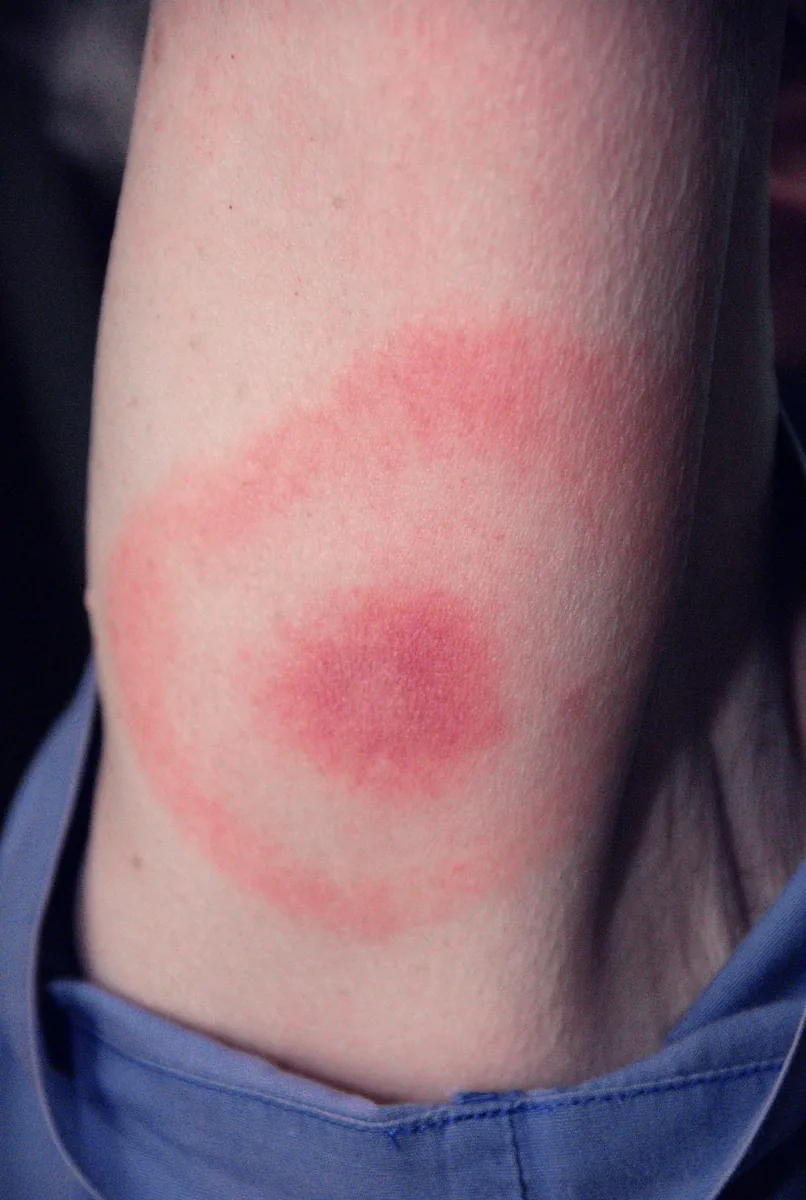
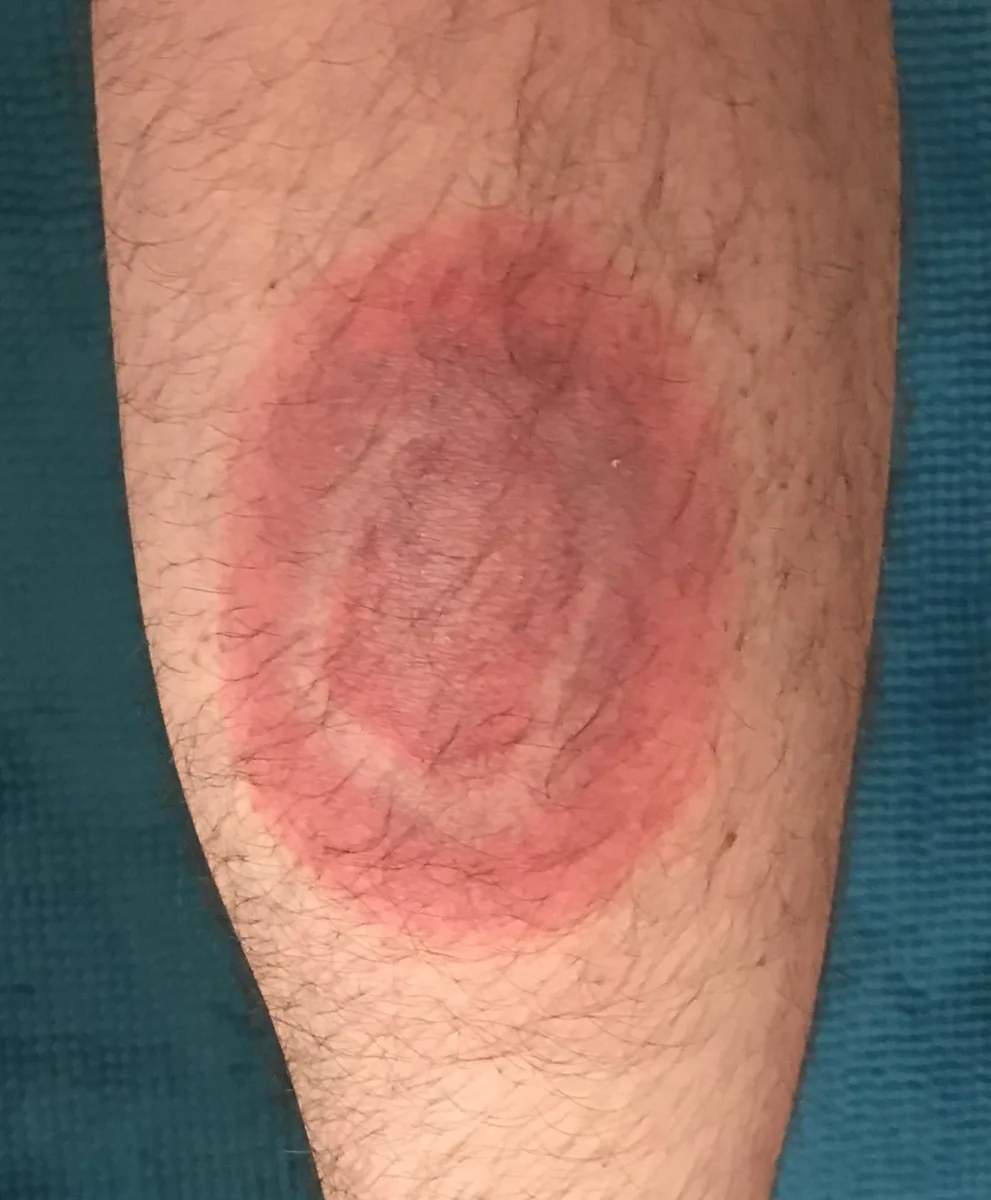
- Erythema migrans: an erythema of at least 5 cm diameter, accentuated at the margin and not raised, spreading centrifugally, often with a visible bite site at the center; symptom-free interval of at least 3 days after the bite. With early dissemination, multiple erythemas, sometimes with fever, myalgias, arthralgias and lymphadenopathy.
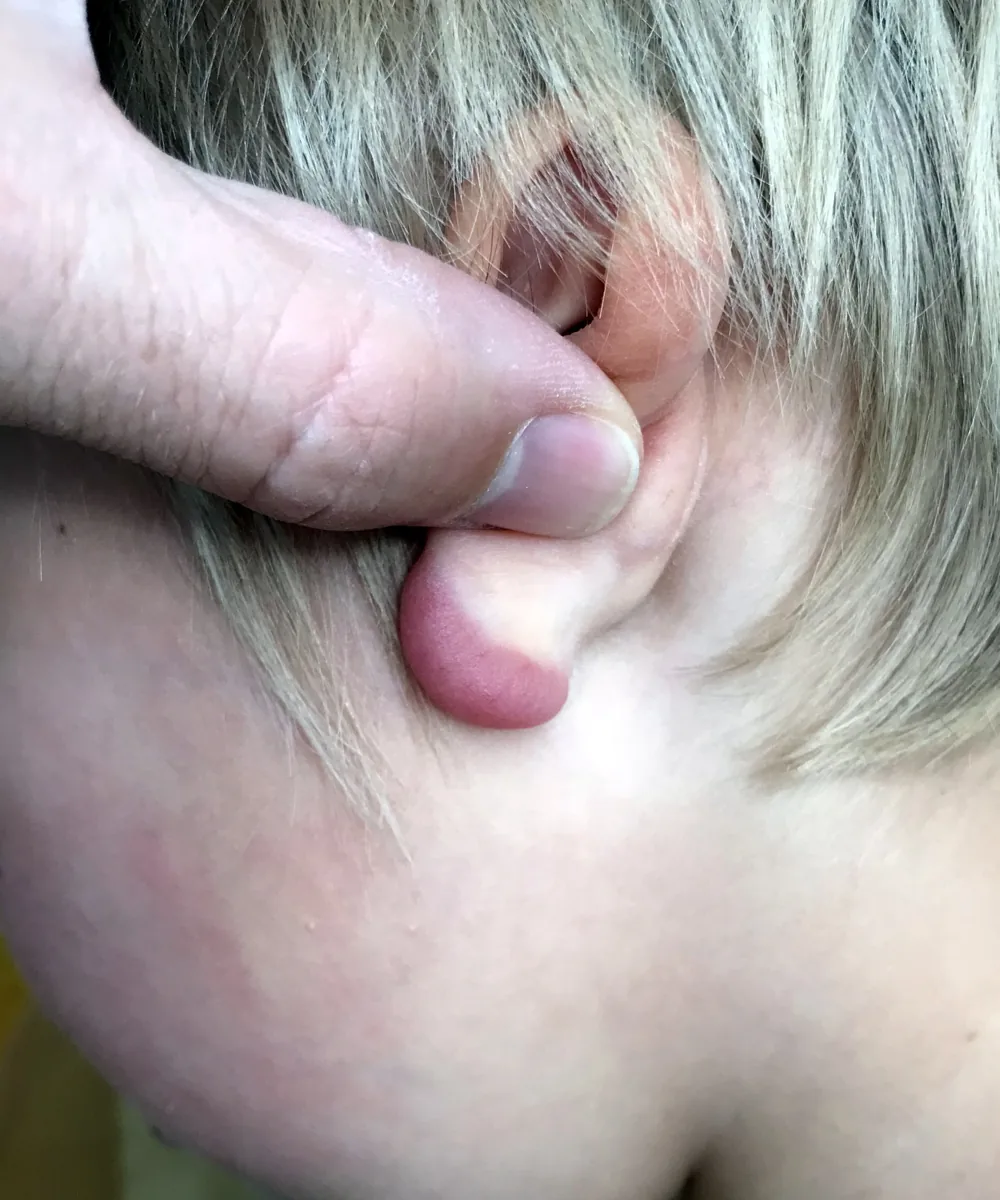
- Borrelial lymphocytoma: pseudolymphoma, mainly in children, typically on the earlobe, nipple or genitals.
- Acrodermatitis chronica atrophicans: first an edematous-infiltrative, then an atrophic stage on the extremities with visible vessels, sometimes juxta-articular fibroid nodules; in about half, involvement of joints and nerves of the affected limb.
Nervous system, joints and heart
- Early neuroborreliosis (probably more than 98 % of neurologic cases): a few weeks to months after the bite; burning, painful meningoradiculitis that is worse at night, often with unilateral or bilateral facial palsy (Garin-Bujadoux-Bannwarth syndrome). Children more often have meningitis or isolated facial palsy. Only 34–46 % of those affected recall an erythema migrans.
- Late neuroborreliosis (very rare): insidious encephalomyelitis with spastic-ataxic gait disorder and bladder dysfunction.
- Lyme arthritis: episodic or chronic mono- or oligoarthritis, most often of the knee, less often of the ankle or elbow. Involvement of small joints, the axial skeleton or the sacroiliac joints argues against Lyme arthritis.
- Lyme carditis (rare): mainly AV block of varying degree or perimyocarditis; also intraventricular conduction disturbances, extrasystoles, atrial fibrillation and tachycardias.
Diagnosis
- Erythema migrans: purely clinical diagnosis; serology is often still negative in the first weeks (diagnostic gap).
- Two-tier serology: screening test (ELISA); if positive or borderline, confirmation by immunoblot. In advanced stages and late manifestations, nearly all patients are seropositive.
- Limitations of serology: IgG and IgM antibodies may persist for years after prior, even asymptomatic, infection; in some population groups more than 20 % are seropositive. False-positive reactions occur in autoimmune diseases, syphilis and herpesvirus infections (e.g. EBV), among others. A positive result indicates Lyme disease only together with compatible clinical findings.
- Neuroborreliosis: cerebrospinal fluid with lymphocytic pleocytosis and blood-CSF barrier dysfunction; detection of intrathecally produced antibodies using the Borrelia-specific antibody index from CSF and serum pairs taken on the same day (positive in the large majority 6–8 weeks after onset). Elevated CXCL13 in CSF may support the suspicion.
- Culture and PCR: additional methods after serology; culture from CSF or skin biopsy is proof but laborious. In Lyme arthritis, PCR of joint fluid or synovial biopsy is clearly superior to culture.
- Lyme carditis: ECG showing AV block or other conduction disturbances.
Keep learning in the app
Further reading (open access)
Cross-references
Note: Learning content for medical education – not a treatment recommendation and no substitute for diagnosis or treatment decisions in individual cases. Treatment and management are deliberately not covered on this page.