COVID-19
Board exam relevance: in 3 of 105 exam reports · rank 111- Synonyms
- coronavirus, SARS-CoV-2, long COVID, post-COVID condition
- Specialty
- Internal medicine · Infectious diseases
- Images
- CT 2
- Last updated
- 10/2026 · Dr. Pascal Bafteh
Contents
Images (2)
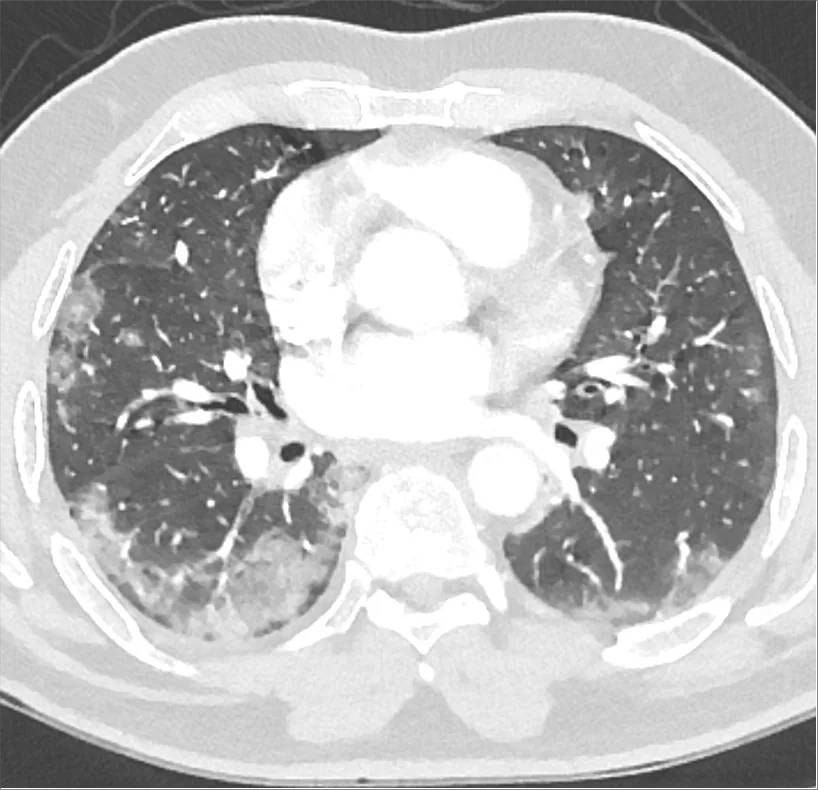 CT
CT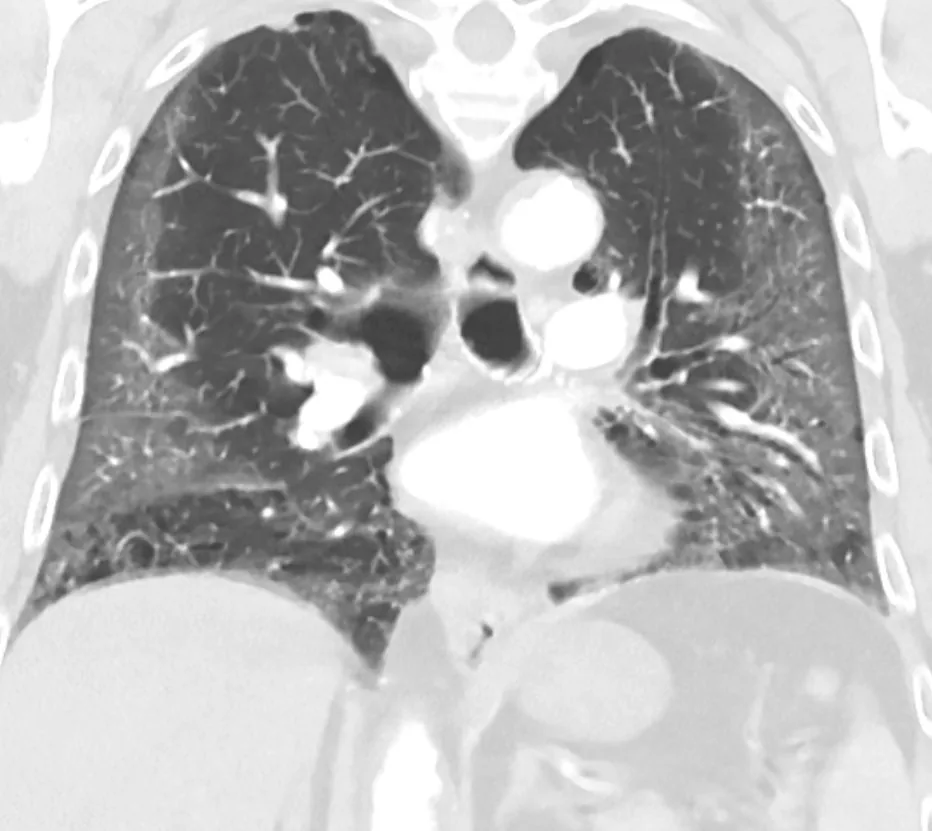 CT
CTDefinition
COVID-19 (coronavirus disease 2019) is the disease caused by the coronavirus SARS-CoV-2. It is primarily an acute respiratory illness with a spectrum from asymptomatic infection to pneumonia with respiratory failure, but it can also affect many other organ systems. After the pandemic from 2020 onward, COVID-19 has entered an endemic phase in Germany.
Classification
- Acute COVID-19: from mild upper respiratory infection to severe disease with pneumonia and acute respiratory distress syndrome (ARDS).
- Long COVID: health complaints persisting longer than 4 weeks after onset, or appearing new or recurring.
- Post-COVID syndrome: complaints present or newly appearing at least 12 weeks after onset that cannot be explained otherwise.
- Variants: the wild type was followed by Alpha (from early 2021), Delta (from the second half of 2021) and, from 2022, Omicron variants.
Occurrence & epidemiology
- First identified in December 2019 in Wuhan (China); a worldwide pandemic with several waves followed. WHO classified the situation as a public health emergency of international concern from January 2020 to May 2023.
- In Germany, by the end of 2022 most of the population had been infected at least once owing to the highly transmissible Omicron variants. Further waves are expected, possibly also outside the autumn and winter season.
- Because of high population immunity, severe courses and long-term sequelae are now much less frequent than in 2020 and 2021.
Aetiopathogenesis
- Pathogen: SARS-CoV-2, a betacoronavirus that probably passed to humans from an animal reservoir (SARS-CoV-2-like viruses in horseshoe bats in Asia). For the endemically circulating virus, humans are the reservoir.
- Cell entry: via the receptor ACE2 (angiotensin-converting enzyme 2), which is present at high density in the airways, gut, vascular cells, kidney and heart muscle.
- Transmission: mainly by inhaling virus-containing droplets and aerosols at short range (about 1.5 m); indoors also over greater distances, as aerosols can remain infectious in the air for hours. Other routes (contact, conjunctivae, fecal-oral) are less well documented.
- Incubation period: for the Omicron subvariants circulating since 2023, on average 3–4 days (range 1–8 days).
- Infectiousness: highest from 2–3 days before to 4–5 days after symptom onset; asymptomatic people can also be infectious. With Omicron, replication-competent virus is shed for about 5 days after symptom onset, viral components are detectable by PCR for about 11 days; much longer in immunosuppression.
- Antigenic drift: ongoing changes allow the virus to partly evade population immunity.
Clinical features
- Respiratory tract: fever, rhinorrhea, cough, sore throat and dyspnea; dyspnea may indicate pneumonia.
- Gastrointestinal: nausea, loss of appetite, vomiting, abdominal pain, diarrhea.
- Neurologic: headache, disturbances of smell and taste, dizziness, confusion; also (meningo)encephalopathies, strokes and Guillain-Barré syndrome. The almost pathognomonic loss of smell and taste, formerly seen in about one quarter, has become much less common since Omicron.
- Cardiovascular: arrhythmias, peri- and myocarditis, myocardial infarction, heart failure.
- Coagulation: thromboembolic events, disseminated intravascular coagulation.
- Other: kidney dysfunction, varied skin manifestations.
- Course: symptoms usually resolve within about a week; some patients deteriorate after about a week, progressing to ARDS.
- Risk of severe disease: age from about 75 years (with risk rising further), immunosuppression, chronic cardiovascular, liver, kidney and lung disease, diabetes mellitus, chronic neurologic disease, pregnancy, living in care facilities.
- Children: rarely pediatric inflammatory multisystem syndrome (PIMS/MIS-C) as a postacute complication; much less common since 2022.
- Post-COVID: mainly shortness of breath, headache and aching limbs, impaired concentration ("brain fog") and delayed, persistent exhaustion after exertion (post-exertional malaise); a high proportion of those affected meet the criteria for ME/CFS after six months.
Diagnosis
- Clinical picture alone is insufficient: symptoms can hardly be distinguished from other acute respiratory infections, and with newer Omicron variants almost not at all; a reliable diagnosis requires virus detection.
- PCR: gold standard for sensitivity and specificity; specimens from the upper airways (nasal, throat or nasopharyngeal swab, saliva). PCR may remain positive for weeks to months after infection without infectiousness.
- Rapid antigen tests: considerably lower sensitivity than PCR but relatively high specificity; a negative result does not exclude infection, especially in the early phase.
- Serology: antibodies against the spike protein and against the nucleocapsid protein; nucleocapsid antibodies specifically indicate past infection; because of high seroprevalence, of little relevance in individual diagnosis.
- Laboratory findings in severe disease: lymphopenia, elevated transaminases, LDH, D-dimer, ferritin and inflammatory markers such as CRP.
- Imaging: chest X-ray or CT shows ground-glass opacities and consolidation in pneumonia; often normal in mild disease.
Keep learning in the app
Further reading (open access)
Cross-references
More topics: Infectious diseases
Note: Learning content for medical education – not a treatment recommendation and no substitute for diagnosis or treatment decisions in individual cases. Treatment and management are deliberately not covered on this page.