Colorectal cancer
Board exam relevance: in 2 of 105 exam reports · rank 142- Synonyms
- bowel cancer, colon cancer, rectal cancer, CRC, colorectal carcinoma
- Specialty
- Internal medicine · Gastroenterology
- Images
- Endoscopy 1 · CT 1 · Histology 1 · Gross specimen 1
- Last updated
- 10/2026 · Dr. Pascal Bafteh
Contents
Images (4)
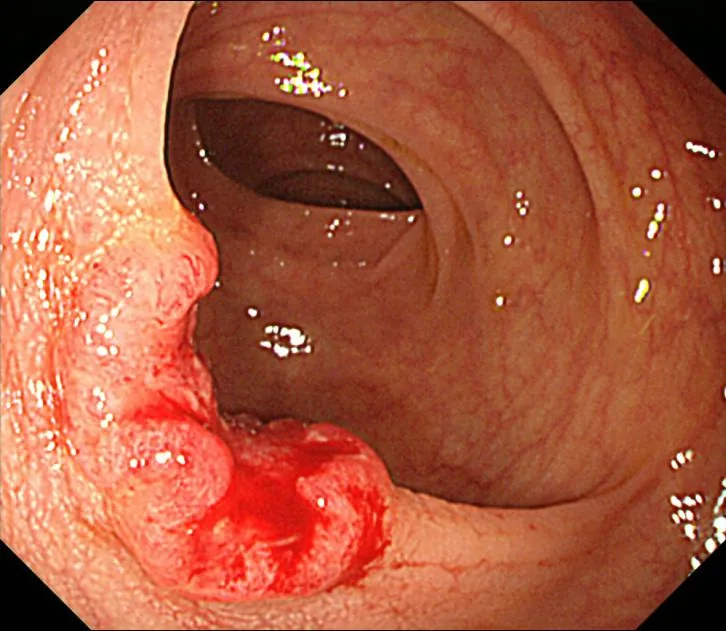 Endoscopy
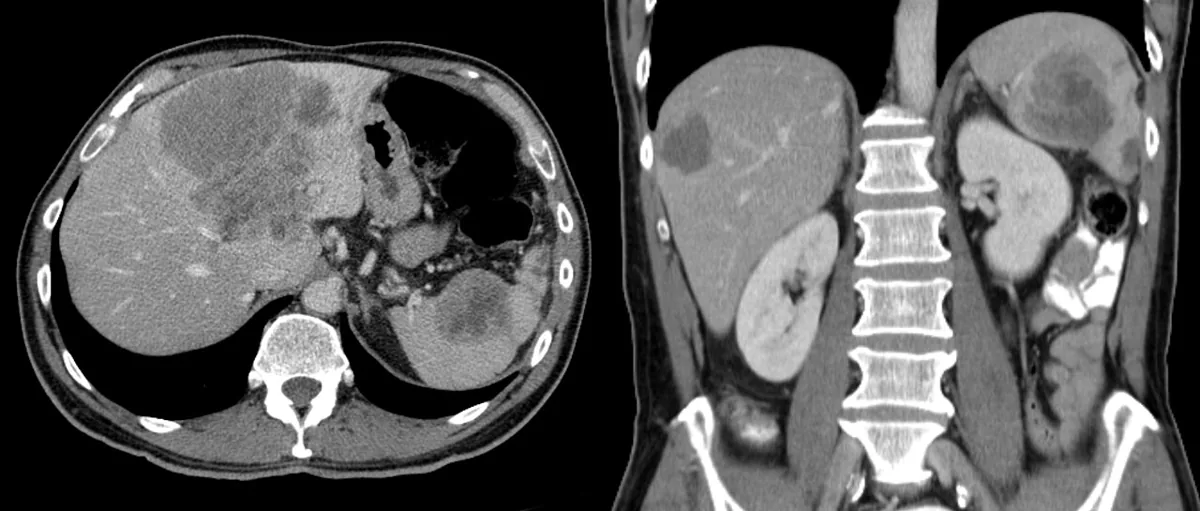 CT
CT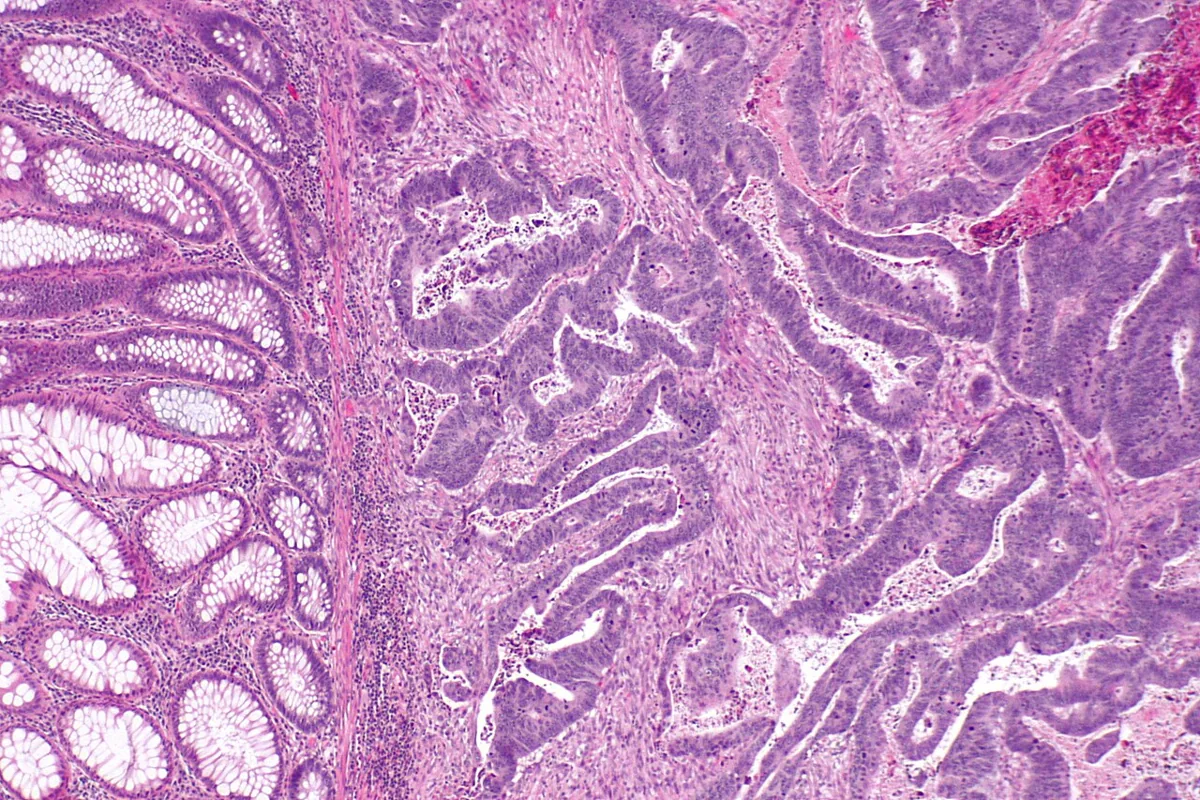 Histology
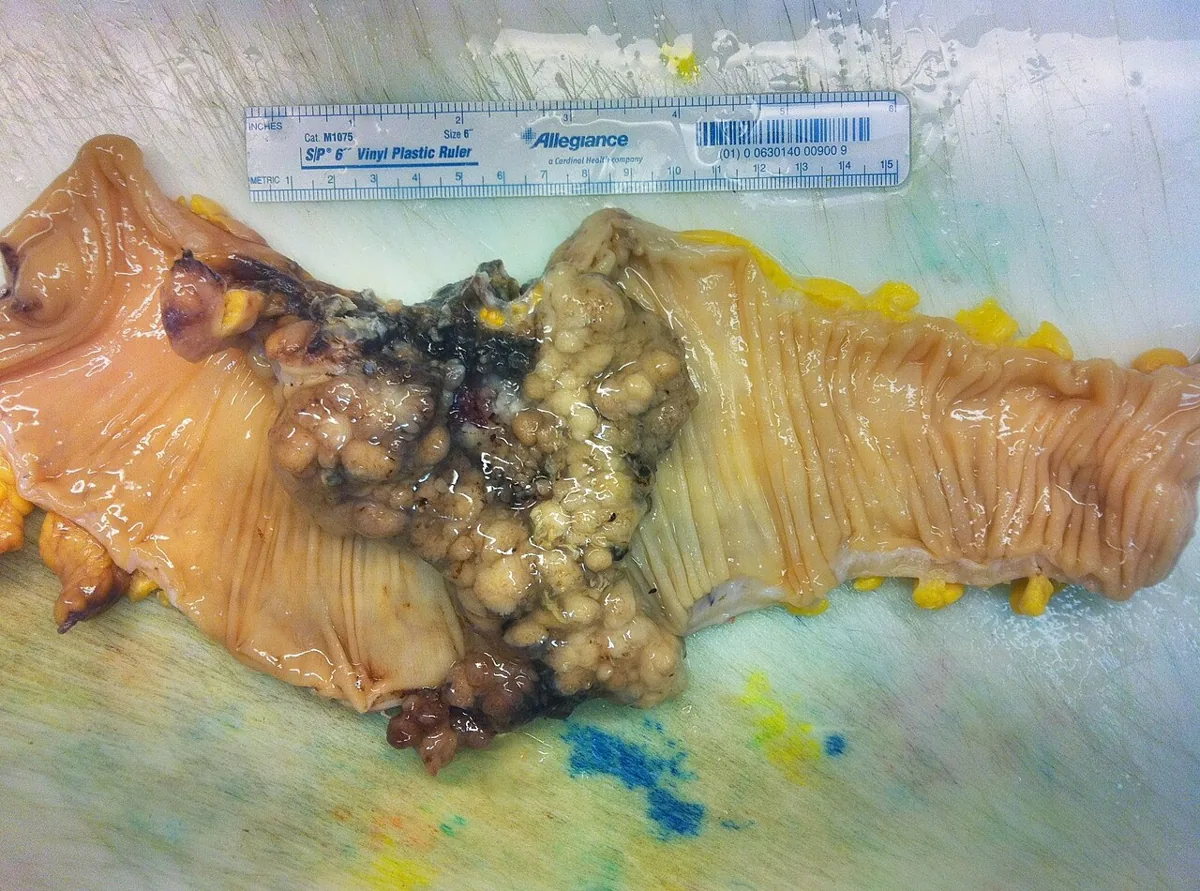 Gross specimen
Definition
Colorectal cancer (CRC) is a malignant tumor of the large bowel (colon) or rectum. 95% are adenocarcinomas, which usually arise within adenomatous polyps. More than half of the tumors are located in the rectum and sigmoid colon.
Classification
Staging follows TNM:
- Tis: carcinoma in situ
- T1: submucosa; T2: muscularis propria; T3: through the muscularis propria into pericolorectal tissue (in rectal cancer into the mesorectum); T4: penetration of the visceral peritoneum (T4a) or invasion of adjacent organs or structures (T4b)
- N1: 1–3 regional nodes or tumor deposits without nodal involvement; N2: 4 or more regional nodes
- M1: distant metastases
Stage I corresponds to T1–2 N0 M0, stage II to T3–4 N0 M0, stage III to any T with N1–2 M0 and stage IV to any distant metastasis.
Occurrence & epidemiology
About one in eight cancers in Germany affects the colon or rectum; in 2023 about 25,000 women and 30,000 men were diagnosed. Over a lifetime, the diagnosis is made in one in 19 women and one in 15 men. About two thirds of tumors arise in the colon. The risk increases into old age: more than half of patients are diagnosed after the age of 70 and only about 10% before 55; the median age at diagnosis is 75 (women) and 71 years (men). Since about 2003, age-standardized incidence rates have been falling, except in the ascending colon. Men are affected slightly more often; synchronous cancers are found in about 5%.
Aetiopathogenesis
CRC usually develops through malignant transformation within adenomatous polyps. About 80% of cases are sporadic and about 20% have an inheritable component.
Risk factors:
- tobacco use and excess body weight as the most important risk factors, followed by physical inactivity and low-fiber eating habits
- regular alcohol consumption, high intake of red or processed meat
- colorectal cancer in first-degree relatives
- hereditary syndromes: familial adenomatous polyposis, Lynch syndrome, Peutz-Jeghers syndrome, juvenile polyposis, MUTYH-associated polyposis
- inflammatory bowel disease (ulcerative colitis, Crohn's colitis), increasing with disease duration
Carcinogens probably derive less directly from food than from bacterial action on dietary substances or biliary and intestinal secretions. CRC spreads by direct extension through the bowel wall, hematogenously, via lymph nodes and along nerves.
Clinical features
Colorectal adenocarcinomas grow slowly; a long time often passes before the first symptoms. Symptoms depend on location, type, extent and complications.
- Right colon: wide lumen, thin wall, liquid contents – obstruction occurs late; bleeding is usually occult. Fatigue and weakness due to anemia may be the only complaints; sometimes the tumor is palpable through the abdominal wall
- Left colon: narrower lumen, more solid stool – earlier partial or complete obstruction with colicky abdominal pain; stool streaked or mixed with blood; occasionally (usually walled-off) perforation
- Rectum: the most common initial symptom is bleeding with defecation; tenesmus or a feeling of incomplete evacuation; pain with perirectal involvement
- Metastases may be the first sign: hepatomegaly, ascites, enlarged supraclavicular lymph nodes
Diagnosis
- Colonoscopy with biopsy: to confirm the diagnosis in symptomatic patients or after a positive screening test (fecal occult blood or stool DNA test); lesions are examined completely by histology
- Even with known hemorrhoids or diverticula, rectal bleeding may be due to cancer
- Barium enema: detects many lesions but is less accurate than colonoscopy
- Staging: CT of the chest, abdomen and pelvis and routine laboratory tests to look for metastases
- CEA: elevated in about 34% of patients with colon cancer (stages I–III); neither sensitive nor specific, measured as a baseline value
- Molecular testing of tumor tissue for changes indicating Lynch syndrome
Rectal cancer
- Pelvic staging MRI: mrTNM + mesorectal fascia.
Keep learning in the app
Further reading (open access)
Cross-references
More topics: Gastroenterology
Note: Learning content for medical education – not a treatment recommendation and no substitute for diagnosis or treatment decisions in individual cases. Treatment and management are deliberately not covered on this page.