Lichenoid drug eruption
- Specialty
- Dermatology · Inflammatory skin diseases
- Images
- Clinical 3
- In the app
- 4 flashcards
- Last updated
- 10/2026 · Dr. Pascal Bafteh
Contents
Images (3)
 AI illustration
Definition
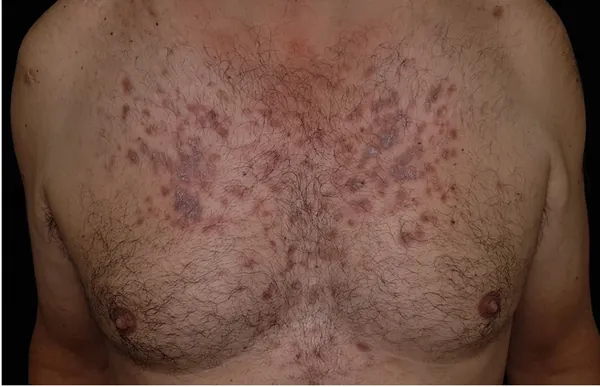
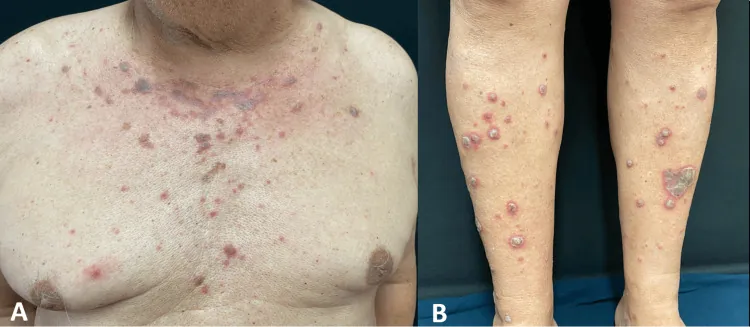
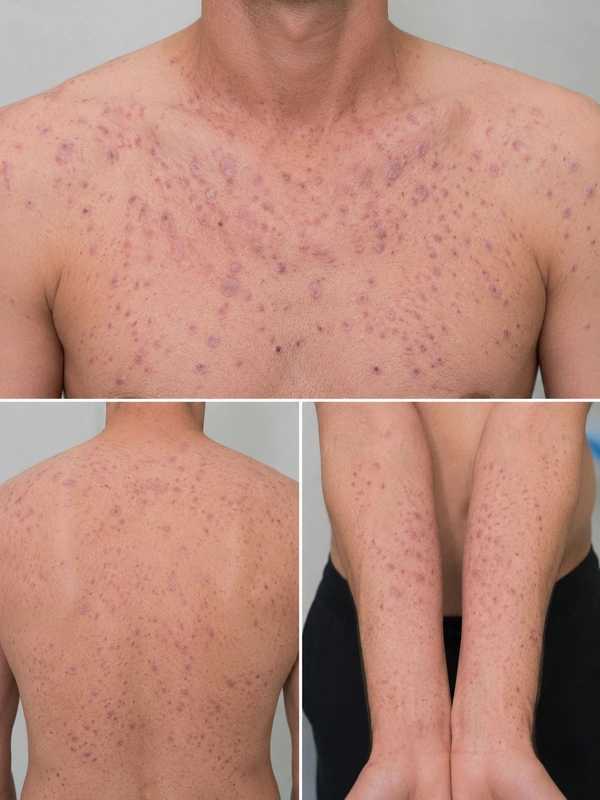
Lichenoid drug eruption is an uncommon rash that can be induced by medicines, but also by environmental agents or industrial by-products. Clinically and histologically it resembles idiopathic lichen planus and can be difficult to distinguish from it.
- Differentiation from classic LP:
- Predilection sites: Different from classic LP (e.g., trunk, extensor surfaces)
- Wickham's striae: Usually absent, mucosa rarely involved
- Common Triggers: NSAIDs, antimalarials, beta-blockers.
- Clinical presentation: Trunk-predominant lichenoid, itchy papules.
- Histology: band-like lymphocytic infiltrate at the dermo-epidermal junction, Civatte bodies.
Occurrence & epidemiology
The latent period between starting the drug and the rash is generally 2–3 months, sometimes more than one year; the eruption may even appear after the drug is no longer taken. This makes it challenging to identify the culprit drug.
Diagnosis
- Suspected from the unusual features (extensive symmetrical distribution, photodistribution, absent Wickham striae, uncommon mucosal and nail involvement), then skin biopsy.
- Detailed history of all medicines taken in the preceding year, including those taken only briefly or once.
Differential diagnoses
 Lichen planus
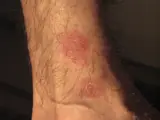 Pityriasis rosea
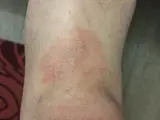 Mycosis fungoides
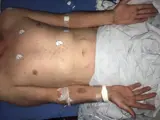 Secondary syphilis (lues II)
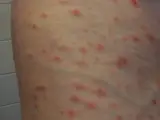 PLEVA (Pityriasis lichenoides et varioliformis acuta)
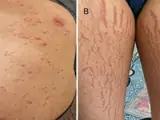 Pityriasis lichenoides chronica (PLC)
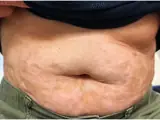 Graft-versus-host disease (GvHD)
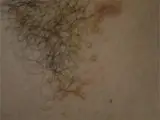 Lichen nitidus
Image credits for the thumbnails
- Lichen planus: James Heilman, MD, “Lichen Planus (2)”, CC BY-SA 3.0, via Wikimedia Commons · CC BY-SA 3.0 · Source
- Pityriasis rosea: Aceofhearts1968, “Pityriasis rosea-1”, Public Domain, via Wikimedia Commons · Public domain · Source
- Mycosis fungoides: Wikindrea, “Mycosis Fungoides Before Sun and Cartamo”, CC BY-SA 4.0, via Wikimedia Commons · CC BY-SA 4.0 · Source
- Secondary syphilis (lues II): Ehlers S, Sergent S, Ashurst J (Clin Pract Cases Emerg Med 2020), CC BY 4.0, via PubMed Central (PMC7676796) · CC BY 4.0 · Source
- PLEVA (Pityriasis lichenoides et varioliformis acuta): Florian Jesse, “PLEVA”, Public domain, via Wikimedia Commons · Public domain · Source
- Pityriasis lichenoides chronica (PLC): Ahmed HB, Aziz JMA, Salih MKB et al. (Clin Case Rep 2026), CC BY 4.0, via PubMed Central (PMC13478903) · CC BY 4.0 · Source
- Graft-versus-host disease (GvHD): Choi E, Nguyen CV (JAAD Case Rep 2024), CC BY 4.0, via PubMed Central (PMC11403442) · CC BY 4.0 · Source
- Lichen nitidus: Belda W, Criado PR, Di Chiacchio NG (An Bras Dermatol 2021), CC BY 4.0, via PubMed Central (PMC8178568) · CC BY 4.0 · Source
Treatment principles
- The key step is withdrawing the causative drug; resolution is often delayed over weeks to months, frequently with post-inflammatory hyperpigmentation.
- Localised disease is treated with topical glucocorticoids, itch with oral antihistamines, and extensive eruptions without features of a severe cutaneous adverse reaction with short-term systemic glucocorticoids.
- An allergy passport and information about possible cross-reactions are part of management.
Specific treatment regimens with drugs and doses are covered in the DermaFuchs app.
Keep learning in the app
References (selection)
Cross-references
Keep learning
Keep learning with flashcards, exam questions and spot diagnoses in the DermaFuchs app – free, in your browser or as an app.
Related pages: Lichen planus · Pityriasis rosea · Mycosis fungoides
Note: This page is intended for medical education and does not replace diagnosis or treatment decisions in individual cases.