Wilson's disease
Board exam relevance: in 4 of 105 exam reports · rank 90- Synonyms
- copper storage disease, hepatolenticular degeneration, Wilson disease, Kayser-Fleischer ring, ATP7B
- Specialty
- Internal medicine · Liver & biliary tract
- Images
- Clinical 2
- Last updated
- 10/2026 · Dr. Pascal Bafteh
Contents
Images (2)
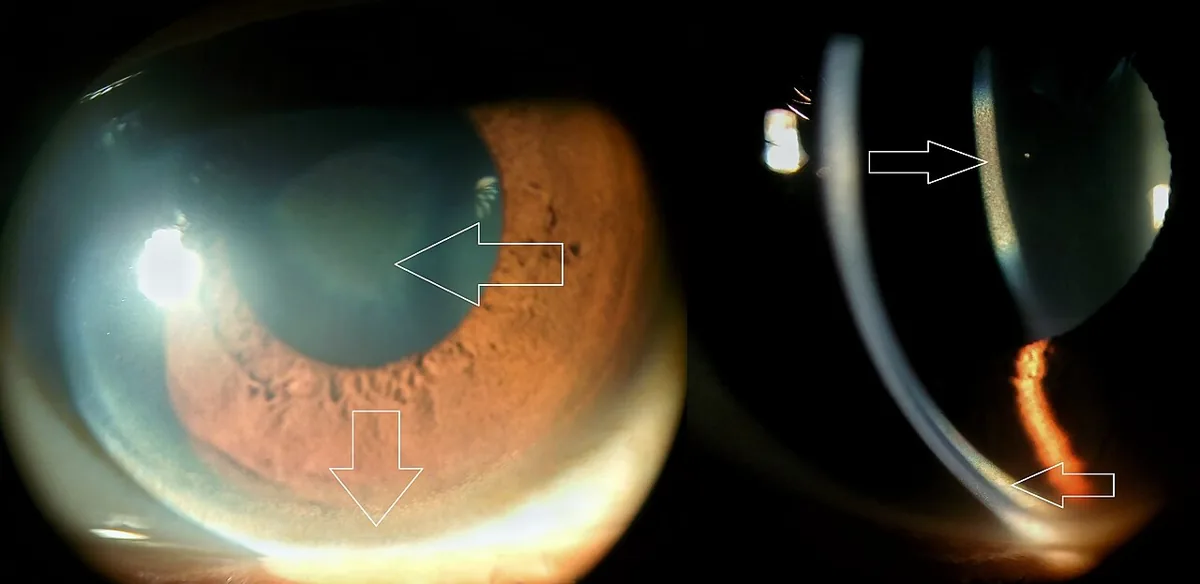

Definition
Wilson's disease (hepatolenticular degeneration) is an inherited disorder of copper metabolism. Because of reduced biliary excretion of copper, copper accumulates first in the liver and later in the brain, cornea, kidneys and other organs.
Occurrence & epidemiology
About 1 in 30,000 people is affected, men and women equally. About 1.1% of the population are asymptomatic heterozygous carriers. Symptoms usually begin between 5 and 35 years of age but can occur from 2 to 72 years.
Aetiopathogenesis
The disease is inherited in an autosomal recessive manner; it is caused by mutations in the ATP7B gene on chromosome 13, which encodes a copper-transporting ATPase. The defective transport reduces copper excretion into bile and the incorporation of copper into the transport protein caeruloplasmin, whose serum level therefore usually falls. Copper overload of the liver begins at birth and leads via inflammation and fibrosis to cirrhosis. Released copper reaches the brain (especially the basal ganglia), cornea and kidneys via the blood and can cause hemolysis.
Clinical features
In almost half of patients, especially adolescents, hepatitis is the first sign: acute, chronic active or fulminant with acute liver failure, often together with Coombs-negative hemolytic anemia. In about 40%, especially young adults, neurological and psychiatric symptoms come first: tremor, dystonia, dysarthria, dysphagia, chorea, drooling, incoordination and cognitive and psychiatric changes. In 5–10%, incidentally discovered Kayser-Fleischer rings, amenorrhoea, repeated miscarriages or hematuria lead to the diagnosis.
Further findings are Kayser-Fleischer rings at the corneal margin, less often a sunflower cataract, and damage to the renal tubules. Liver involvement ranges from asymptomatic raised aminotransferases to cirrhosis.
Diagnosis
Wilson's disease is suspected in people under 40 with unexplained liver, neurological or psychiatric disease, persistently raised aminotransferases, fulminant hepatitis or affected relatives.
- Slit-lamp examination: golden-brown to greenish Kayser-Fleischer rings due to copper deposition in Descemet's membrane
- Serum caeruloplasmin: normally about 20–35 mg/dL, usually low in Wilson's disease but may be normal; values below 5 mg/dL strongly suggest the disease. Low values also occur in heterozygous carriers and other liver diseases.
- 24-hour urinary copper excretion: normally at most 30 micrograms per day, in Wilson's disease usually above 100 micrograms per day
- Serum copper: of little value, may be high, normal or low
- Liver biopsy with measurement of copper content in unclear cases; false-negative results are possible because of uneven distribution or fulminant necrosis
- Molecular genetics: detection of ATP7B mutations
Low caeruloplasmin together with Kayser-Fleischer rings or high urinary copper excretion confirms the diagnosis.
Leipzig score
- Points from: Kayser-Fleischer, neurology, Coombs-negative hemolysis, ceruloplasmin, 24-h urine Cu, liver biopsy Cu, ATP7B mutations.
- Score ≥ 4: Wilson diagnosis confirmed.
Keep learning in the app
Further reading (open access)
Cross-references
More topics: Liver & biliary tract
Note: Learning content for medical education – not a treatment recommendation and no substitute for diagnosis or treatment decisions in individual cases. Treatment and management are deliberately not covered on this page.