Acute liver failure
Board exam relevance: in 2 of 105 exam reports · rank 142- Synonyms
- ALF, fulminant hepatic failure, fulminant liver failure, acute hepatic failure
- Specialty
- Internal medicine · Liver & biliary tract
- Images
- Histology 2
- Last updated
- 10/2026 · Dr. Pascal Bafteh
Contents
Images (2)
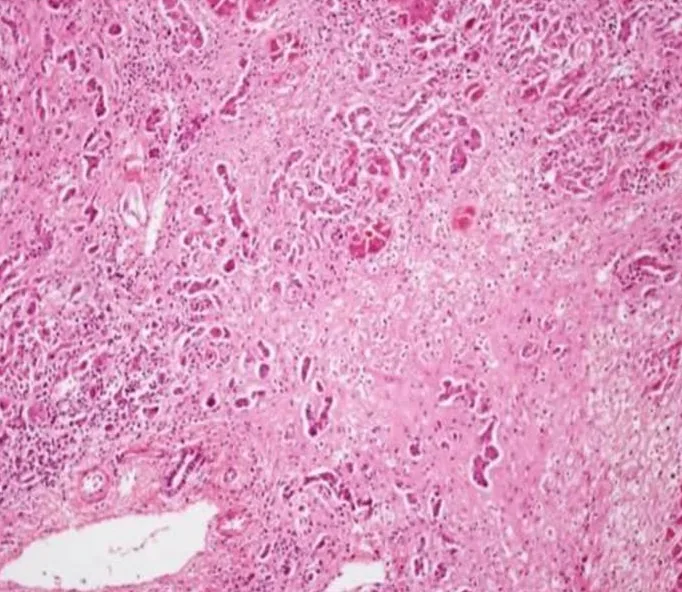 Histology
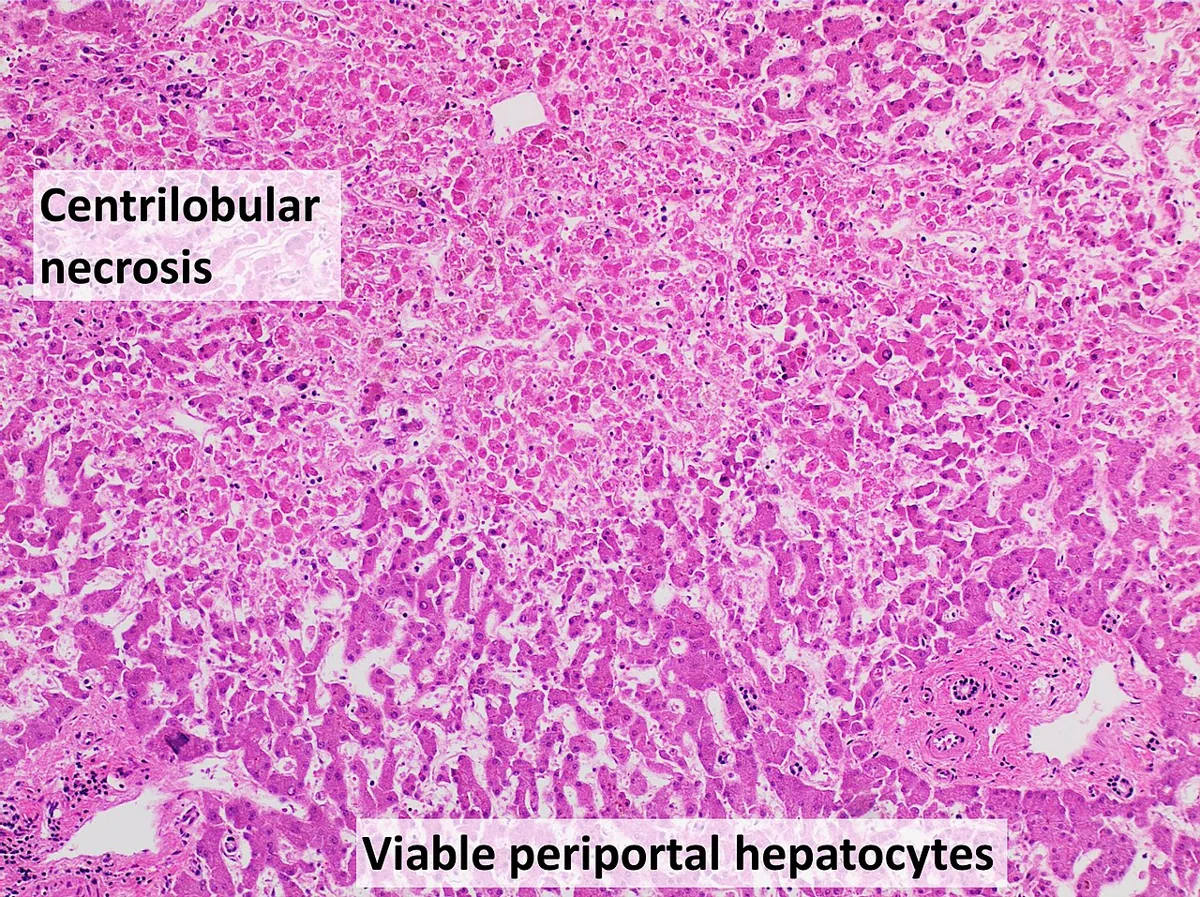 Histology
Definition
Acute liver failure (ALF) is a sudden, severe loss of liver function in patients without pre-existing liver disease or cirrhosis. It is defined by coagulopathy (INR of 1.5 or more) and hepatic encephalopathy of any grade with an illness duration of less than 26 weeks.
Acute deterioration of known chronic liver disease, by contrast, is termed acute-on-chronic liver failure (ACLF) and has a different pathophysiology.
Classification
There is no universally accepted classification; classification by the timing of encephalopathy is common:
- Acute (fulminant): encephalopathy within 2 weeks after the onset of jaundice or within 8 weeks in previously healthy patients; cerebral edema is frequent
- Subacute: encephalopathy later, but within 6 months; kidney failure and portal hypertension are more common than in the acute form
Aetiopathogenesis
In countries with good sanitation, drugs and toxins come first; in countries with poor sanitation, viral hepatitis predominates.
- Toxic: most commonly amount-dependent liver injury caused by paracetamol (acetaminophen); pre-existing liver disease, chronic alcohol use and enzyme-inducing medicines are predisposing factors. Other triggers are idiosyncratic drug reactions, herbal products and death cap mushrooms (Amanita phalloides).
- Viruses: mainly hepatitis B (often with hepatitis D), also hepatitis A and E (the latter especially in pregnancy), herpes simplex, varicella zoster, cytomegalovirus and Epstein-Barr virus, parvovirus B19
- Vascular: Budd-Chiari syndrome, ischemic hepatitis, portal vein thrombosis, sinusoidal obstruction syndrome
- Metabolic and pregnancy-related: Wilson's disease, acute fatty liver of pregnancy, HELLP syndrome, Reye's syndrome
- Other: autoimmune hepatitis, extensive liver metastases, heatstroke, sepsis
Depending on the region, the cause remains unknown in 5–70% of cases.
Clinical features
The cardinal features are jaundice, coagulopathy and altered mental status (hepatic encephalopathy). Malaise, loss of appetite, fetor hepaticus and motor disturbances are added. Signs of chronic liver disease such as ascites argue against an acute process.
Liver failure affects numerous organ systems:
- Brain: encephalopathy; cerebral edema is frequent in severe encephalopathy, with the risk of herniation; signs are clouding of consciousness, bradycardia and rising blood pressure
- Circulation: hyperdynamic circulation with low vascular resistance, similar to septic shock
- Kidneys: acute kidney injury in up to 70% of patients
- Immune system: impaired defence with frequent bacterial and fungal infections up to sepsis; in up to 30%, typical signs of infection are absent
- Metabolism: hypoglycemia, hypokalemia, hypophosphatemia, hypomagnesemia, early alkalosis, metabolic acidosis in shock
- Lungs: non-cardiogenic pulmonary edema
Despite a prolonged INR, bleeding is rare because clotting-promoting and clotting-inhibiting factors are reduced alike; if anything, there is a tendency to thrombosis.
Diagnosis
- Confirmation: INR of 1.5 or more and encephalopathy in acute liver injury without pre-existing liver disease; bilirubin and INR indicate severity
- Baseline tests: blood count, electrolytes including calcium, phosphate and magnesium, renal function (creatinine is more reliable than urea), urinalysis, blood glucose, blood gas analysis
- Arterial ammonia: independent risk factor for severe encephalopathy and intracranial hypertension; values above 100 µmol/L predict severe encephalopathy, and with values above 200 µmol/L intracranial hypertension developed in 55% in one cohort
- Search for the cause: detailed history of medicines and substances including herbal products; paracetamol level; IgM anti-HAV, HBsAg, IgM anti-HBc, anti-HCV, depending on the situation HDV, HEV, HSV, CMV and EBV; autoantibodies and immunoglobulins; pregnancy test in women of child-bearing age; caeruloplasmin if Wilson's disease is suspected
- Imaging: Doppler ultrasound to exclude Budd-Chiari syndrome, portal vein thrombosis and metastases; head CT with worsening consciousness (cerebral edema, hemorrhage)
- Search for infection: blood, urine and ascites cultures, chest X-ray
Keep learning in the app
Further reading (open access)
Cross-references
More topics: Liver & biliary tract
Note: Learning content for medical education – not a treatment recommendation and no substitute for diagnosis or treatment decisions in individual cases. Treatment and management are deliberately not covered on this page.