Hepatitis B
Board exam relevance: in 4 of 105 exam reports · rank 90- Synonyms
- HBV, serum hepatitis, hep B, HBsAg carrier, chronic hepatitis B
- Specialty
- Internal medicine · Liver & biliary tract
- Images
- Histology 1
- Last updated
- 10/2026 · Dr. Pascal Bafteh
Contents
Images (1)
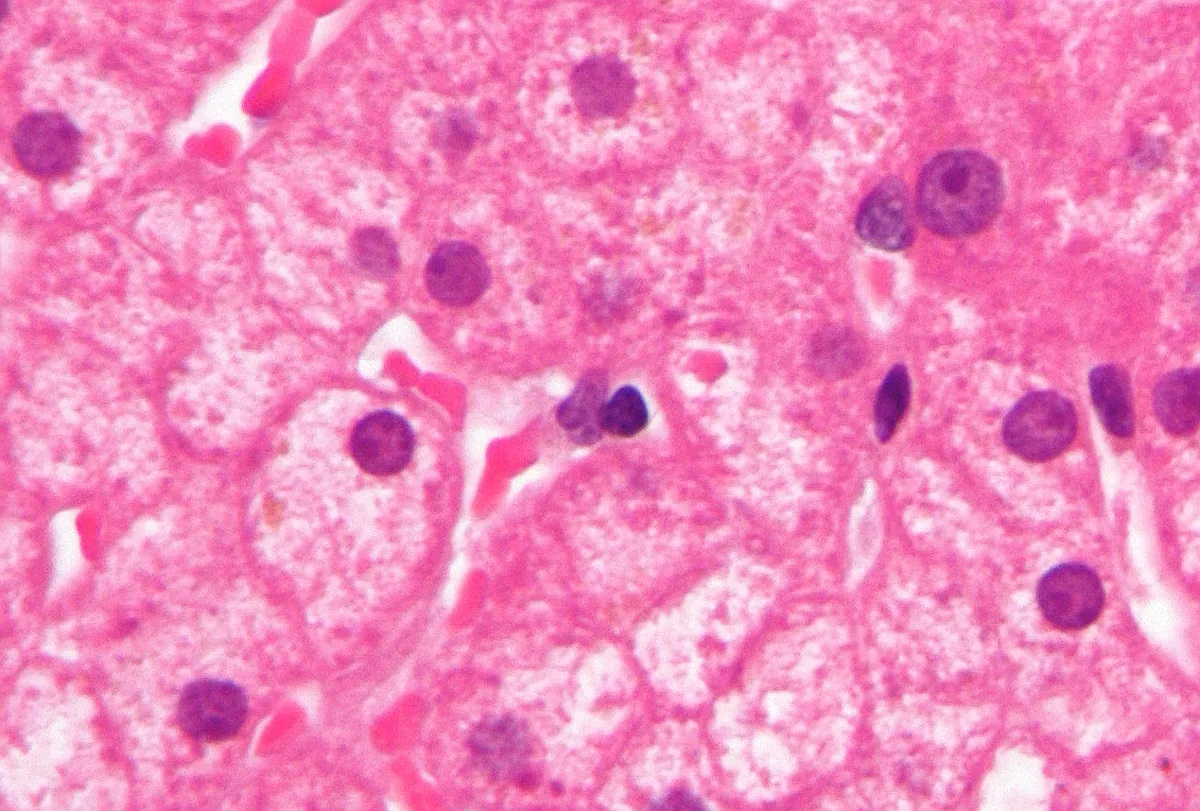 Histology
Definition
Hepatitis B is an infection of the liver with hepatitis B virus (HBV), a small, enveloped DNA virus of the family Hepadnaviridae. The envelope carries the surface antigen HBsAg, and the capsid consists of the core antigen HBcAg; the soluble HBeAg indicates high viral replication. The virus replicates via an RNA intermediate using a reverse transcriptase.
The infection may run an acute course or become chronic. Chronic hepatitis B is present when HBsAg remains detectable in serum for longer than 6 months.
Classification
Chronic HBV infection is divided into phases according to HBeAg status, HBV DNA level and ALT:
- Immune-tolerant phase: HBeAg positive, HBV DNA of 10 million IU/mL or more, normal ALT
- HBeAg-positive immune-active phase: HBeAg positive, HBV DNA of 20,000 IU/mL or more, ALT at least twice the upper limit of normal
- HBeAg-negative immune-active phase: HBeAg negative, HBV DNA of 2,000 IU/mL or more, ALT at least twice the upper limit of normal
- Inactive phase: HBeAg negative, low HBV DNA, normal ALT
- HBsAg-negative phase: HBsAg lost, HBV DNA in serum usually undetectable
Occult HBV infection is present when HBV DNA (typically below 200 IU/mL) is found without detectable HBsAg. Nine genotypes (A–I) are known; genotypes A2 and D predominate in Europe.
Occurrence & epidemiology
Hepatitis B is among the most common infectious diseases worldwide; according to the WHO, about 3% of the world population is chronically infected. Prevalence is highest in sub-Saharan Africa and East Asia (5–10% of adults) and below 1% in Western Europe and North America.
In Germany, the DEGS1 study (2008–2011) found a prevalence of acute or chronic infection of 0.3% in adults; 5.1% had anti-HBc as a sign of past or current infection. Prevalence is considerably higher among people from countries with high prevalence and among people who use drugs.
Aetiopathogenesis
HBV is highly infectious and reaches high concentrations in blood; in HBeAg-positive carriers, tiny amounts of blood can transmit infection through skin or mucosal injuries. Important routes of transmission:
- sexual contact (a large proportion of new infections in industrialised countries)
- perinatal transmission from HBsAg-positive mothers to the newborn, worldwide a main cause of chronic infection
- drug use with shared needles and paraphernalia
- contact with blood in households, communal facilities, through needlestick injuries in healthcare or through unhygienic tattooing and piercing
The incubation period is 45–180 days, usually 60–120 days. The virus itself hardly damages the liver cell: liver inflammation results from the immune reaction against infected hepatocytes.
The risk of chronicity depends on age at infection. After perinatal infection, about 90% of infections become chronic, in young children up to 3 years and in immunocompromised people 30–90%, whereas in adults it is up to 10%.
Clinical features
Acute hepatitis B
In adults, about one third of infections present as acute icteric hepatitis, one third as anicteric illness and one third asymptomatically. The prodromal stage brings loss of appetite, joint pain, nausea, vomiting and fever; 3–10 days later dark urine and jaundice may follow. In children, papular acrodermatitis (Gianotti-Crosti syndrome) may occur. About 0.5–1% of infections run a fulminant course with acute liver failure. More than 90% of acute illnesses in adults resolve completely.
Chronic hepatitis B
Chronic hepatitis B often causes few symptoms for a long time, with fatigue and non-specific upper abdominal discomfort. It can lead to liver cirrhosis and hepatocellular carcinoma; HCC can also develop without cirrhosis. In highly viremic carriers, immune complex diseases such as polyarteritis nodosa and membranous glomerulonephritis occur.
Reactivation with an inflammatory flare is possible in HBsAg carriers and is particularly dangerous under immunosuppression; it can also occur after clinically resolved infection and then run a fulminant course.
Diagnosis
Serology and laboratory tests
- HBsAg: marker of current infection; positive for longer than 6 months means chronic infection
- Total anti-HBc: sign of past or current infection; high titres of IgM anti-HBc suggest acute infection but may also be moderately raised during flares of chronic hepatitis B
- HBeAg and anti-HBe: HBeAg indicates high viral replication; however, many patients with replicative hepatitis B are HBeAg-negative (precore or core promoter variants)
- HBV DNA (quantitative PCR): measure of viral load; earliest marker after infection
- Anti-HBs: detectable together with anti-HBc after the infection has resolved; on its own a sign of immunisation
- Isolated anti-HBc: may correspond to a long-past infection, a latent chronic infection or a false-positive result
When HBV infection is confirmed, anti-HDV is tested. Aminotransferases, coagulation, blood count and fibrosis assessment (elastography) reflect disease activity and liver damage.
Keep learning in the app
Further reading (open access)
Cross-references
More topics: Liver & biliary tract
Note: Learning content for medical education – not a treatment recommendation and no substitute for diagnosis or treatment decisions in individual cases. Treatment and management are deliberately not covered on this page.