Autoimmune hepatitis
Board exam relevance: in 7 of 105 exam reports · rank 53- Synonyms
- AIH, autoimmune liver inflammation, lupoid hepatitis, autoimmune chronic active hepatitis
- Specialty
- Internal medicine · Liver & biliary tract
- Images
- Histology 2
- Last updated
- 10/2026 · Dr. Pascal Bafteh
Contents
Images (2)
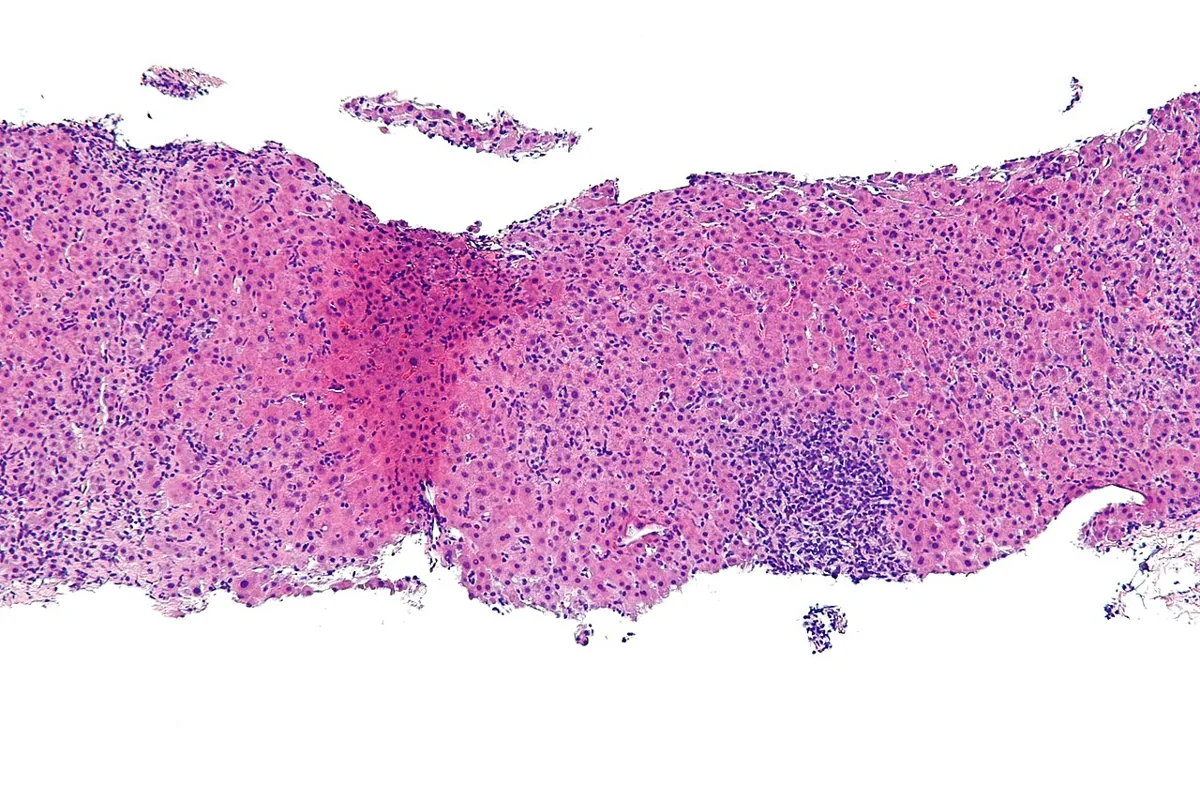 Histology
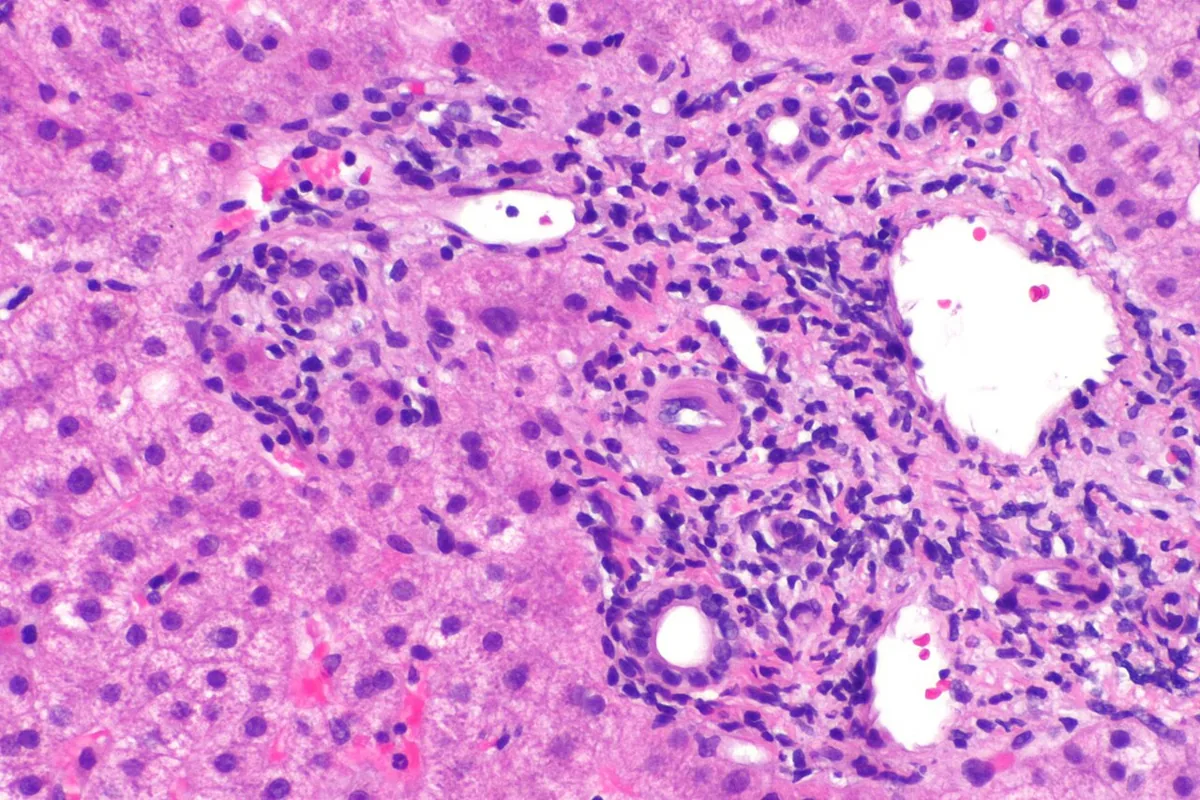 Histology
Definition
Autoimmune hepatitis (AIH) is a chronic, immune-mediated inflammation of the liver parenchyma. It is characterised by raised aminotransferases, raised IgG, circulating autoantibodies and interface hepatitis on histology. There is no single confirmatory test; the diagnosis is based on the combination of clinical, laboratory and histological findings after exclusion of other causes.
Classification
According to the autoantibody profile, the following are distinguished:
- AIH type 1: antinuclear antibodies (ANA), smooth muscle antibodies (SMA, anti-actin) and/or anti-SLA/LP; with about 70% of patients the most common form
- AIH type 2: antibodies to liver-kidney microsomes (anti-LKM1) and/or anti-LC1; about 10% of patients
Anti-SLA/LP has the highest disease specificity. Overlap with PBC or PSC occurs (variant syndromes).
Occurrence & epidemiology
The incidence of AIH in Europe is about 1–2 per 100,000 persons per year, and the prevalence about 10–30 per 100,000. Around 80% of those affected are women. The disease occurs at any age, with a peak of first manifestation between 40 and 70 years.
Aetiopathogenesis
The cause is not fully understood. In genetically predisposed individuals, among others with the HLA types DR3 and DR4, a misdirected T-cell-mediated immune reaction is directed against liver cells. Clustering with other autoimmune diseases is typical:
- autoimmune thyroiditis (Hashimoto's) in 10–23%
- ulcerative colitis, rheumatoid arthritis, Sjögren's syndrome, systemic lupus erythematosus
- celiac disease, type 1 diabetes, vitiligo
- PBC or PSC as overlap
Clinical features
The spectrum ranges from asymptomatic raised liver values through insidious chronic hepatitis to acute icteric hepatitis and fulminant liver failure. With an insidious onset, fatigue and exhaustion predominate. Arthralgia is common; in young women, further manifestations such as acne, amenorrhoea and thyroiditis occur.
At diagnosis, 20–37% of patients already have liver cirrhosis, more often in symptomatic than in asymptomatic patients.
Histology
The key finding is interface hepatitis: a lymphocytic or lymphoplasmacytic infiltrate of the portal tracts crosses the limiting plate and extends into the lobule. Hepatocyte rosettes and single-cell necroses are also seen. In acute first presentation, perivenular necrosis and lobular inflammation are often present; bile duct changes argue against AIH.
Diagnosis
- Laboratory tests: raised aminotransferases, typically raised IgG; testing for ANA, SMA, anti-LKM1 and anti-SLA/LP; TSH because of frequent thyroid involvement
- Exclusion of other causes: viral hepatitis, drug-induced or toxic injury, alcohol, Wilson's disease, fatty liver disease
- Ultrasound and non-invasive fibrosis assessment
- Liver biopsy: usually to confirm the diagnosis and assess inflammatory activity
Diagnostic score
The simplified AIH score (Hennes 2008) supports the diagnosis:
- Autoantibodies: ANA or SMA of 1:40 or more (1 point); ANA or SMA of 1:80 or more, LKM of 1:40 or more or SLA/LP positive (2 points); at most 2 points
- IgG: above normal (1 point), above 1.1 times normal (2 points)
- Histology: compatible with AIH (1 point), typical of AIH (2 points)
- Absence of viral hepatitis: 2 points
From 6 points AIH is probable, from 7 points it is considered definite. The more detailed revised score of the International Autoimmune Hepatitis Group also exists.
Keep learning in the app
Further reading (open access)
Cross-references
More topics: Liver & biliary tract
Note: Learning content for medical education – not a treatment recommendation and no substitute for diagnosis or treatment decisions in individual cases. Treatment and management are deliberately not covered on this page.