Reactive arthritis
Board exam relevance: in 3 of 105 exam reports · rank 111- Synonyms
- Reiter syndrome, postinfectious arthritis, Reiter's disease
- Specialty
- Internal medicine · Rheumatology & immunology
- Images
- Clinical 1
- Last updated
- 10/2026 · Dr. Pascal Bafteh
Contents
Images (1)
Definition
Reactive arthritis is an acute spondyloarthritis usually triggered by a preceding genitourinary or gastrointestinal infection. It is a postinfectious arthritis: microbial antigens can sometimes be detected in the synovium by PCR, but the organizms cannot be cultured from joint fluid. The spectrum ranges from transient monoarthritis to a severe multisystem disorder.
Occurrence & epidemiology
The sexually transmitted form occurs primarily in men aged 20 to 40. The postenteric (dysenteric) form occurs in both sexes. HLA-B27 is found in up to about 80 % of patients compared with about 7 % of healthy controls.
Aetiopathogenesis
- Genitourinary form: most often after infection with Chlamydia trachomatis.
- Postenteric form: after infections with Shigella, Salmonella, Yersinia, Campylobacter, or Clostridioides difficile.
- Also described after BCG instillation for bladder cancer.
- In about 40 %, no pathogen can be identified.
- Genetic predisposition through HLA-B27.
Clinical features
- Urethritis 7–14 days after sexual contact (less often after diarrhea), followed over the next weeks by low-grade fever, conjunctivitis, and arthritis; incomplete forms are common.
- Arthritis: asymmetric and oligoarticular, mainly toes and large joints of the legs; large, often surprisingly minimally painful knee effusions; dactylitis.
- Enthesitis (plantar fasciitis, Achilles tendinitis, digital periostitis) is common and characteristic.
- Back pain in severe disease; chronic axial involvement more often in HLA-B27-positive patients, with asymmetric, bulky syndesmophytes.
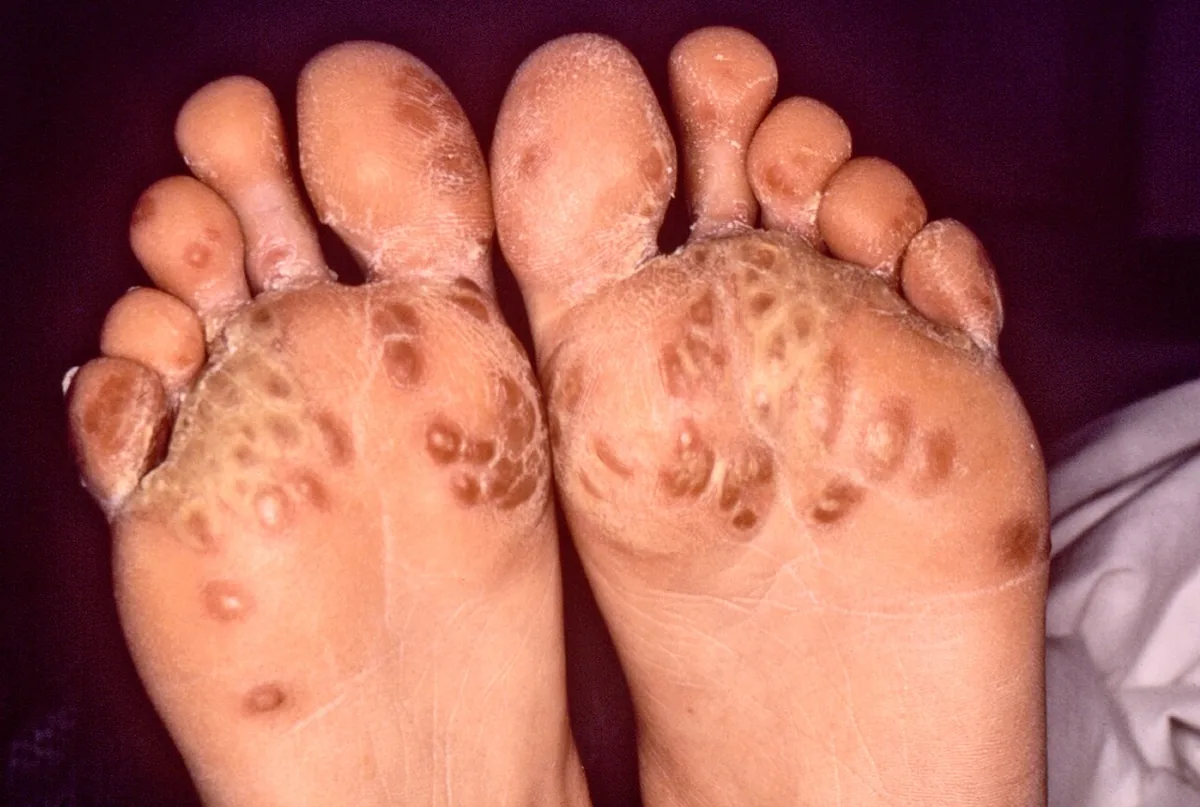
- Skin and mucosa: painless superficial ulcers on the oral mucosa, tongue, and glans penis (balanitis circinata); keratoderma blennorrhagicum on palms and soles; nail dystrophy; erythema nodosum especially after Yersinia infection.
- Eyes: conjunctivitis most common, also keratitis and anterior uveitis.
- Rarely aortitis, aortic insufficiency, conduction abnormalities, pleuritis.
- Constitutional symptoms: fever, fatigue, weight loss.
Diagnosis
- The diagnosis is clinical: typical peripheral arthritis plus symptoms of a genitourinary or gastrointestinal infection or another extra-articular feature. Because features appear at different times, diagnosis may take months.
- Suspicious is acute asymmetric arthritis of the large leg joints or toes, especially with enthesitis, dactylitis, or preceding diarrhea or dysuria.
- Complement levels in serum and synovial fluid are elevated but not diagnostic.
- In severe reactive arthritis, HIV infection is considered.
Keep learning in the app
Further reading (open access)
Cross-references
More topics: Rheumatology & immunology
- Rheumatoid arthritis
- Systemic lupus erythematosus (SLE)
- Granulomatosis with polyangiitis (GPA)
- Polymyalgia rheumatica
- Gout
- Behçet's disease
- Giant cell arteritis (temporal arteritis)
- Septic arthritis
- Mixed connective tissue disease (Sharp syndrome)
- Psoriatic arthritis
- Uveitis in rheumatic diseases
- Adult-onset Still's disease
Note: Learning content for medical education – not a treatment recommendation and no substitute for diagnosis or treatment decisions in individual cases. Treatment and management are deliberately not covered on this page.