Hepatocellular carcinoma (HCC)
- Synonyms
- HCC, liver cancer, hepatoma, primary liver cancer, liver cell carcinoma
- Specialty
- Internal medicine · Liver & biliary tract
- Images
- CT 1 · Blood smear & cytology 1 · Histology 1
- Last updated
- 10/2026 · Dr. Pascal Bafteh
Contents
Images (3)
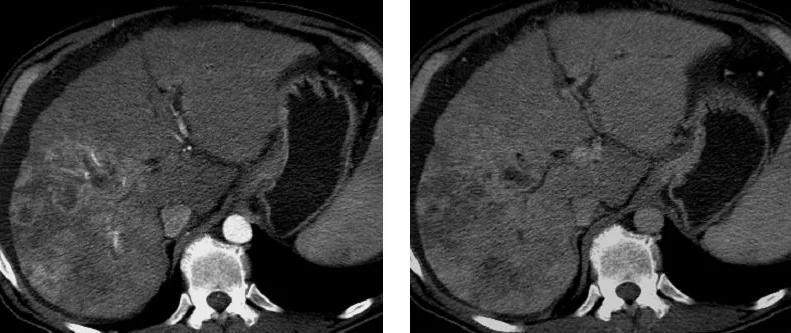 CT
CT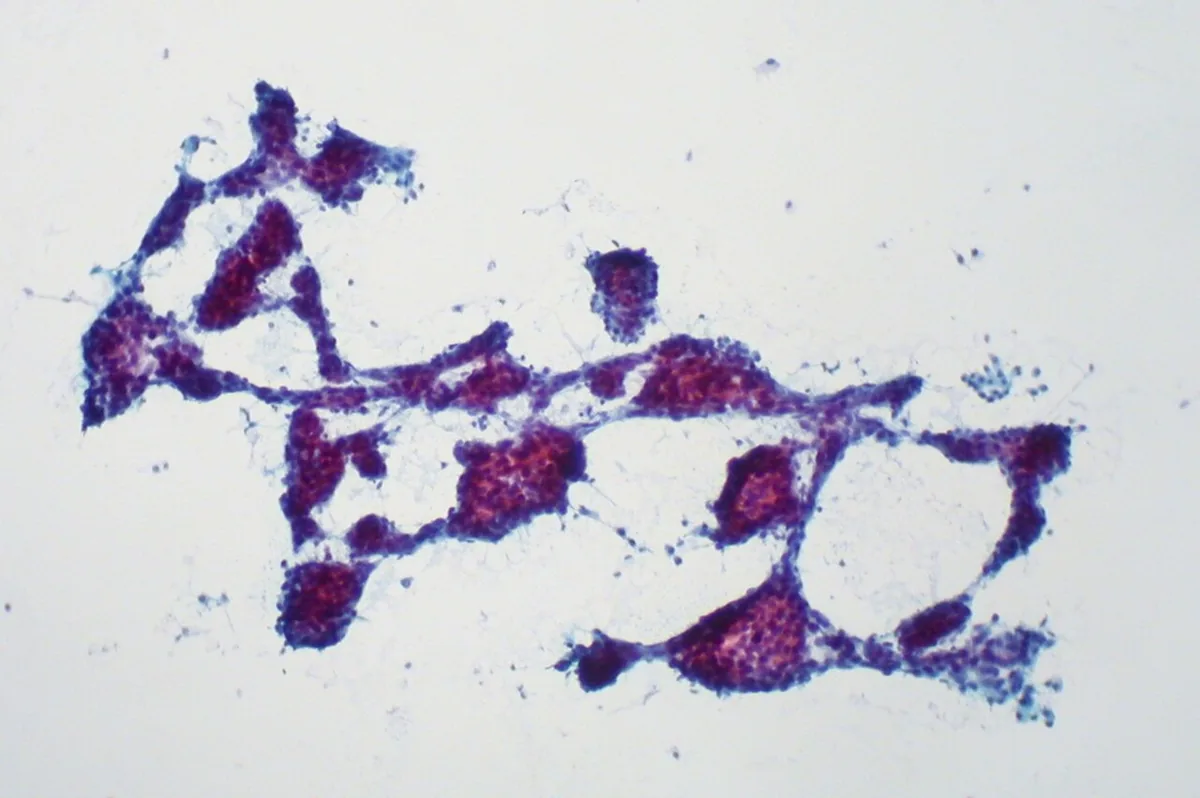 Blood smear & cytology
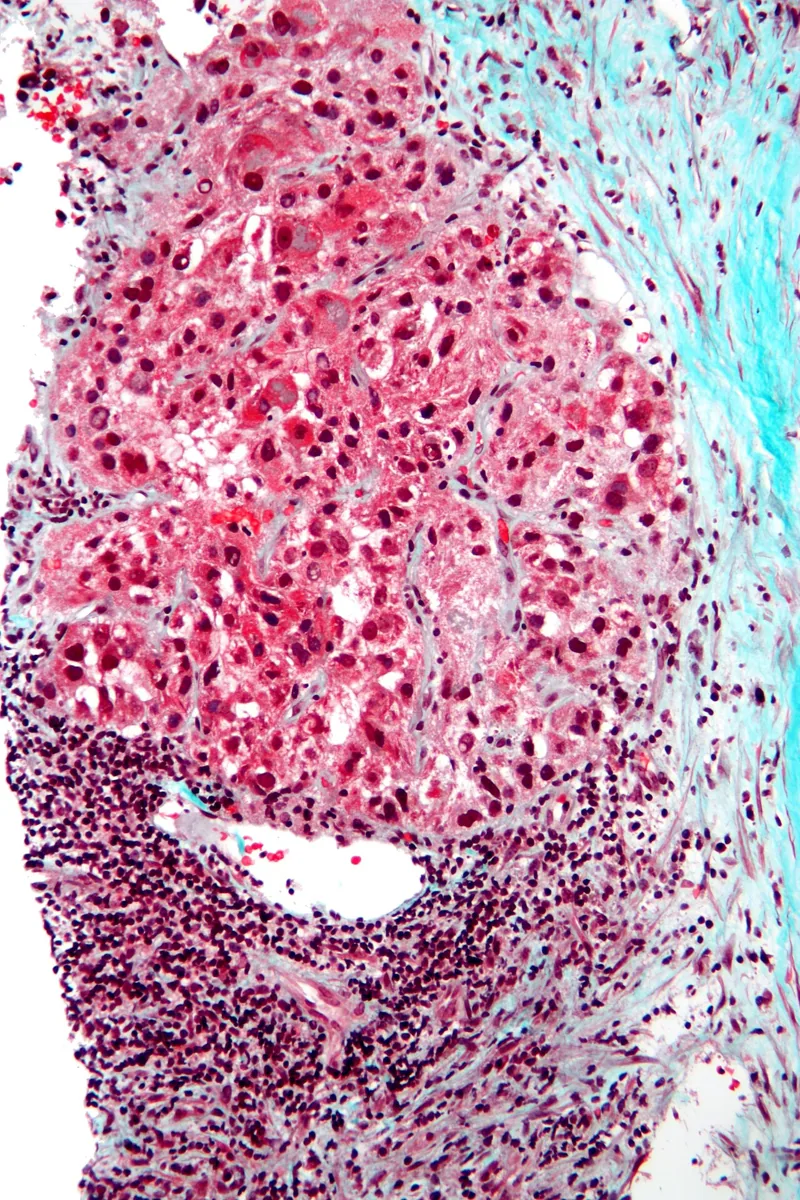 Histology
Definition
Hepatocellular carcinoma (HCC) is a malignant tumor arising from liver cells. It is the most common primary liver cancer and develops predominantly on the basis of liver cirrhosis.
Classification
LI-RADS
LI-RADS grades liver observations in patients at increased risk of HCC by level of suspicion from LR-1 (definitely benign) to LR-5 (definitely HCC); in addition there are LR-M (probably malignant, but not specific for HCC) and LR-TIV (tumor in vein).
- Major features on CT and MRI: non-rim arterial phase hyperenhancement, non-peripheral washout, enhancing capsule and threshold growth (size increase of at least 50% in at most 6 months)
- Observations of 10–19 mm: arterial phase hyperenhancement plus washout or threshold growth gives LR-5, arterial phase hyperenhancement with capsule only gives LR-4
- Washout alone is not sufficient for LR-5
For staging, the TNM classification, the Okuda classification and the Barcelona Clinic Liver Cancer (BCLC) classification are used. Okuda and BCLC take into account not only the size, number and spread of tumors but also the severity of the liver disease.
Occurrence & epidemiology
In the USA, HCC accounts for about three quarters of all primary liver cancers. It is much more common in East Asia and sub-Saharan Africa, where its frequency parallels the prevalence of chronic hepatitis B infection. Men are affected about twice as often as women.
Aetiopathogenesis
The most important risk factor is liver cirrhosis of any cause. The annual incidence of HCC in cirrhosis is about 1% (e.g. MASH, hemochromatosis) up to 3–5% (chronic hepatitis C), depending on the underlying disease.
- Hepatitis B: increases the risk in carriers more than a hundredfold; through integration of viral DNA into the host genome, HCC can develop even without cirrhosis
- Hepatitis C, alcoholic cirrhosis and hemochromatosis
- MASH: possible even without cirrhosis; MASH now accounts for about half of HCC cases without cirrhosis
- Aflatoxins: mould toxins in contaminated food contribute to the high rate in subtropical regions
Clinical features
Usually there are no symptoms, and the tumor is discovered during routine examinations. Advanced tumors cause abdominal pain, weight loss, a palpable mass in the right upper quadrant, fever and unexplained deterioration of known liver disease. Occasionally a friction rub or bruit can be heard over the liver.
Rarely, tumor hemorrhage with bloody ascites, shock or peritonitis is the first sign. Paraneoplastic hypoglycemia, erythrocytosis, hypercalcemia and hyperlipidemia may occur.
Diagnosis
- Suspicion with unexplained decompensation of chronic liver disease or a new liver lesion, especially in cirrhosis
- Alpha-fetoprotein (AFP): markedly raised (above 400 ng/mL) in 40–65% of patients; lower elevations are non-specific and also occur with hepatocyte regeneration, for example in hepatitis. AFP-L3 and des-gamma-carboxy prothrombin (DCP) complement the work-up.
- Imaging: contrast-enhanced multiphase CT or MRI, alternatively contrast-enhanced ultrasound; typical features are arterial hyperenhancement, washout in the delayed phase, a pseudocapsule and growth over time. In cirrhosis, HCC can thus be confirmed according to LI-RADS without biopsy.
- Liver biopsy: only in unclear cases
- Staging: chest CT, imaging of the portal vein (tumor thrombus), bone scintigraphy if needed; assessment of liver function with the Child-Pugh score
Keep learning in the app
Further reading (open access)
- MSD Manual Professional: Hepatocellular Carcinoma
- MSD Manual Professional: Cirrhosis
- CT/MRI LI-RADS v2018 versus CEUS LI-RADS v2017 in primary hepatic nodules (Ann Transl Med 2021)
- CT/MRI LI-RADS v2018 vs. CEUS LI-RADS v2017 – Can Things Be Put Together? (Biology 2021)
- Diagnostic Performance of LI-RADS Version 2018 for Primary Liver Cancer in Liver Cirrhosis (Front Oncol 2022)
Cross-references
More topics: Liver & biliary tract
Note: Learning content for medical education – not a treatment recommendation and no substitute for diagnosis or treatment decisions in individual cases. Treatment and management are deliberately not covered on this page.