Drug-induced liver injury (DILI)
Board exam relevance: in 1 of 105 exam reports · rank 181- Synonyms
- DILI, drug hepatitis, drug-induced hepatitis, hepatotoxicity, toxic hepatitis, Hy's law
- Specialty
- Internal medicine · Liver & biliary tract
- Images
- Histology 1
- Last updated
- 10/2026 · Dr. Pascal Bafteh
Contents
Images (1)
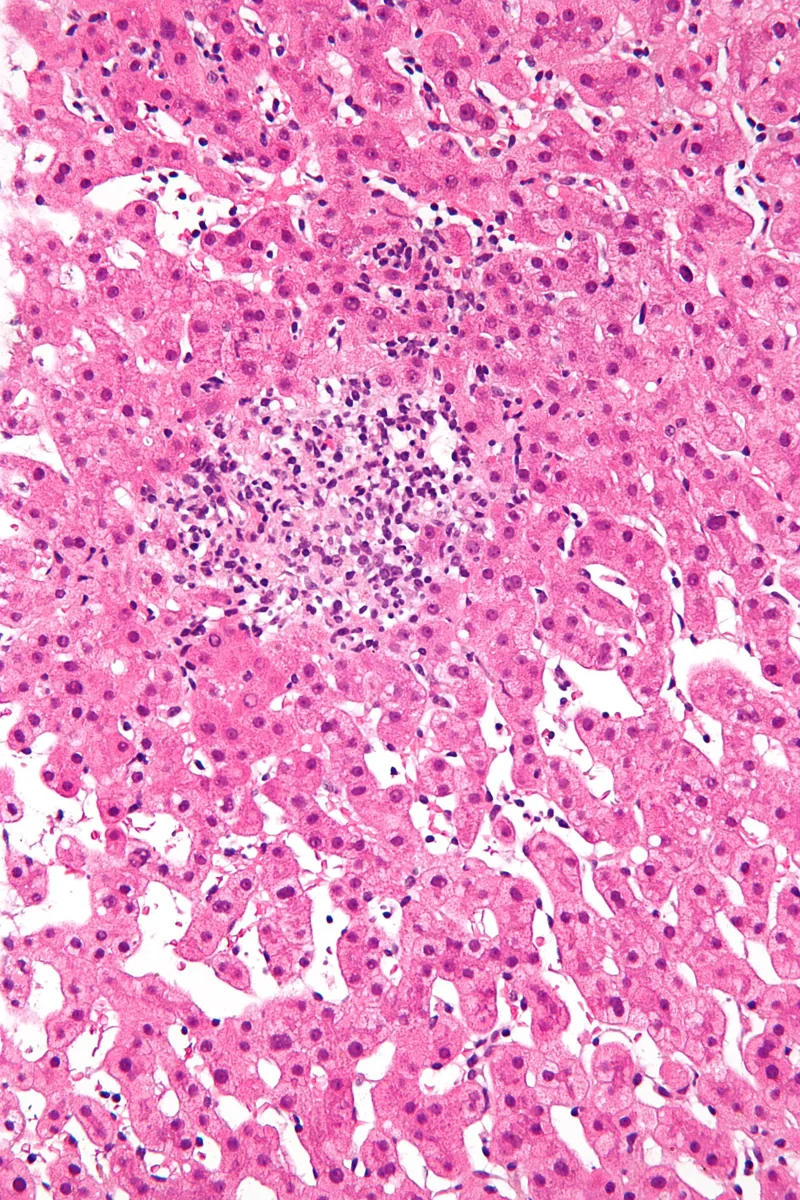 Histology
Definition
Drug-induced liver injury (DILI) is liver damage caused by medicines, herbal products or nutritional products. The spectrum ranges from asymptomatic rises in liver values to acute liver failure. There is no confirmatory test; the diagnosis is based on the temporal relationship, the typical pattern of injury and the exclusion of other causes.
Classification
- Predictable (intrinsic) liver injury: dependent on the amount taken, shortly after exposure; the typical example is paracetamol-induced liver injury
- Unpredictable (idiosyncratic) liver injury: independent of the amount taken, after a latency period, rare overall
Pattern of injury
The pattern of injury is derived from the ratio R: ALT as a multiple of the upper limit of normal divided by ALP as a multiple of the upper limit of normal, measured when liver injury is suspected.
- Hepatocellular: R ≥ 5
- Cholestatic: R ≤ 2
- Mixed: R between 2 and 5
Aetiopathogenesis
Possible mechanisms are binding of the substance to cell proteins with a subsequent immune reaction, blockage of metabolic pathways, blockade of transport pumps of bile secretion, disturbed mitochondrial function and induction of programmed cell death.
Risk factors depend on the substance and are only partly known: age, obesity and diabetes, pre-existing liver disease, alcohol and tobacco use and genetic variants (e.g. in the PTPN22 gene).
Common triggers by pattern (examples): hepatocellular, for instance paracetamol, tuberculosis drugs, statins, valproate, green tea extract and kava; cholestatic, for instance antibacterial combinations with clavulanate, chlorpromazine, estrogens and anabolic androgens; mixed, for instance phenytoin, carbamazepine and sulfonamides.
Clinical features
Many cases are asymptomatic and are noticed only because of raised liver values. Non-specific complaints such as malaise, nausea and loss of appetite are possible, up to jaundice, impaired hepatic synthetic function and encephalopathy.
- Hepatocellular pattern: malaise and upper abdominal pain with a marked rise in aminotransferases; if jaundice develops (hepatocellular jaundice), the course is particularly severe
- Cholestatic pattern: pruritus and jaundice with a marked rise in alkaline phosphatase; usually less severe, but recovery can be protracted; rarely progression to vanishing bile duct syndrome
- Mixed pattern: neither aminotransferases nor ALP clearly predominate
Diagnosis
- History: complete record of all medicines, herbal remedies and nutritional products with start and duration; comparison with the known injury profile of the substance (e.g. in the LiverTox database)
- Clinically significant DILI is present with at least one criterion: AST or ALT above 5 times normal or ALP above 2 times normal (twice at least 24 hours apart); total bilirubin above 2.5 mg/dL with raised aminotransferases or ALP; INR above 1.5 with raised aminotransferases or ALP
- Exclusion of other causes: viral hepatitis, biliary disease (ultrasound), alcohol, autoimmune hepatitis and metabolic disorders
- Improvement of liver values after the end of exposure supports the diagnosis.
Hy's law
- Hy's Law constellation: ALT > 3× ULN + bilirubin > 2× ULN (no AP-dominant rise) + other causes excluded.
- Histology: depending on substance — steatosis, lobular hepatitis, granulomatous, etc.
Causality assessment (RUCAM)
The updated RUCAM (Roussel Uclaf Causality Assessment Method) assesses causality in a structured way, with separate scales for hepatocellular and for cholestatic or mixed injury. The total score is graded as follows:
- 0 points or less: excluded
- 1–2 points: unlikely
- 3–5 points: possible
- 6–8 points: probable
- 9 points or more: highly probable
Keep learning in the app
Further reading (open access)
Cross-references
More topics: Liver & biliary tract
Note: Learning content for medical education – not a treatment recommendation and no substitute for diagnosis or treatment decisions in individual cases. Treatment and management are deliberately not covered on this page.