Krukenberg tumour
Exam relevance: in 1 of 197 board exam reports · rank 171
- Specialty
- Gynaecology · Ovary & adnexa
- Images
- Endoscopy & gross 1 · Mammography/MRI 1
- Exam relevance
- 1 of 197 reports · rank 171
- In the app
- 1 flashcards · GynFuchs
- Last updated
- 10/2026 · Dr. Pascal Bafteh
Contents
Images (2)
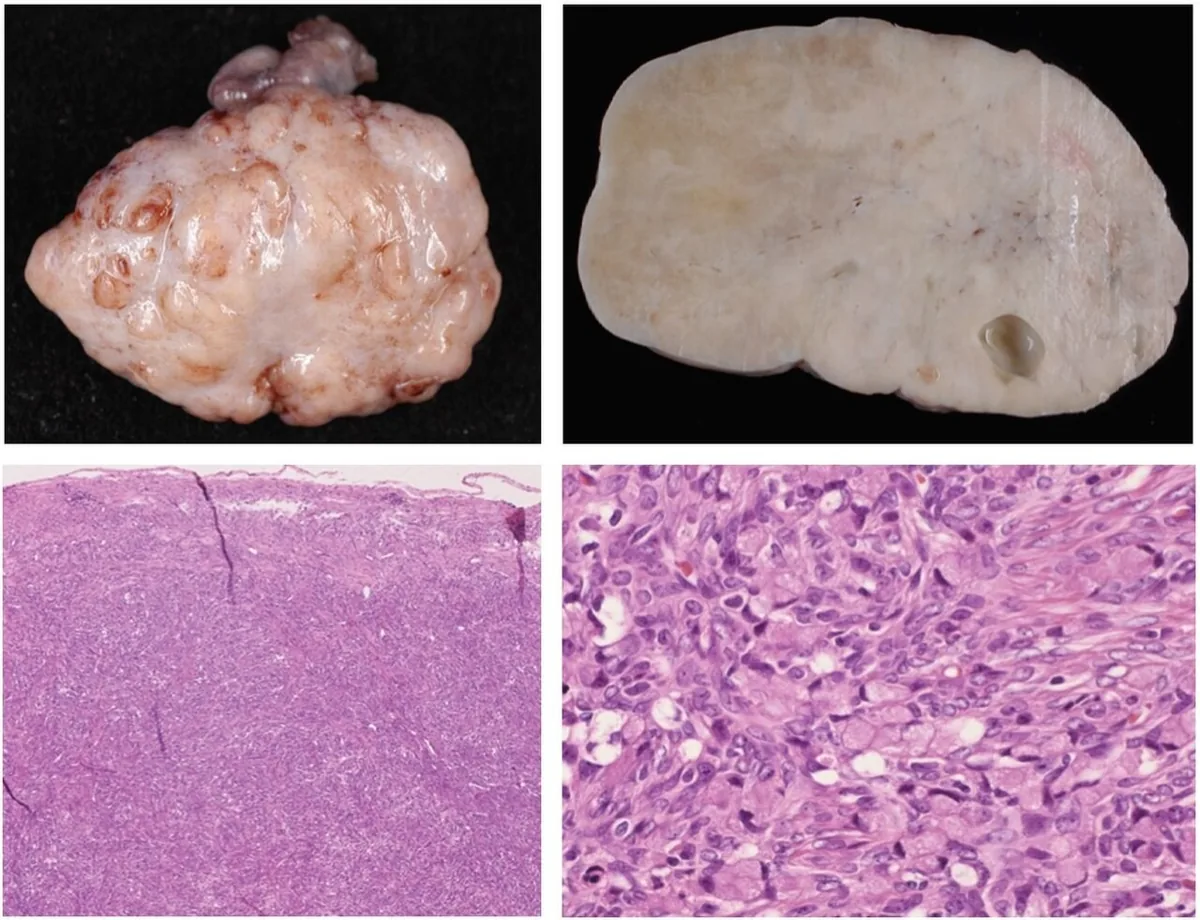 Endoscopy & gross
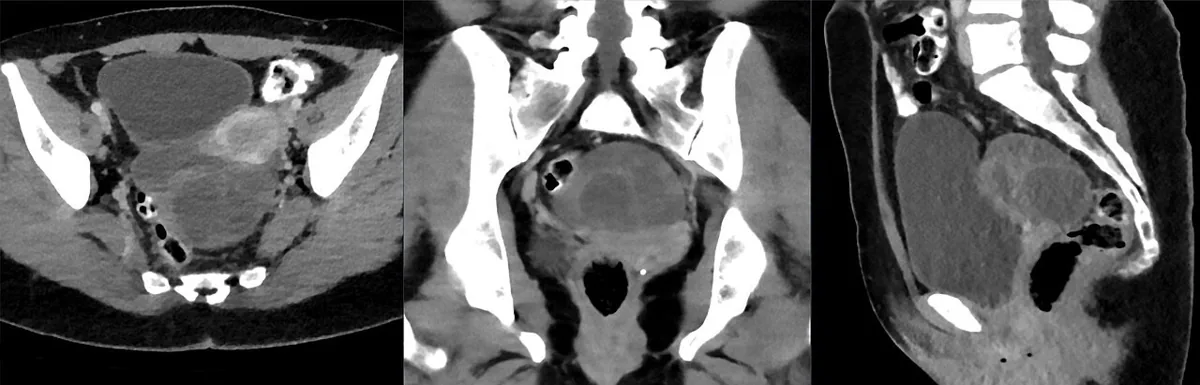 Mammography/MRI
Definition
Krukenberg tumour
- Krukenberg tumour: The Krukenberg tumour is a bilateral ovarian metastasis with signet ring cells, most commonly from gastric cancer.
- Krukenberg tumour is an ovarian metastasis of signet-ring cell carcinoma, mostly from the gastrointestinal tract and in about 76% from the stomach.
- Less often the primary lies in the appendix, breast, colon, small bowel, gallbladder, pancreas or genitourinary tract; occasionally it is not found.
Occurrence & epidemiology
Epidemiology
- About 10% of ovarian tumours are metastases, nearly half of them Krukenberg tumours; the proportion is higher in Japan, Korea and China because gastric cancer is more common there.
- Patients tend to be young, with an average age of about 45 years.
Aetiopathogenesis
Spread
- Spread is often lymphatic, via retrograde lymphatic spread in gastric cancer, but may also be haematogenous or by direct invasion.
Clinical features
- Abdominal pain and distension are common, as are bloating, ascites, irregular vaginal bleeding and dyspareunia; the ovarian symptoms may be the first sign of the cancer.
- The remaining patients have non-specific gastrointestinal complaints or are asymptomatic.
- Ascites is present in about half of cases and usually contains malignant cells; changes in the ovarian stroma can lead to hormone production.
Histology
- Signet-ring cells with pale cytoplasm lie singly or in nests within the ovarian stroma; a sarcoma-like stromal reaction is typical, and the stroma may also be luteinised.
- Signet-ring cells are highly specific for a metastatic origin, but they may rarely occur in primary mucinous ovarian carcinomas as well.
Diagnosis
- Ultrasound and CT usually show bilateral solid ovarian masses, less often cystic ones; both ovaries are involved in about 80%.
- The primary tumour is often very small and requires careful radiological and endoscopic search.
Keep learning in the app
Further reading (selection)
- StatPearls: Krukenberg Tumor
- Krukenberg tumor presenting as back pain and a positive urine pregnancy test: a case report and literature review (J Ovarian Res 2014, PubMed Central)
- Primary mucinous ovarian tumors vs. ovarian metastases from gastrointestinal tract, pancreas and biliary tree: a review of current problematics (Diagn Pathol 2021, PubMed Central)
- DocCheck Flexikon, Ovarialtumor
Cross-references
More topics: Ovary & adnexa
- Ovarian cysts (adnexal cysts)
- Corpus luteum cyst and haemorrhagic ovarian cyst
- Mature cystic teratoma (dermoid cyst)
- Adnexal torsion (ovarian torsion)
- Ovarian cancer
- Borderline ovarian tumour
- Ovarian germ cell tumours
- Granulosa cell tumour and sex cord-stromal tumours
- Pelvic inflammatory disease (PID)
- Tubo-ovarian abscess
Note: Learning content from the GynFuchs app (flashcards, exam questions, image cases) for medical education – not a treatment recommendation and no substitute for diagnosis or treatment decisions in individual cases. Treatment and management are deliberately not covered on this page.