Borderline ovarian tumour
Exam relevance: in 5 of 197 board exam reports · rank 101
- Specialty
- Gynaecology · Ovary & adnexa
- Images
- Ultrasound 2
- Exam relevance
- 5 of 197 reports · rank 101
- In the app
- 1 flashcards · GynFuchs
- Last updated
- 10/2026 · Dr. Pascal Bafteh
Contents
Images (2)
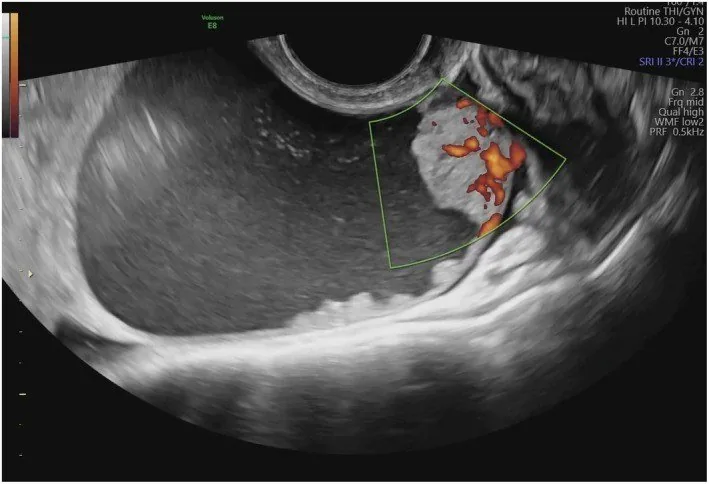 Ultrasound
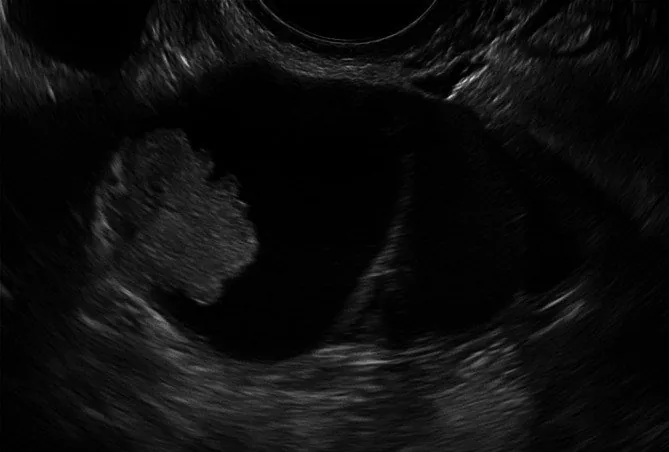 Ultrasound
Definition
- Definition: A borderline tumour is an epithelial tumour with cellular atypia and proliferation, but without destructive stromal invasion.
- Patient population: It often affects significantly younger women than invasive carcinoma, often with a desire to have children.
- Ultrasound: On ultrasound, it is often noted for papillary projections in an otherwise unilocular cyst.
- Borderline ovarian tumours are epithelial tumours whose behaviour lies between benign tumours and invasive carcinomas.
- They show no destructive stromal invasion, which distinguishes them from other ovarian neoplasms.
Classification
Staging
- Mucinous subtype: For a mucinous borderline tumour, infracolic omentectomy and assessment of the appendix is added.
- The commonest subtypes are serous (about 50%) and mucinous (about 45%); endometrioid, clear cell, seromucinous and Brenner borderline tumours are rarer.
- Despite the absence of stromal invasion, microinvasion, lymph node involvement and non-invasive or invasive peritoneal implants may occur.
Occurrence & epidemiology
Epidemiology
- They occur in 1.8–4.8 per 100,000 women per year and make up 10–20% of epithelial ovarian tumours; women of reproductive age are frequently affected.
Aetiopathogenesis
Pathogenesis
- Molecularly, borderline tumours resemble low-grade serous carcinomas; in some cases a gradual progression from cystadenoma through borderline tumour to low-grade serous carcinoma has been observed.
- The BRAF V600E mutation is found in up to 40% of serous borderline tumours.
Diagnosis
- Before histological confirmation, assessment relies on markers such as CA 125, HE4 and the ROMA algorithm; imaging and tumour markers alone cannot reliably distinguish a borderline tumour from early ovarian carcinoma.
- The diagnosis is histological; frozen section is less accurate for borderline tumours than for benign or malignant tumours, and particularly in bulky tumours microinvasion or intraepithelial carcinoma may be missed.
Keep learning in the app
Further reading (selection)
Cross-references
More topics: Ovary & adnexa
- Ovarian cysts (adnexal cysts)
- Corpus luteum cyst and haemorrhagic ovarian cyst
- Mature cystic teratoma (dermoid cyst)
- Adnexal torsion (ovarian torsion)
- Ovarian cancer
- Ovarian germ cell tumours
- Granulosa cell tumour and sex cord-stromal tumours
- Krukenberg tumour
- Pelvic inflammatory disease (PID)
- Tubo-ovarian abscess
Note: Learning content from the GynFuchs app (flashcards, exam questions, image cases) for medical education – not a treatment recommendation and no substitute for diagnosis or treatment decisions in individual cases. Treatment and management are deliberately not covered on this page.