Hydrops fetalis
Exam relevance: in 5 of more than 150 board exam reports · rank 101
- Specialty
- Obstetrics · Fetus & prenatal medicine
- Images
- Ultrasound 3 · Clinical 4
- Exam relevance
- 5 of more than 150 reports · rank 101
- In the app
- 1 flashcard · GynFuchs
- Last updated
- 10/2026 · Dr. Pascal Bafteh
Contents
Images (7)
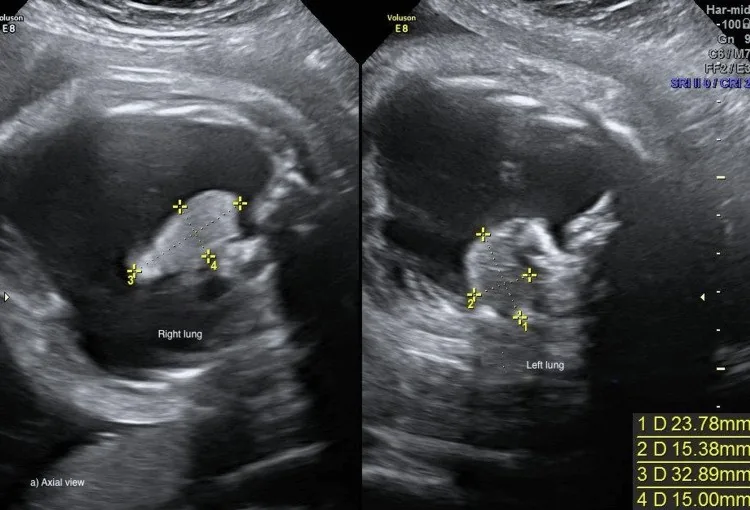 Ultrasound
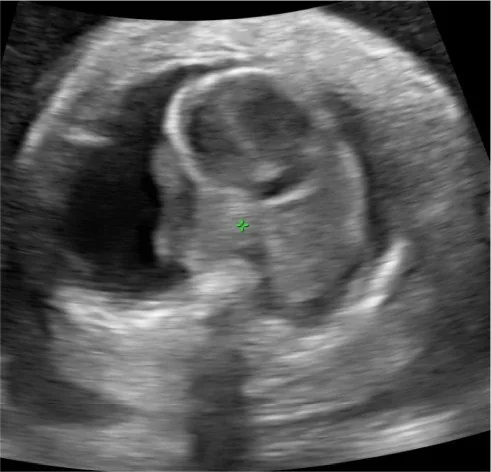
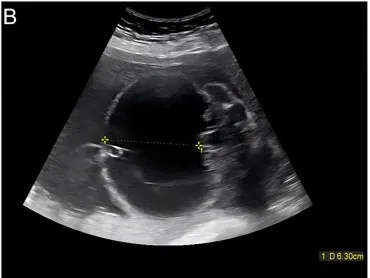 Ultrasound
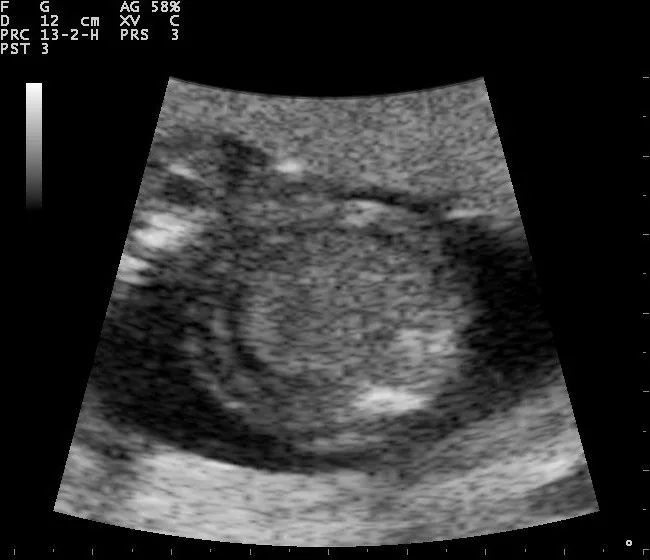
 Ultrasound
Definition
Definition and findings
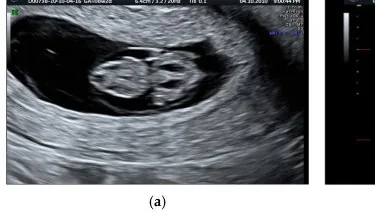
- A cystic hygroma represents an extreme variant of increased nuchal translucency and is associated with conditions such as Turner syndrome, trisomy 21 and 18, and Noonan syndrome.
- A resolving cystic hygroma can later present as pterygium colli.
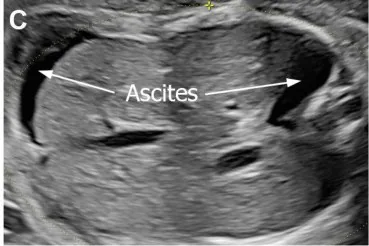
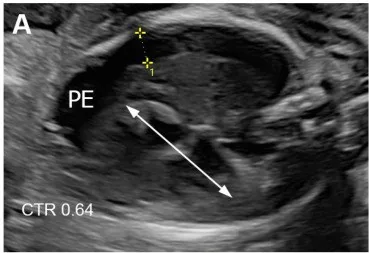
- The diagnosis of hydrops fetalis requires evidence of fluid in at least two compartments, such as skin oedema >5 mm, ascites, pleural or pericardial effusion.
Aetiopathogenesis
Causes of hydrops fetalis
- The classic immunological cause is a blood group incompatibility, most notably Rh and Kell incompatibility.
- The majority of cases today have non-immune causes, such as cardiac malformations, tachyarrhythmias, or fetal anaemia, for example due to parvovirus B19.
- The mnemonic PTORCH summarises important infectious causes, where P stands for Parvovirus B19.
Treatment principles
- Treatment depends on the cause and is delivered at a specialised centre, including maternal antibody screening and Doppler assessment for fetal anaemia.
- In severe fetal anaemia, for example due to red cell alloimmunisation or parvovirus infection, intrauterine transfusion is the treatment of choice; in twin-to-twin transfusion syndrome, laser coagulation of the anastomoses; and in fetal tachyarrhythmias, transplacental antiarrhythmic therapy.
- The mother is monitored for mirror syndrome; the prognosis depends heavily on the cause.
Specific treatment regimens with drugs and doses are covered in the GynFuchs app.
Keep learning in the app
Further reading (selection)
Cross-references
More topics: Fetus & prenatal medicine
- Cystic hygroma and increased nuchal translucency
- Congenital diaphragmatic hernia
- Cleft lip and palate (prenatal)
- Omphalocele and gastroschisis
- Spina bifida (neural tube defect)
- Trisomy 18 and 13
- Trisomy 21 (prenatal diagnosis)
- Ventriculomegaly and hydrocephalus
- Anencephaly
- Congenital heart defects (prenatal)
Keep learning
Keep learning with flashcards, exam questions and spot diagnoses in the GynFuchs app – free, in your browser or as an app.
Related pages: Cystic hygroma and increased nuchal translucency · Congenital diaphragmatic hernia · Cleft lip and palate (prenatal)
Note: Learning content from the GynFuchs app (flashcards, exam questions, image cases) for medical education – not a treatment recommendation and no substitute for diagnosis or treatment decisions in individual cases. Treatment and management are deliberately not covered on this page.