Congenital heart defects (prenatal)
Exam relevance: in 2 of 197 board exam reports · rank 144
- Specialty
- Obstetrics · Fetus & prenatal medicine
- Images
- Clinical 1
- Exam relevance
- 2 of 197 reports · rank 144
- Last updated
- 10/2026 · Dr. Pascal Bafteh
Contents
Images (1)
Definition
- Congenital heart defects are structural malformations of the heart and great vessels and the most common form of birth defects.
Classification
- Conotruncal anomalies include transposition of the great arteries, tetralogy of Fallot, double-outlet right ventricle and truncus arteriosus.
- Other examples are ventricular septal defect, atrioventricular septal defect and coarctation of the aorta.
Occurrence & epidemiology
Epidemiology
- They affect about 8 to 10 per 1,000 live-born term infants (0.8 to 1%); in preterm infants the rate is up to ten times higher.
Aetiopathogenesis
Aetiology and associations
- Chromosomal anomalies are frequently associated; with a prenatally detected ventricular septal defect the rate is about 10 to 30% depending on type and size, and atrioventricular septal defect is often linked to trisomy 21.
- Increased nuchal translucency is associated with fetal heart defects; apparently isolated findings may reflect an underlying heart defect.
Clinical features
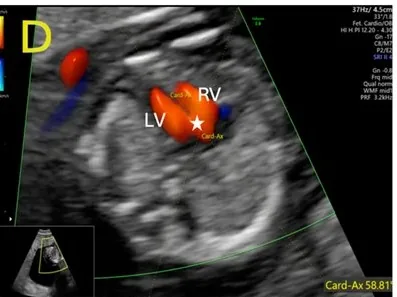
- Atrioventricular septal defect is usually tolerated in utero; a few fetuses develop heart failure with non-immune hydrops due to severe AV valve regurgitation or complete heart block.
Diagnosis
- Normally two thirds of the heart lie on the left and the cardiac axis is about 45 ± 20 degrees; an abnormal axis is associated with chromosomal anomalies and heart defects.
- The four-chamber view alone misses many conotruncal anomalies; adding the outflow tracts raised sensitivity from about 30% to 69 to 83%, and the three-vessel and three-vessel-trachea views are added.
- An absent or hypoplastic thymus in the three-vessel view points to a 22q11.2 deletion.
Keep learning in the app
Further reading (selection)
Cross-references
Note: Learning content from the GynFuchs app (flashcards, exam questions, image cases) for medical education – not a treatment recommendation and no substitute for diagnosis or treatment decisions in individual cases. Treatment and management are deliberately not covered on this page.