Congenital diaphragmatic hernia
Exam relevance: in 2 of 197 board exam reports · rank 144
- Specialty
- Obstetrics · Fetus & prenatal medicine
- Images
- Clinical 1
- Exam relevance
- 2 of 197 reports · rank 144
- Last updated
- 10/2026 · Dr. Pascal Bafteh
Contents
Images (1)
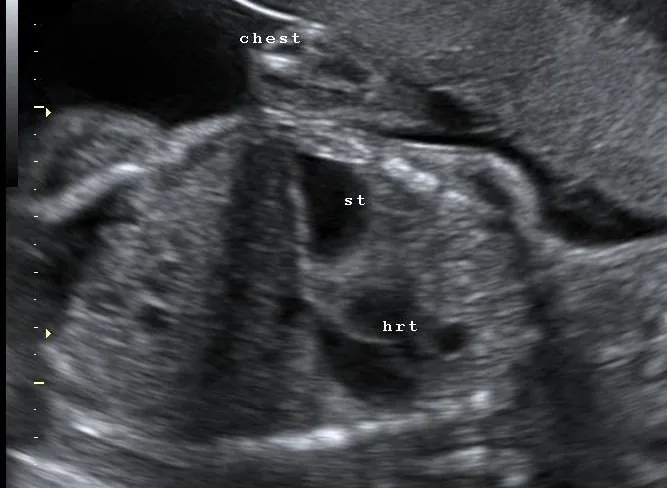
Definition
- Developmental defect of the diaphragm that allows abdominal viscera to enter the chest, resulting in pulmonary hypoplasia, pulmonary hypertension and cardiac strain.
Classification
- In about 95% the defect is posterolateral (Bochdalek hernia), left-sided in about 85% and bilateral in about 2%; Bochdalek hernias are usually the most clinically severe.
- Anterior Morgagni hernias arising from an anteromedial defect are much less common at about 5%.
Aetiopathogenesis
Aetiology and pathophysiology
- Small and large bowel, stomach, liver and spleen may herniate through the defect into the chest; with large hernias the lung on the affected side is hypoplastic, and the contralateral lung may also be affected.
- Underdevelopment of the pulmonary vasculature raises pulmonary vascular resistance and leads to pulmonary hypertension with possible right-to-left shunting through the foramen ovale or a patent ductus arteriosus.
- In about 50% other congenital anomalies are present, particularly heart defects.
Clinical features
- Respiratory distress usually develops in the first hours of life, immediately after birth in severe cases; typical are a scaphoid abdomen and bowel sounds with absent breath sounds over the affected hemithorax, and with smaller defects symptoms may begin only after hours or days.
Diagnosis
- Prenatally the hernia may be detected on ultrasound, and fetal MRI allows additional risk stratification.
- After birth, the radiograph shows stomach and bowel loops in the chest with displacement of the heart and mediastinum to the opposite side; CT and MRI assess defect location, contents and lung volumes, and echocardiography screens for associated heart defects.
Keep learning in the app
Further reading (selection)
Cross-references
Note: Learning content from the GynFuchs app (flashcards, exam questions, image cases) for medical education – not a treatment recommendation and no substitute for diagnosis or treatment decisions in individual cases. Treatment and management are deliberately not covered on this page.