Genital herpes
Exam relevance: in 7 of 197 board exam reports · rank 88
- Synonyms
- HSV
- Specialty
- Gynaecology · Vulva & vagina
- Images
- Clinical 5 · Endoscopy & gross 1
- Exam relevance
- 7 of 197 reports · rank 88
- In the app
- 2 flashcards · GynFuchs
- Last updated
- 10/2026 · Dr. Pascal Bafteh
Contents
Images (6)
 Endoscopy & gross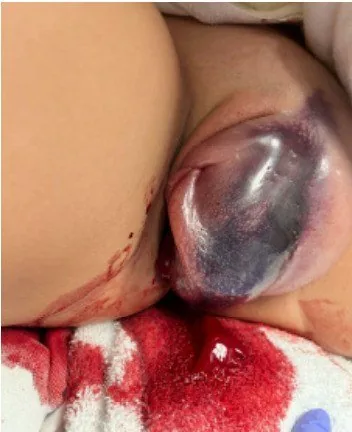


Definition
- Genital herpes is an infection with herpes simplex virus type 1 or 2 that presents as a primary or recurrent infection.
- The virus replicates in the epithelium, travels along sensory nerves to the ganglia, remains latent there and can reactivate periodically.
Occurrence & epidemiology
Epidemiology
- Genital herpes is among the most common sexually transmitted infections; most cases are due to HSV-2, while HSV-1 is increasingly implicated.
- Most HSV-2 infections remain unrecognised; HSV-2 prevalence is almost twice as high in women as in men.
Aetiopathogenesis
Aetiology and risk factors
- Transmission is mostly sexual; the majority of transmissions occur from people without lesions who are unaware of their infection.
- After primary infection, HSV-2 remains latent for life in the lumbosacral ganglia and can reactivate later.
- The child is mostly infected during birth (about 85 % of neonatal infections) and rarely in utero (about 5 %); the risk is highest with primary maternal infection in the third trimester.
Clinical features
Recognition
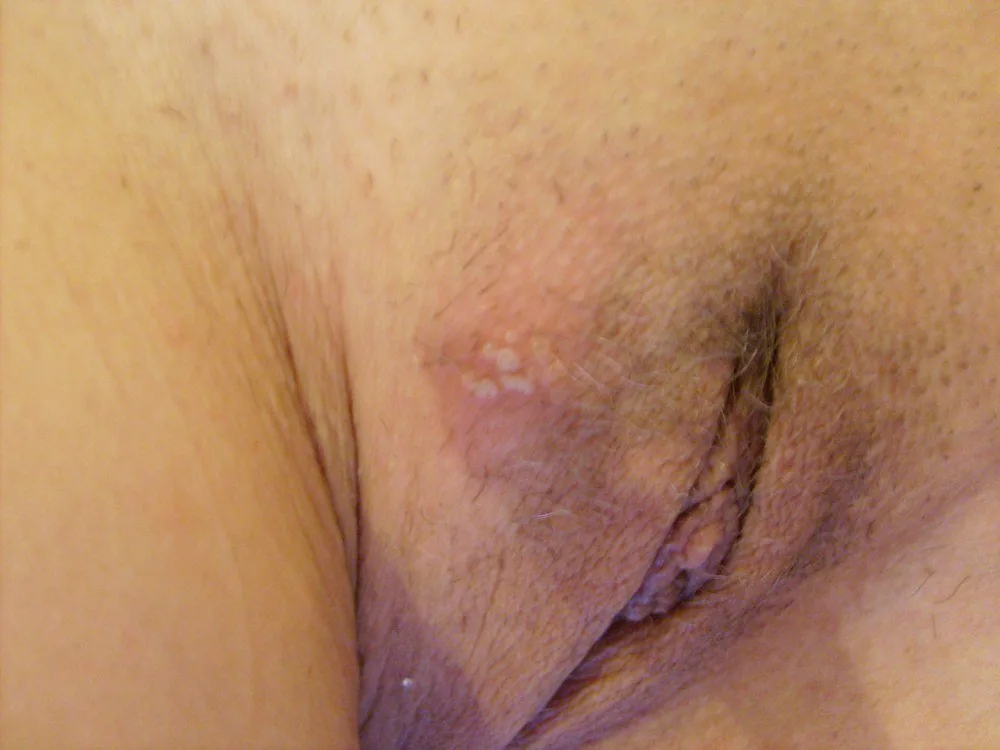
- Typical finding: grouped vesicles on an erythematous base.
- Key symptom: severe pain, dysuria, urinary retention.
- Additionally in a primary infection: fever and inguinal lymphadenopathy.
- Pathogen: herpes simplex virus (HSV), esp. type 2, also type 1.
- Diagnosis: PCR from vesicle base or erosion swab.
Genital herpes on the vulva
- Clinical presentation: The typical signs are grouped vesicles on an erythematous base that erode painfully, often with lymph node swelling and dysuria.
- Course: The primary infection is more severe than a recurrence, with systemic symptoms and fever.
- Primary infection presents with painful genital ulcers, tender regional lymphadenopathy and frequently dysuria.
- Grouped vesicles on an erythematous base rapidly ulcerate and crust; in primary infection the lesions usually heal within 2–3 weeks, and recurrences are shorter. In women, the vulva may swell markedly.
- Primary infection is often accompanied by systemic symptoms such as fever, malaise and myalgia; recurrences are usually smaller and localised.
Diagnosis
Typical imaging findings
- Clinical finding: Several grouped, partly pustular vesicles sit on an erythematous, slightly swollen base on the labium majus. Beside them are small flat erosions where vesicles have already ruptured; the lesions are markedly tender.
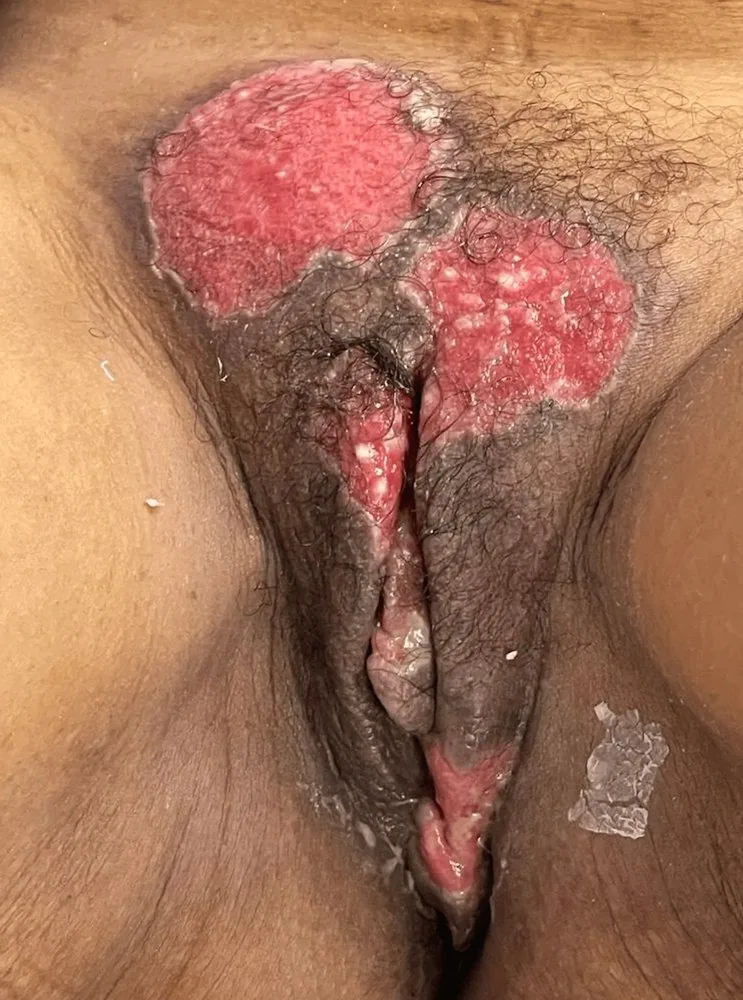
- Clinical finding: Both labia majora bear large, sharply demarcated, bright red granular ulcerations. Classic grouped vesicles are absent; the margins are raised and the lesions are extensive and persistent.
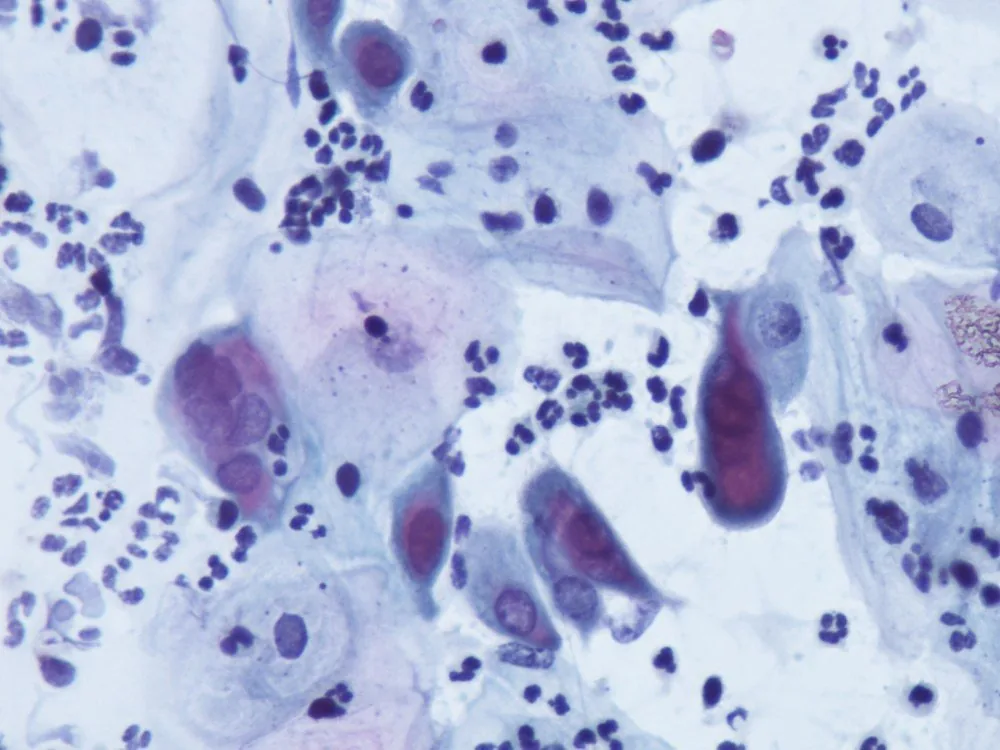
- For virus detection, a vesicle is unroofed and its base or the ulcer base is swabbed; PCR is most sensitive early in the course of the lesion.
- PCR with typing distinguishes HSV-1 from HSV-2; type-specific serology can demonstrate past infection.
Keep learning in the app
Further reading (selection)
- Viral Infections of the Vulva: A Narrative Review (Life (Basel) 2025, PubMed Central)
- Maternal-Fetal Implications of Herpes Virus Infection: An Updated Review (Diagnostics (Basel) 2026, PubMed Central)
- Herpes Simplex Virus Type 2 Screening in Persons with and Without HIV: Evidence, Challenges, and Future Directions (Curr HIV/AIDS Rep 2026, PubMed Central)
- DocCheck Flexikon, Herpes genitalis
- DocCheck Flexikon, Bartholinitis
Cross-references
Note: Learning content from the GynFuchs app (flashcards, exam questions, image cases) for medical education – not a treatment recommendation and no substitute for diagnosis or treatment decisions in individual cases. Treatment and management are deliberately not covered on this page.