Female genital mutilation (FGM)
Exam relevance: in 2 of 197 board exam reports · rank 144
- Synonyms
- female circumcision, FGM, FGM/C
- Specialty
- Gynaecology · Vulva & vagina
- Images
- Diagram 1
- Exam relevance
- 2 of 197 reports · rank 144
- Last updated
- 10/2026 · Dr. Pascal Bafteh
Contents
Images (1)
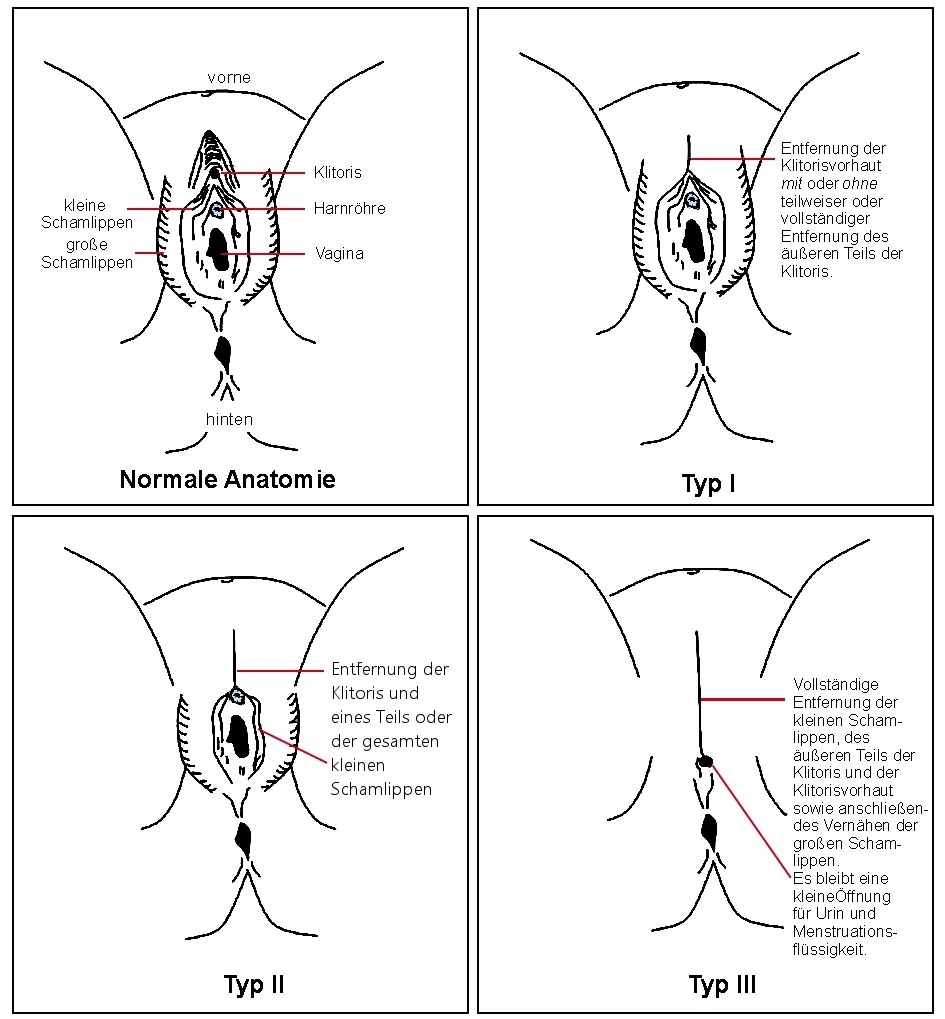 Diagram
Definition
- According to the WHO, female genital mutilation comprises all practices that partially or totally cut away the external female genitalia or otherwise injure the female genital organs for non-medical reasons.
Classification
- Type 1: partial or total cutting of the clitoral glans and/or the clitoral prepuce.
- Type 2: partial or total cutting of the clitoral glans and labia minora, with or without the labia majora.
- Type 3 (infibulation): narrowing of the vaginal opening by a covering seal formed from cut and repositioned labia minora or majora, with or without cutting of the clitoral prepuce and glans.
- Type 4: all other harmful practices for non-medical purposes such as pricking, piercing, incising, scraping or burning the genital area.
Occurrence & epidemiology
Epidemiology
- More than 230 million girls and women alive today have been affected, mainly in countries in Africa, the Middle East and Asia.
- The practice is mostly carried out on girls between infancy and age 15, and occasionally on adult women.
Clinical features
- Acute risks include severe pain, haemorrhage, swelling, fever, infections such as tetanus, urinary problems, wound complications, injury to surrounding tissue, shock and death.
- Long-term consequences include urinary and vaginal infections, menstrual problems, scarring and keloids, cysts, sexual problems, childbirth complications and psychological sequelae such as depression, anxiety and post-traumatic stress disorder.
- All forms are associated with an increased risk of complications, which is greater with more severe forms.
Keep learning in the app
Further reading (selection)
Cross-references
Note: Learning content from the GynFuchs app (flashcards, exam questions, image cases) for medical education – not a treatment recommendation and no substitute for diagnosis or treatment decisions in individual cases. Treatment and management are deliberately not covered on this page.